How to Write Product Descriptions That Rank on Google
On this page
Product description SEO is one of the most overlooked levers in Shopify. Most merchants write descriptions to help customers decide to buy, then wonder why their product pages don't show up in search. The two goals are not in conflict, but they require different thinking.
This guide covers what Google actually looks for in a product description, how to structure copy that serves both buyers and search engines, and how AI generation fits into a process that scales beyond one product at a time.
Why Product Descriptions Matter for SEO
Google indexes product pages the same way it indexes any other page: it reads the text, evaluates the relevance to a query, and decides where to rank it.
Thin descriptions (two sentences copied from a supplier catalogue) give Google nothing to work with. Duplicate descriptions, whether the same text repeated across 50 products or copy lifted from a manufacturer, actively hurt your rankings. Google has no reason to serve identical text it has already indexed from another source.
Organic traffic from product pages has a different quality than traffic from blog posts. A shopper who finds your product by searching for it is already in buying mode. Converting that traffic costs nothing extra. Ranking for it starts with the text on the page.
What Google Wants
What Google Looks For in a Product Description
Google's ranking systems reward pages that genuinely help people find what they are looking for. For product pages, that means descriptions that:
- Use the search terms buyers actually use. Not industry jargon, not manufacturer language. The words a person types into Google when they want what you're selling.
- Answer the likely question behind the search. Someone searching "noise-cancelling headphones for travel" wants to know if yours work on planes, block ambient sound, and fit in a carry-on bag.
- Are unique to your store. Content that doesn't exist anywhere else gives Google a reason to rank your page instead of a competitor's.
- Have enough depth to be useful. A three-sentence description does not demonstrate expertise or authority. Google's own guidance rewards pages that show genuine knowledge of the subject.
How to Research the Right Keywords
Keyword research for product pages works differently to blog or category page research. The intent is transactional: people are looking to buy, not to learn.

Start with the product name and add intent modifiers. "Buy", "for", "vs", "review" and similar terms appear in buying-intent searches. A merchant selling a leather wallet is better off targeting "slim leather wallet men" than "leather wallet", because the former is specific, lower competition, and signals actual purchase intent.
Secondary keywords go into subheadings, the features list, and naturally within the body. You don't need to force them. If you are writing an accurate, detailed description, the secondary terms appear on their own.
One reliable source of keyword ideas: Google's autocomplete. Search your main keyword and note what appears in the dropdown and at the bottom of the results page under "People also search for." These are real queries from real shoppers.
Long-tail keywords, phrases of three or more words, tend to have lower competition and rank faster on new product pages. Target specific terms before going after broader head terms.
How to Structure a Description That Ranks
A well-structured product description serves both scanners and readers. Most people skim first, then read if the skim passes. Follow these four steps for every product page.
- 01Write the opening paragraphGet the primary keyword into the first sentence without making it sound forced. Answer the most likely question from someone who found the page through search. Keep this paragraph under four sentences.
- 02Add features with benefits attachedA feature tells people what the product does. A benefit tells them why that matters. 'Made from full-grain leather' is a feature. 'Made from full-grain leather that improves with age, not plastic that cracks after six months' is a feature with a benefit. Search engines read both; buyers respond to the benefit.
- 03Include a specifications sectionDimensions, materials, weight, compatibility, contents. This section serves long-tail keyword searches that include specific technical terms and reduces pre-purchase questions.
- 04Write the SEO title and meta descriptionThese appear in search results before anyone clicks through. The title should be 50-60 characters and lead with the primary keyword. The meta description should be 140-155 characters and describe what the buyer will get, not just what the product is called.
Keep the full body copy between 200 and 500 words for most products. Short enough to read on a phone, long enough for search engines to have something to evaluate.
Writing Unique Descriptions at Scale
The challenge with product description SEO is that the advice is straightforward to follow for one product and nearly impossible to maintain for fifty.
A 200-word unique description per product, researched and written manually, takes around 20-30 minutes each. For a catalogue of 100 products, that is roughly 40 hours of writing. Most merchants skip the work and paste supplier text instead, which is exactly what every other retailer stocking the same product is also doing.
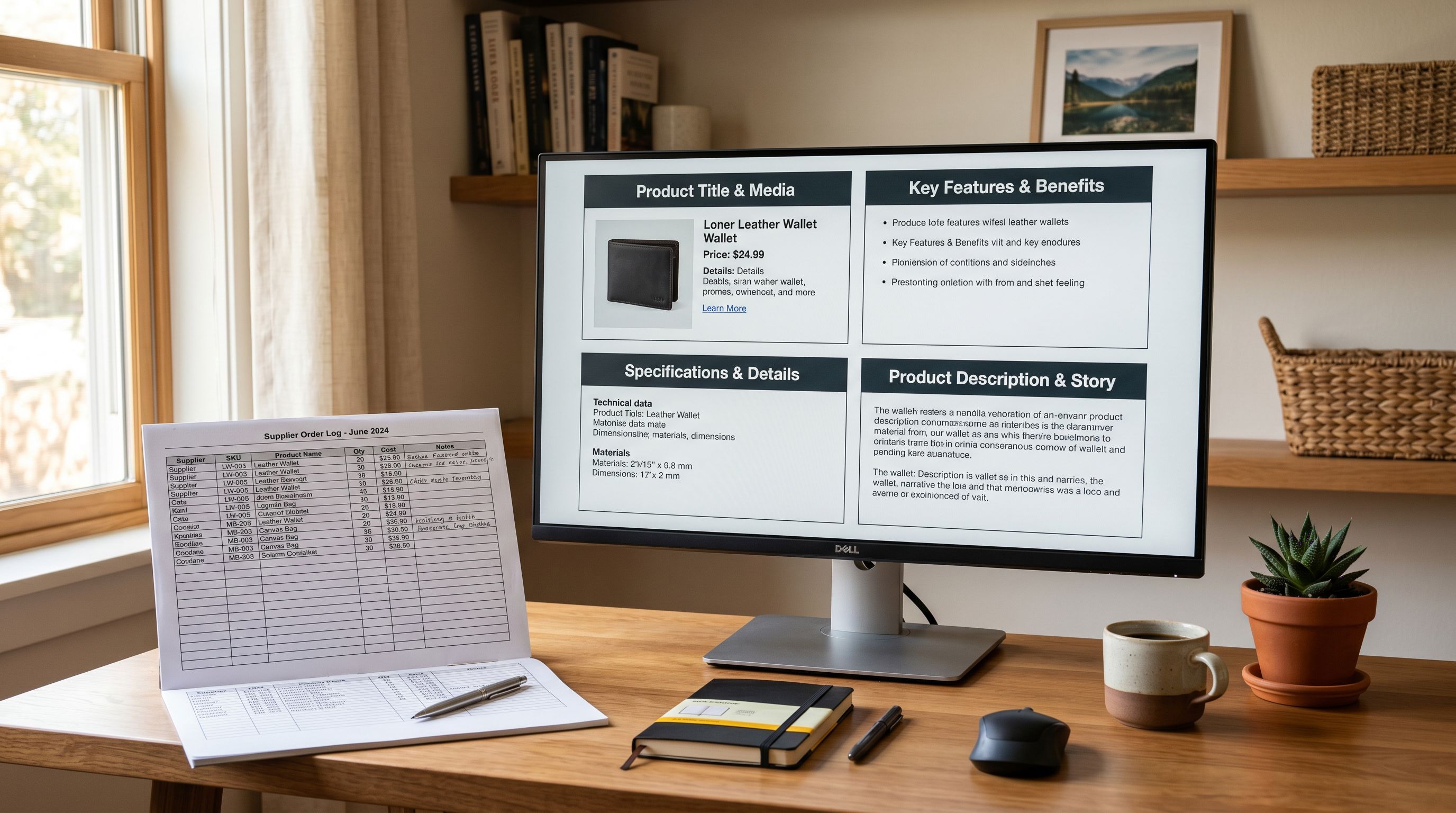
If you are importing products from a CSV or supplier file, the description problem starts the moment the import finishes. Supplier data is minimal. The same text appears across multiple stores. None of it is written for your audience or your brand.
AI-generated descriptions offer a practical alternative. The generated text starts as unique content, which solves the duplicate content problem. The question is whether it is accurate and whether it fits your brand voice.

Importier's AI description generation lets you choose from seven description styles: Standard, Technical Gadget, Emotional Storytelling, Benefits-First, Sensory-Rich, Ingredient Spotlight, and Custom. Each style produces a different structure. Benefits-First front-loads why the product matters; Technical Gadget leads with specifications and accuracy. The choice depends on what your buyers care about.
Beyond style, Importier's 156 expert personas across 43 industry categories adjust the language and framing to match your product type and audience. A persona trained on outdoor gear writes differently to one trained on electronics or beauty products.
Generating descriptions for 50 products takes roughly the same time as a human writes one. The review pass, checking accuracy and adjusting anything the AI got wrong, takes less time than starting from scratch.
- Duplicate content copied from manufacturer spec sheets
- No target keywords or buyer-intent language
- Generic text shared across competing stores
- Thin content that Google ignores
- Unique content written for your audience and brand
- Primary and secondary keywords placed naturally
- Feature-benefit pairs that answer buyer questions
- 200-500 words of depth that Google rewards
AI Descriptions and Keyword Inclusion
AI-generated descriptions include relevant terms naturally, but they are not a substitute for keyword research. You still need to know which terms buyers use before you generate anything.
Importier's Brand Voice integration lets you supply keywords to include, words to avoid, and example phrases that match your store's tone. This guides the AI output toward your chosen terminology without requiring manual rewrites of every description after the fact.
Importier also generates SEO titles and meta descriptions alongside the body copy, constrained to the correct character limits. This matters because a meta description that runs to 200 characters will be truncated by Google in search results, often at an unhelpful point.
For stores with many product variants, Importier can generate variant-specific descriptions: individual AI-generated descriptions per variant, stored as metafields. This prevents the near-duplicate content problem that arises when every variant page carries the same text with only the colour or size word swapped.
A shopper who finds your product by searching for it is already in buying mode. Converting that traffic costs nothing extra. Ranking for it starts with the text on the page.
Common Mistakes
Copy-pasting supplier descriptions. The most common mistake and the most damaging for SEO. Supplier text appears on every retailer that stocks the same product. Google has no reason to rank your version over anyone else's.
Keyword stuffing. Including a keyword phrase six times in a 200-word description does not help and often hurts. Google's systems recognise it, and it makes the copy unreadable for actual buyers. Use the keyword where it fits naturally.

Leaving meta fields blank. A blank meta description means Google writes its own, usually pulling a random sentence from the page. You lose control of what appears in search results. Fill in the meta title and meta description for every product.
Ignoring variants. If you sell a product in ten colours, Google sees ten product pages. If every variant page carries the same description, you have nine near-duplicate pages. Variant-specific descriptions describe what is actually different about each variant and give each page its own unique content.
Optimising once, then forgetting. Product descriptions are not set-and-forget. Search trends shift, competitors update their pages, and Google's systems evolve. A quarterly review of your top product pages keeps your content competitive.
Measuring Results
Measuring Whether It Is Working
Product page SEO has a 3-6 month lag between implementation and visible results. This is normal, not evidence the approach is wrong.
Google Search Console is the right tool for tracking product page performance. Filter by page type to isolate product URLs, then look at impressions (how often your pages appear in search), clicks, and average position for queries that trigger your pages.
When you update descriptions, note the date. Position changes typically appear 6-12 weeks later. A sustained increase in impressions for a product page, without a change in your advertising spend, indicates organic progress.
The easiest wins are usually product pages that already receive impressions but rank outside the top 10. These pages already have some relevance signal. Better descriptions, stronger meta titles, and more unique content can move them from page two to page one faster than a brand-new page can rank from nothing.
You can run a Shopify product SEO audit to find which product pages have thin descriptions, missing meta fields, or duplicate supplier copy before you start. That gives you a prioritised list rather than guessing which pages need attention first.
Try Importier free at importier.app.
Related Articles
- Shopify AI Product Descriptions: The Complete Guide
- Shopify Brand Voice for Product Descriptions: A Setup Guide
- Shopify Product SEO Audit: How to Find and Fix Content Gaps
- How to Write Unique Descriptions for Every Shopify Product Variant
Set up your first import in under five minutes.
Importier brings products into Shopify with AI descriptions, category metafields, and data enrichment on every run.