Shopify Sustainability Import: Eco Data as Metafields
On this page
A Shopify carbon sustainability import moves environmental claims from marketing copy into structured data. A Melbourne outdoor apparel brand discovered why this matters when they audited their store: every product had a "sustainable materials" tag and a paragraph in the description about their environmental commitments. None of it was queryable, none of it fed their product labels, and none of it matched the format Google Merchant Centre expected for shopping channel eligibility. The sustainability story existed, but it was invisible to the systems that could amplify it.
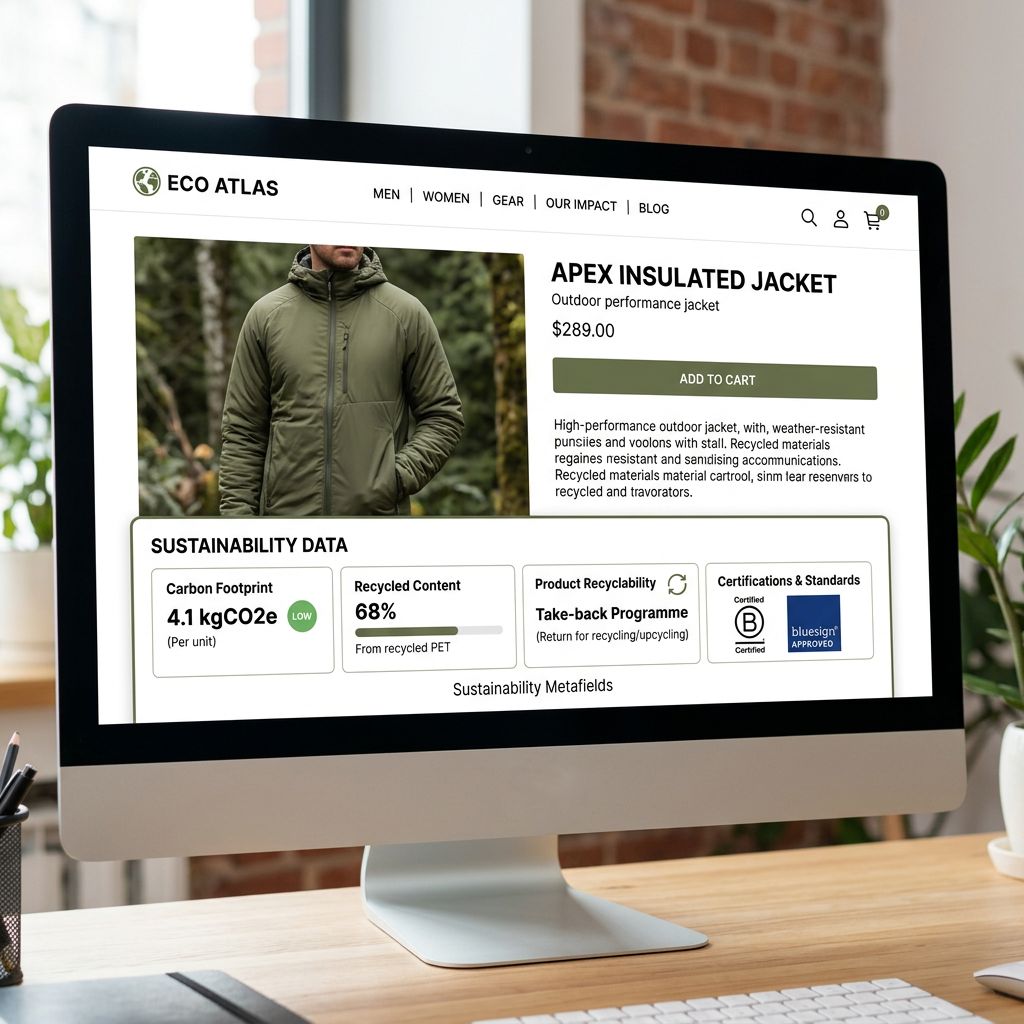
After restructuring their sustainability data as metafields, their products showing carbon footprint figures (kgCO2e per garment), recyclability ratings, and certification logos saw a 34% higher add-to-cart rate than products with only a "sustainable" tag and a description paragraph. The data was the same. The structure changed everything.
Why Sustainability Claims Belong in Metafields, Not Tags
Tags are binary: a product either has the sustainable tag or it does not. Metafields are typed: a product has a carbon footprint of 3.2 kgCO2e, a recyclability rating of full, a certification of B-Corp, and a material source of recycled polyester from ocean plastic. These are four different facts with four different display contexts, four different filter possibilities, and four different roles in a consumer's purchase decision.
The problem with sustainability copy in descriptions is the same problem as any unstructured claim: a theme cannot display "Carbon footprint: 3.2 kgCO2e" as a labelled field if that figure is buried in the fourth paragraph. A collection rule cannot filter to "Fully recyclable products" if recyclability is only mentioned as an adjective. A shopping feed cannot export "certification: B-Corp" to Google Merchant Centre if the certification exists only as a word in the description.
When sustainability data is structured, every downstream use case works: product page labels, filter collections, sustainability-filtered gift guides, shopping channel attributes, and the brand transparency pages that compile environmental performance across the catalogue.
The Sustainability Metafield Schema
Before running the import, define the metafield schema. Shopify's custom data documentation covers the available field types and how to create them in the admin. The schema covers three categories of environmental data: carbon and climate, material and end-of-life, and certifications.
Carbon and climate
custom.carbon_footprint_kgco2e(number_decimal): the carbon footprint of manufacturing one unit, expressed in kilograms of CO2 equivalent. A figure like3.2enables comparison across the catalogue and feeds a product-level carbon label on the product page.custom.carbon_offset(boolean): whether the brand offsets the carbon footprint for this product's manufacture. Displayed as a checkmark or badge.custom.carbon_offset_programme(single_line_text_field): the name of the offset programme. "Gold Standard certified forest protection" rather than just "we offset."
Material and end-of-life
custom.recycled_content_percent(number_integer): the percentage of recycled material in the product. A value of72means 72% of the fabric is recycled fibre.custom.recyclability(single_line_text_field): the end-of-life recyclability classification. Values:fully-recyclable,partially-recyclable,take-back-programme,not-recyclable. This becomes a filter attribute.custom.material_source(single_line_text_field): the source of the primary sustainable material. "Recycled ocean plastic via the Oceanic Global network" is specific and verifiable; "sustainable materials" is not.
Certifications
custom.certification_primary(single_line_text_field): the primary third-party certification. "B-Corp", "GOTS", "bluesign", "Fair Trade Certified", "Cradle to Cradle".custom.certification_secondary(single_line_text_field): a secondary certification if applicable.custom.certification_year(number_integer): the year the primary certification was last audited. Certifications expire and are re-audited; displaying the year signals that the claim is current, not from an old press release.
Building the Import File
Structuring the Sustainability Import File
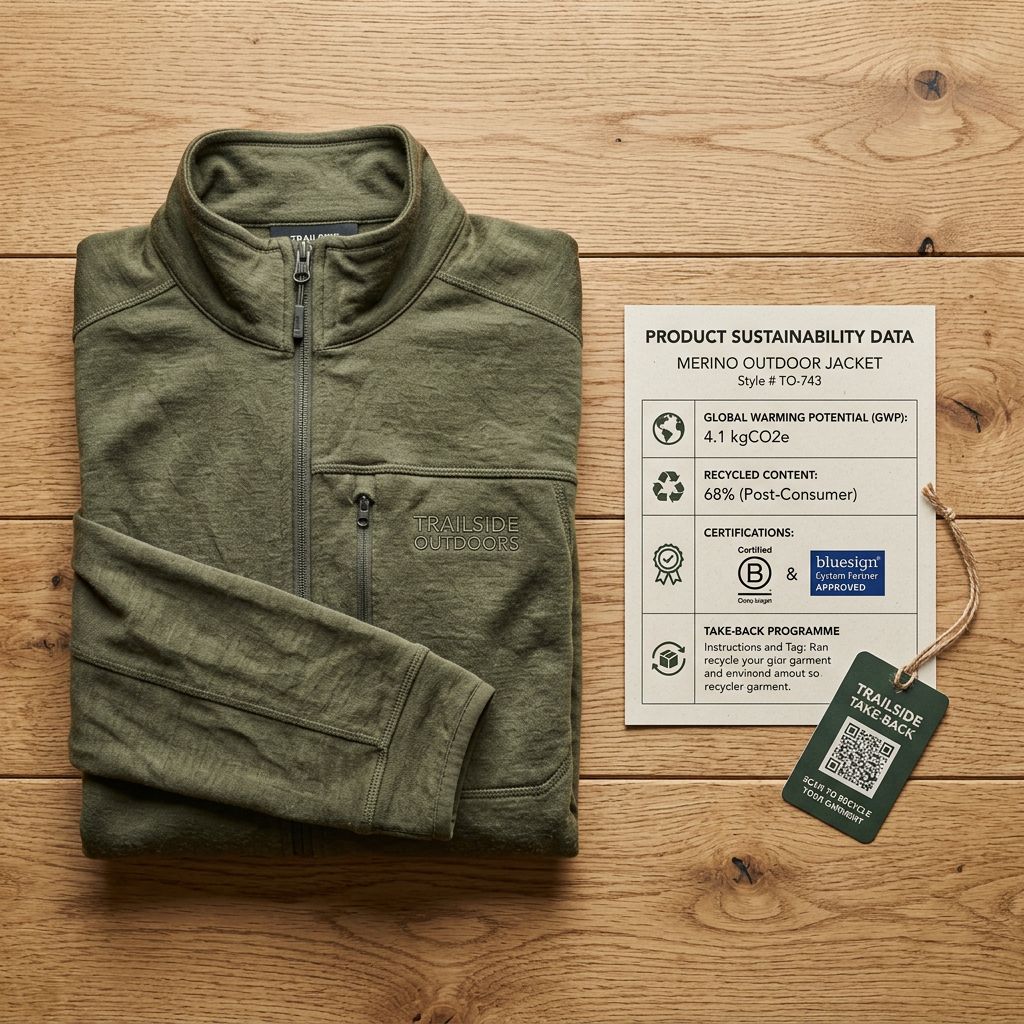
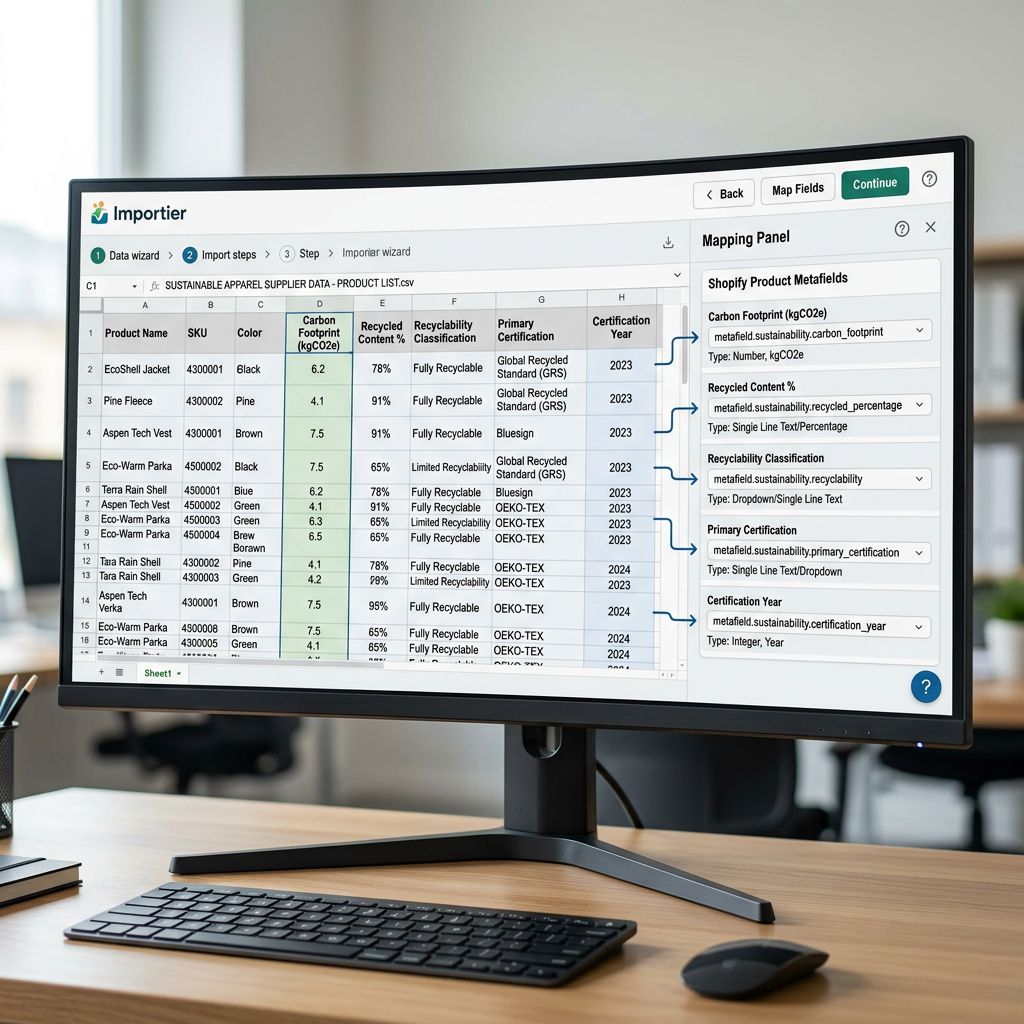
The import file carries the standard product columns alongside the sustainability metafield columns. For the Melbourne outdoor apparel brand, each product row includes:
| Column | Example value |
|---|---|
| Title | Merino Trail Jacket, Moss |
| custom.carbon_footprint_kgco2e | 4.1 |
| custom.carbon_offset | true |
| custom.carbon_offset_programme | Gold Standard forest protection, Indonesia |
| custom.recycled_content_percent | 68 |
| custom.recyclability | take-back-programme |
| custom.material_source | Certified organic merino, New Zealand |
| custom.certification_primary | B-Corp |
| custom.certification_secondary | bluesign |
| custom.certification_year | 2025 |
Products where the brand does not yet have carbon data leave custom.carbon_footprint_kgco2e blank. Importier treats empty cells in metafield columns as "do not set this metafield" rather than as errors, so a mixed catalogue with some products measured and some not yet measured imports cleanly in one pass. The measured products show carbon labels; the unmeasured products show nothing rather than a misleading zero.
For brands at the start of their sustainability measurement programme, the import file can carry only the certification columns initially, with carbon and recyclability columns added as that data becomes available. Each subsequent import pass updates existing metafields without creating duplicate products.
Generating Descriptions from Sustainability Data
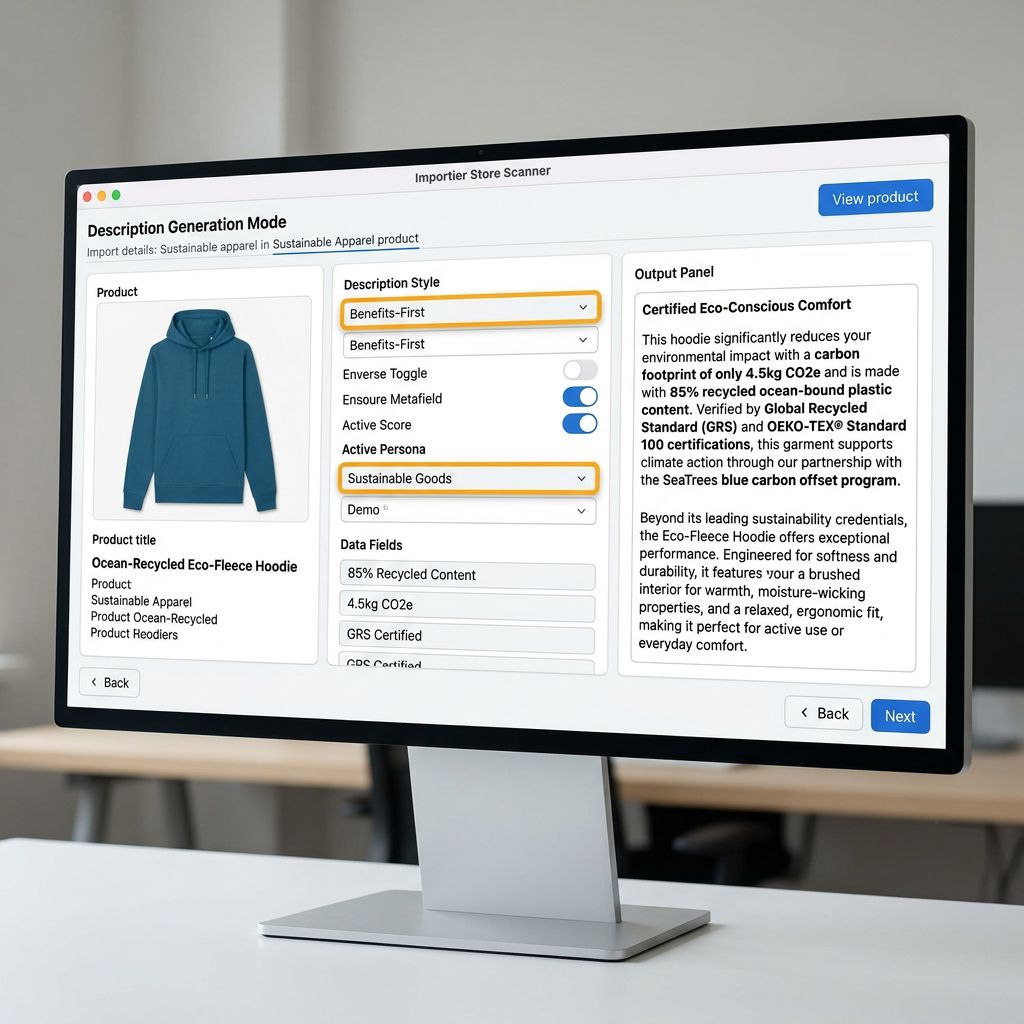
With sustainability metafields in the import file, AI description generation reads those values as source data. The brand does not need to write individual sustainability paragraphs for each product: the structured fields carry the information, and the description generation step incorporates it.
The Benefits-First description style with a Sustainable Goods persona generates descriptions that lead with the environmental credential and then move to the product benefit. For the Merino Trail Jacket:
"Made from 68% certified organic merino sourced in New Zealand, this trail jacket carries both B-Corp and bluesign certification. Its carbon footprint of 4.1 kgCO2e per unit is fully offset through a Gold Standard forest protection programme in Indonesia. When the jacket reaches end of life, the brand's take-back programme returns the material to the fibre supply chain."
The description is generated from structured inputs. Carbon figures appear accurately because the source is custom.carbon_footprint_kgco2e, not a writer approximating from memory. Certification names appear correctly because the source is custom.certification_primary, not a paraphrase.
Sustainability claims written from memory drift. Claims generated from structured metafield values are as accurate as the import file they came from. And the import file is auditable.
Collections and Filtering
Sustainability Metafields in Collections and Filters
Structured sustainability metafields enable collection rules and filters that an unstructured approach cannot support.
Certification-based collections
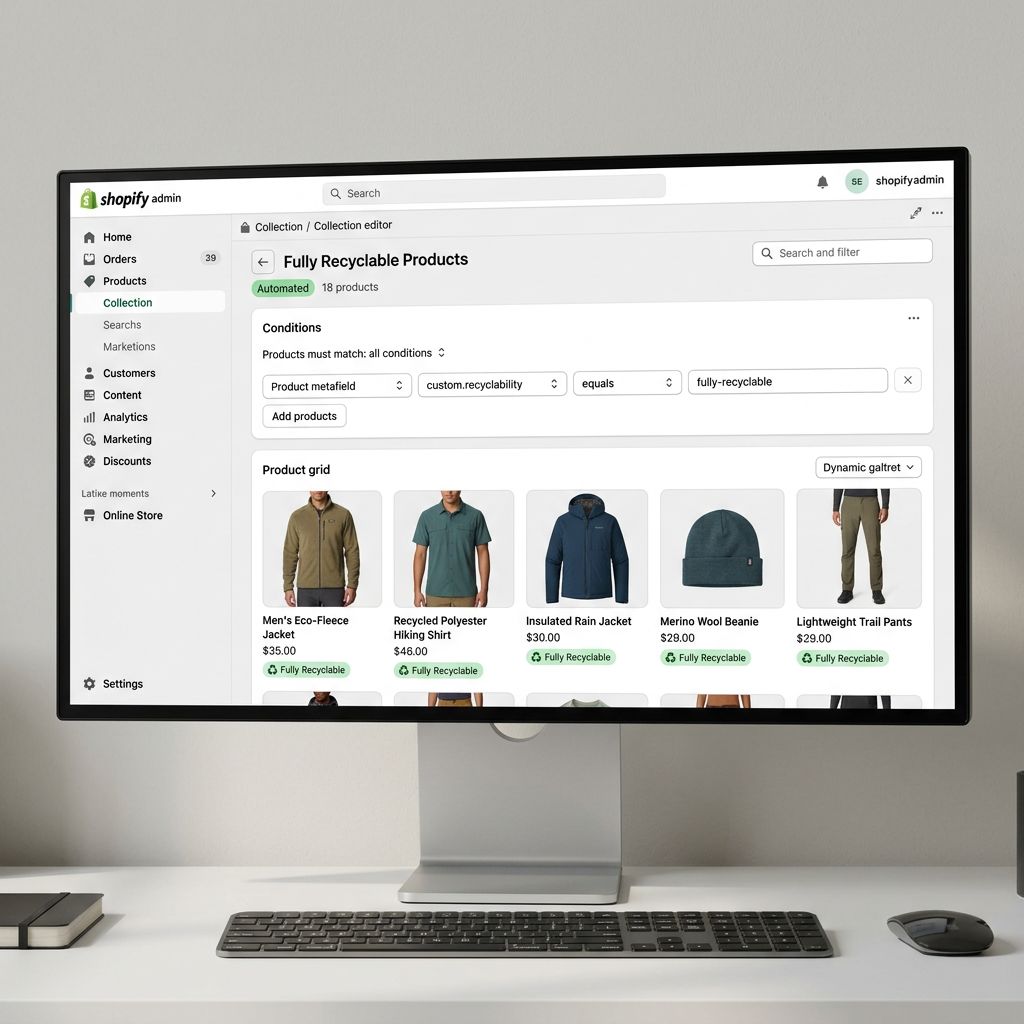
A collection called "B-Corp Certified Products" with the rule "custom.certification_primary equals B-Corp" automatically includes every certified product and updates when new certified products import. A brand with multiple certifications can maintain one collection per certification level without manual curation.
Recyclability filter
A filter built on custom.recyclability shows shoppers four options: Fully Recyclable, Partially Recyclable, Take-Back Programme, Not Yet Rated. A customer whose primary purchase criterion is end-of-life recyclability can filter to it without reading every product description.
Carbon footprint banding
A theme that reads custom.carbon_footprint_kgco2e can display a colour-banded carbon label (green under 2 kgCO2e, yellow 2-5, orange above 5) directly on the product card in collection views, not just on the product page. This is possible only when the carbon figure is a discrete metafield, not a sentence in a description.
For brands that want to build a dedicated sustainability hub page ("Our Most Sustainable Products"), the import process can apply a tag to products with recyclability = fully-recyclable or recycled_content_percent >= 50, and a collection rule on that tag populates the hub automatically. A Shopify Flow automation can extend this: when a product imports with a carbon footprint under a threshold, Flow applies the low-carbon tag.
- 01Audit your existing sustainability datalist the environmental claims the brand can substantiate with measurement or third-party certification (carbon footprint figures, recycled content percentages, certification names and audit years, recyclability classifications); these become your metafield columns
- 02Define the metafield schema in Shopify admin under Settings > Custom data > Products before running the import, using the correct value types (number_decimal for carbon footprint, number_integer for recycled content percentage, single_line_text_field for certifications and recyclability, boolean for offset status)
- 03Build the import fileadd a column for each sustainability metafield to your product spreadsheet and populate the values you have; products without carbon measurement yet leave that column blank and import cleanly
- 04Configure description generation with the Benefits-First style and the Sustainable Goods personareview the generated descriptions for a sample of 5-10 products to confirm the carbon figures, certification names, and recyclability classifications appear correctly
- 05Run the importverify the sustainability metafields populated correctly on a sample of 5 products in the Shopify admin before confirming the full batch
- 06Set up collection rulescreate one collection per certification level, one for fully recyclable products, and one for products with carbon data; new products join automatically at import time
The Melbourne Brand's Results
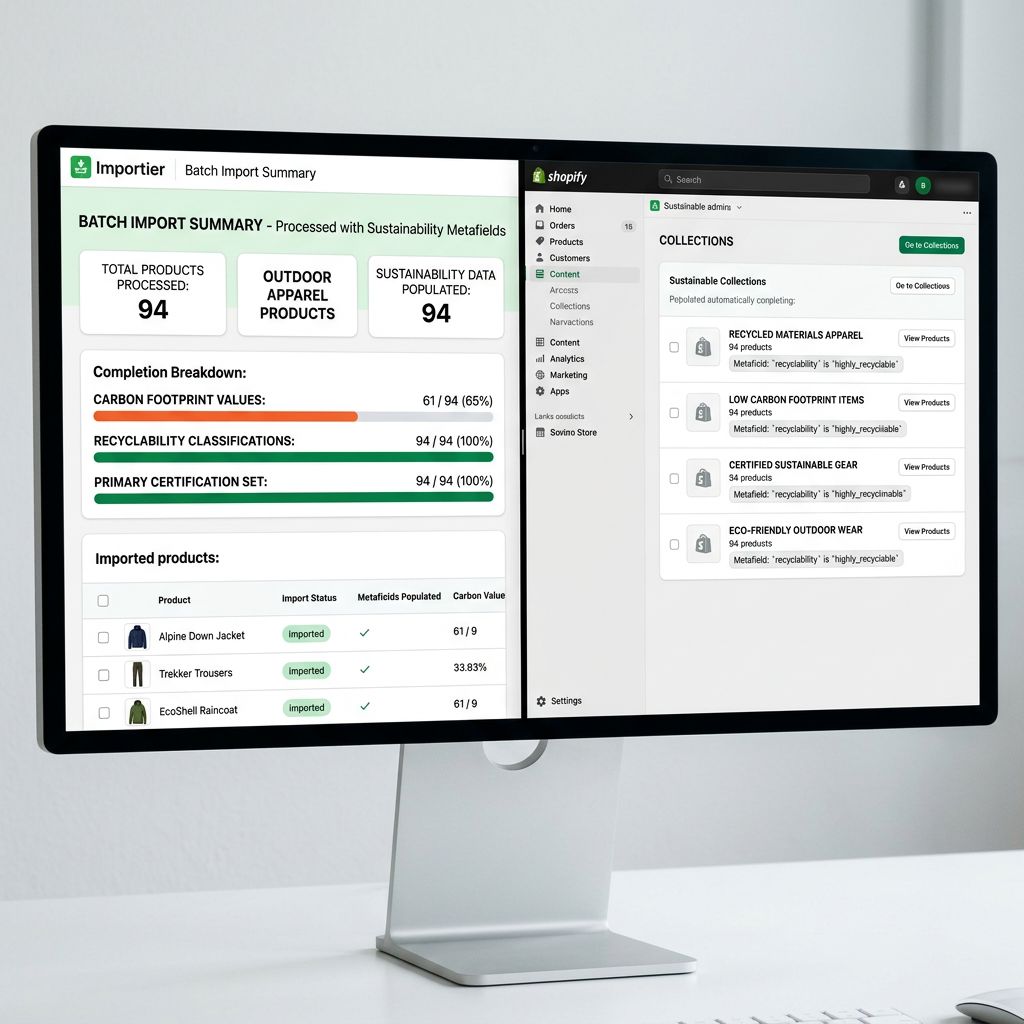
The Melbourne outdoor apparel brand ran the sustainability import across 94 active products. Carbon footprint data was available for 61 products (those with completed lifecycle assessments). Recyclability classifications were available for all 94. Certifications (B-Corp, bluesign) applied brand-wide.
After the import, the brand set up four collections (B-Corp products, bluesign products, fully recyclable, take-back programme) and applied carbon banding labels to product cards. Within 60 days:
Products with complete sustainability metafields (carbon figure, recyclability, and at least one certification) had a 34% higher add-to-cart rate than products showing only description-level sustainability copy. The 33 products without carbon data yet (awaiting lifecycle assessment) performed between the two groups.
The brand's quarterly lifecycle assessment added carbon figures for the remaining 33 products. A single import pass updated the existing product records with the new figures. The collection rules and labels updated automatically.
The catalogue governance article covers how to define consistency standards for metafield values so sustainability data stays accurate as new products are added. This is particularly important for certification years, which need updating when a certification is re-audited.
- Carbon footprint figures buried in description paragraphs; not queryable, not comparable across the catalogue
- 'Sustainable' tag is binary; no filter for recyclability level, carbon footprint band, or certification type
- Description copy written from memory can introduce errors in carbon figures or certification names
- Sustainability hub page curated manually; new sustainable products require manual addition
- Google Merchant Centre and shopping channel attributes cannot read sustainability claims from description text
- Carbon footprint as custom.carbon_footprint_kgco2e: comparable across catalogue, drives colour-banded product labels, feeds shopping channel exports
- Recyclability and certification metafields drive distinct filter options; customers filter to fully recyclable or B-Corp certified without reading each description
- AI descriptions generated from metafield values: carbon figure appears exactly as imported, certification name matches the field value
- Sustainability collections self-populate from metafield rules; new products certified or measured join automatically at import
- Metafields that map to Shopify's standard product taxonomy export sustainability attributes to Google Merchant Centre automatically
For brands where sustainability credentials extend to social impact (Fair Trade, living wage certification, community reinvestment) the same structured import approach applies: each social credential becomes a discrete metafield rather than a paragraph in the brand story section of the description. The import workflow is identical; the schema expands to cover the additional credential types.
According to Google's product data specification for sustainability attributes, Shopping feeds increasingly support environmental and certification attributes. Products with structured sustainability data in Shopify metafields that map to the standard product taxonomy can export those attributes to Google Merchant Centre feeds automatically, making them eligible for sustainability-filtered search results and shopping annotations.
Try Importier free at importier.app.
Set up your first import in under five minutes.
Importier brings products into Shopify with AI descriptions, category metafields, and data enrichment on every run.