Shopify Sneaker Import: Size Variants and Collab Metafields
On this page
A streetwear retailer inherited an 840-row supplier spreadsheet when they migrated from their previous platform. Each row was a single sneaker SKU: one row for "Air Force 1 Low White / US 7 Men's", another for "Air Force 1 Low White / UK 6.5 Men's", another for "Air Force 1 Low White / EU 40 Men's". The same physical size, the same physical shoe, appeared three times because the supplier tracked all three sizing conventions. After the initial import attempt, the Shopify catalogue had 840 products, one per row, and every product title included a size number.
The problem was not the supplier's data quality. Sneaker catalogues have structural requirements that differ from standard apparel or footwear imports. The size run spans multiple sizing conventions simultaneously. The same model ships in colourways that function as separate products. Collaboration releases carry metadata that matters to buyers before price: collab partner, release date, retail versus resale price spread. That metadata belongs in structured metafields, not in product descriptions where it is invisible to filters and faceted navigation.
Why Sneaker Catalogues Break Standard Import Workflows
Standard apparel import workflows handle one sizing convention per product: the size option runs S / M / L / XL for clothing, or a single numeric sequence for footwear. Sneaker catalogues require parallel sizing conventions on a single product.
A single sneaker model in a full US size run sells in US Men's sizes 7 through 13 (including half sizes), US Women's sizes 5.5 through 11.5 (including half sizes), and Grade School sizes 3.5Y through 7Y. US Men's size 10 and US Women's size 10 are different physical shoes: different lasts, different measurements. Suppliers who export all three gender categories in one file produce a spreadsheet where the same "size 10" means three different things depending on which gender category the row belongs to.
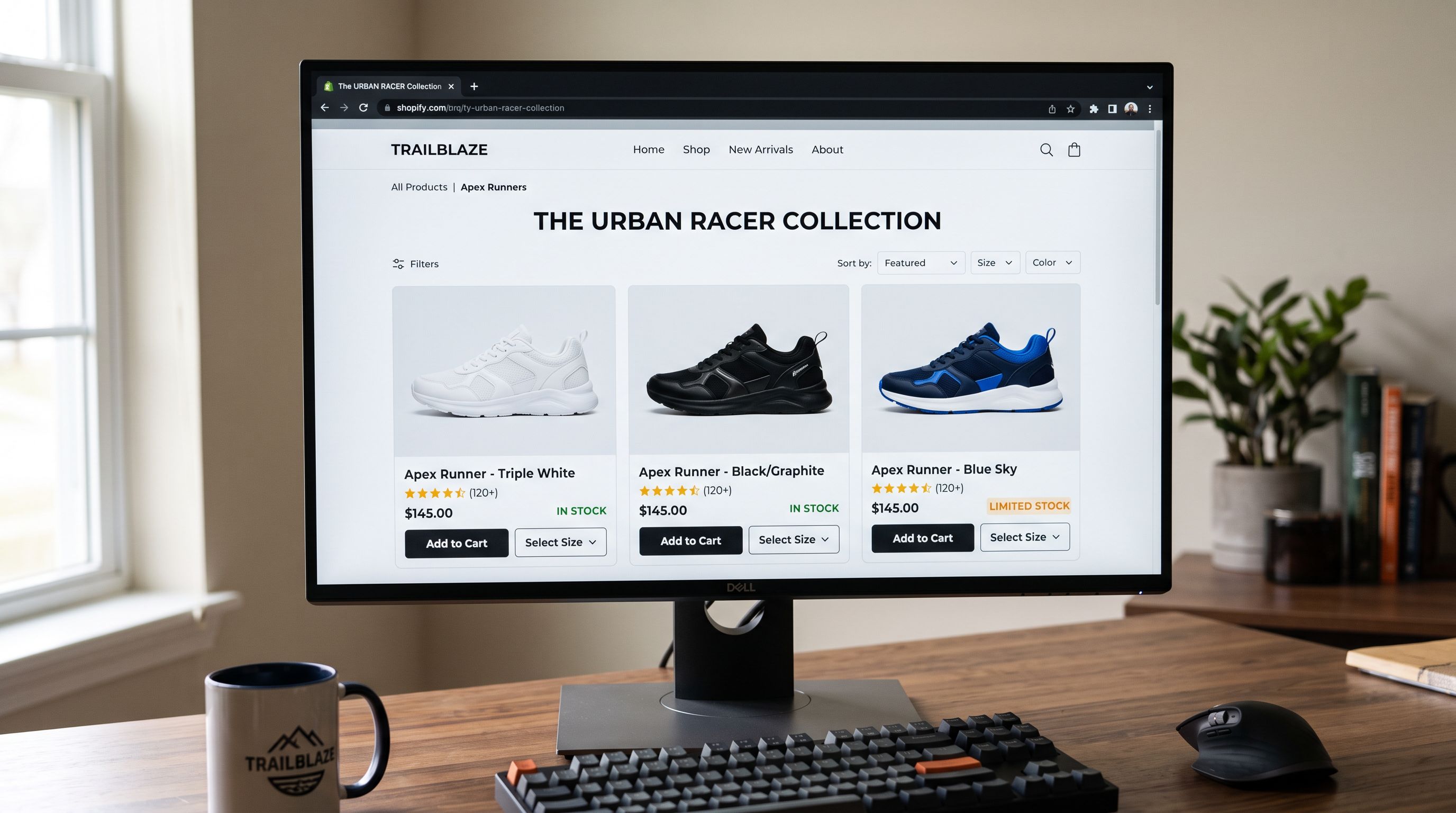
The second complication is cross-referenced sizing. US Men's 10 = UK 9 = EU 44. Shopify's variant system stores one value per option per variant. For a sneaker in a full international size run, the correct option name is "US Men's Size" with values "7, 7.5, 8, 8.5, 9, 9.5, 10, 10.5, 11, 11.5, 12, 12.5, 13" rather than a generic "Size" field with values mixing US, UK, and EU numbers across different rows. The variant option naming standards for footwear require the sizing convention to be encoded in the option name itself, not left implicit from row position.
Structuring a Full Size Run Import
A sneaker size run import requires three structural decisions before any file is processed.
The first is gender category separation. A model that sells in both men's and women's sizing should be two separate Shopify products, not one product with 26 size variants. Men's and women's versions have different lasts, different size sequences, different customer search intent. A buyer searching for a women's size 8 does not want to scroll past 13 men's sizes to find it. Two products in the same collection, cross-referencing each other via a "Related Sizing" metafield, is the correct structure.
The second is colourway separation. A Nike Air Force 1 Low in "White/White" and "Black/Black" and "University Blue/White" are three separate products, not three colour variants of one product. Each colourway has its own SKU structure, its own demand level and pricing, and its own inventory history. Colour variants in Shopify share inventory and pricing logic; colourways in the sneaker market do not. Related-by-model colourways belong in the same collection and can share a "Model" metafield value, but they should not share a product record.
The third is half-size handling. Half sizes (8.5, 9.5, 10.5) must appear as explicit values in the variant option, not rounded to the nearest whole number. A supplier who exports US 8 and US 8.5 as separate rows is supplying correct data; both values must survive the import as distinct variants with their own inventory quantities.
- 01Separate the supplier file by colourway before importingif the supplier exports all colourways in one file, split by the colourway identifier column so each import batch contains one colourway group only; this prevents colour variants from being merged when they should remain separate products
- 02Configure the variant option name in the import profileuse a convention such as 'US Men's Size' rather than the generic 'Size'; Importier's column mapping step allows a fixed value for the Option1 Name field applied to all rows in the batch
- 03Set the variant grouping column to the model identifierthe column that identifies the base model without size or colour becomes the grouping key; all rows sharing that value become variants of the same Shopify product
- 04Review the variant count in the import previewa model in US Men's sizes 7 through 13 with half sizes should produce 13 variants; a count above 13 indicates that another sizing system or gender category crossed into the batch
- 05Apply AI descriptions after variant structure is confirmedAI generation uses the product title and variant labels as context; a correctly structured title with correct option naming produces descriptions calibrated to the specific colourway and gender category
Importier's Smart Variant Detection recognises 150+ footwear size patterns, including numeric US shoe sizing, half sizes, UK integer sizing, and EU full-size sequences. The detection engine groups per-row SKUs from the supplier file into a correctly structured product with labelled variants without requiring manual row-by-row configuration.
Collaboration and Release Data as Metafields
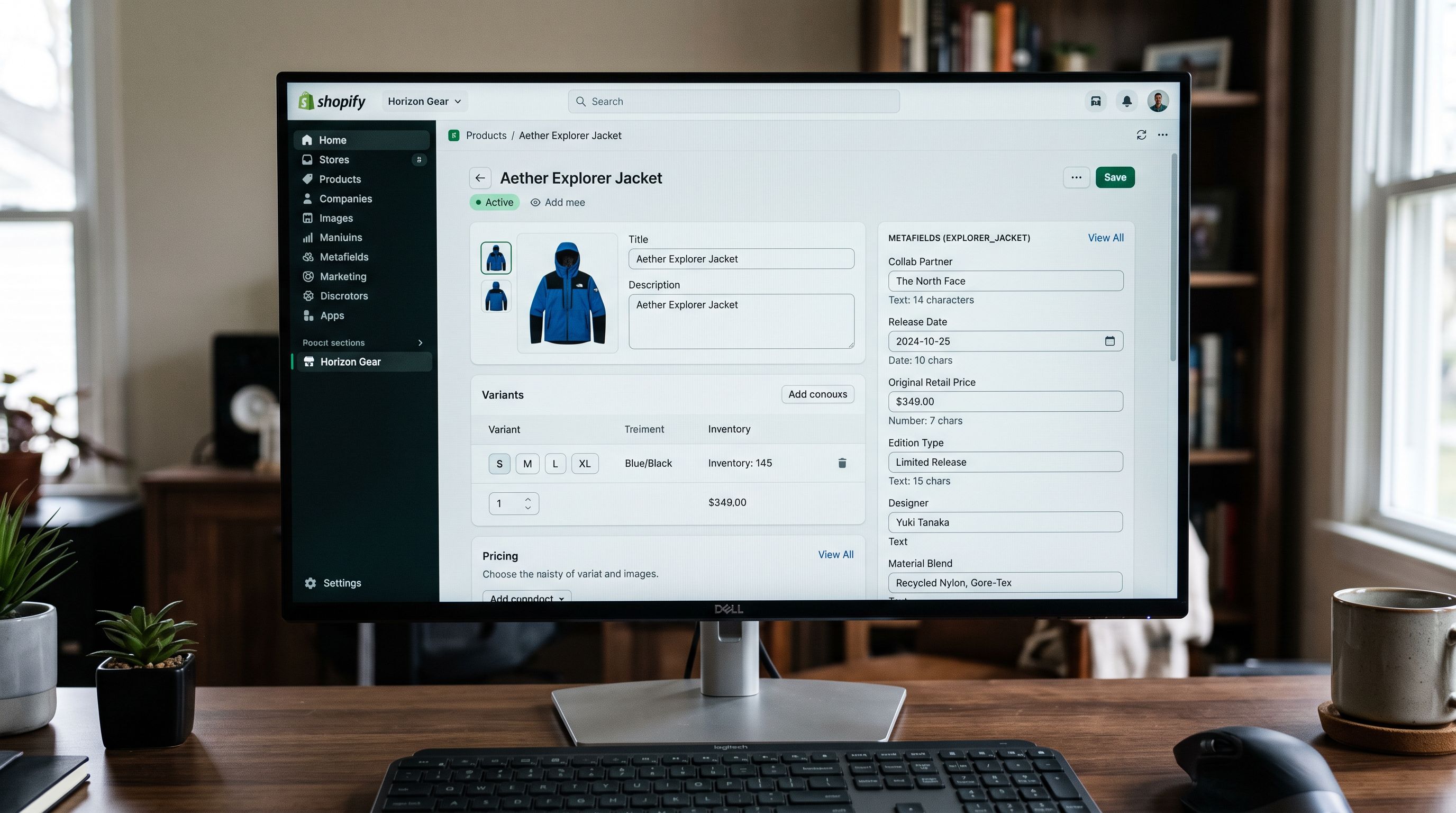
The sneaker resale and collector market treats collaboration data as first-class product information. A buyer evaluating a Nike x Travis Scott collaboration does not start with the price. They start with the collab partner, the release year, the original retail price, and the specific colourway name. This data belongs in structured metafields where it surfaces in filters, faceted navigation, and product page metadata, not buried in the product description body where no filter can read it.
According to Shopify's metafield documentation, merchants can create custom metafield definitions with specific value types that enable filtering, search, and structured display in storefront themes. For sneaker collaboration products, the core metafield set is:
Collab Partner (single_line_text): the brand, artist, or organisation listed on the collaboration. "Travis Scott", "Off-White", "Supreme". This becomes a filter facet on collection pages.
Release Date (date type): the date the product originally released at retail. This allows products to be grouped as "recent drop", "backcatalogue", or "archive" via collection rules.
Original Retail Price (money type): the price at retail on release day. This is the reference point buyers use to assess the current resale price spread.
Edition Type (single_line_text): "Collaboration", "General Release", "Limited Release", "Friends and Family". Controls how the product appears in filtered navigation.
Colourway Name (single_line_text): the official brand colourway name. "University Blue/White/Black", "Bred Toe", "Chicago". These names have direct search intent in the sneaker community.
Importier's Industry Packs include attribute sets for limited-edition and collaboration products that map to these metafield definitions. Running an enrichment pass after the description generation step populates the relevant metafields from the product title and any structured data in the supplier's original content. A supplier file that includes a "Collab" column and a "Release Year" column maps directly to the Collab Partner and Release Date metafields in the import profile.
Resale and Condition Metafields
Condition Metafields for Deadstock and Resale Products
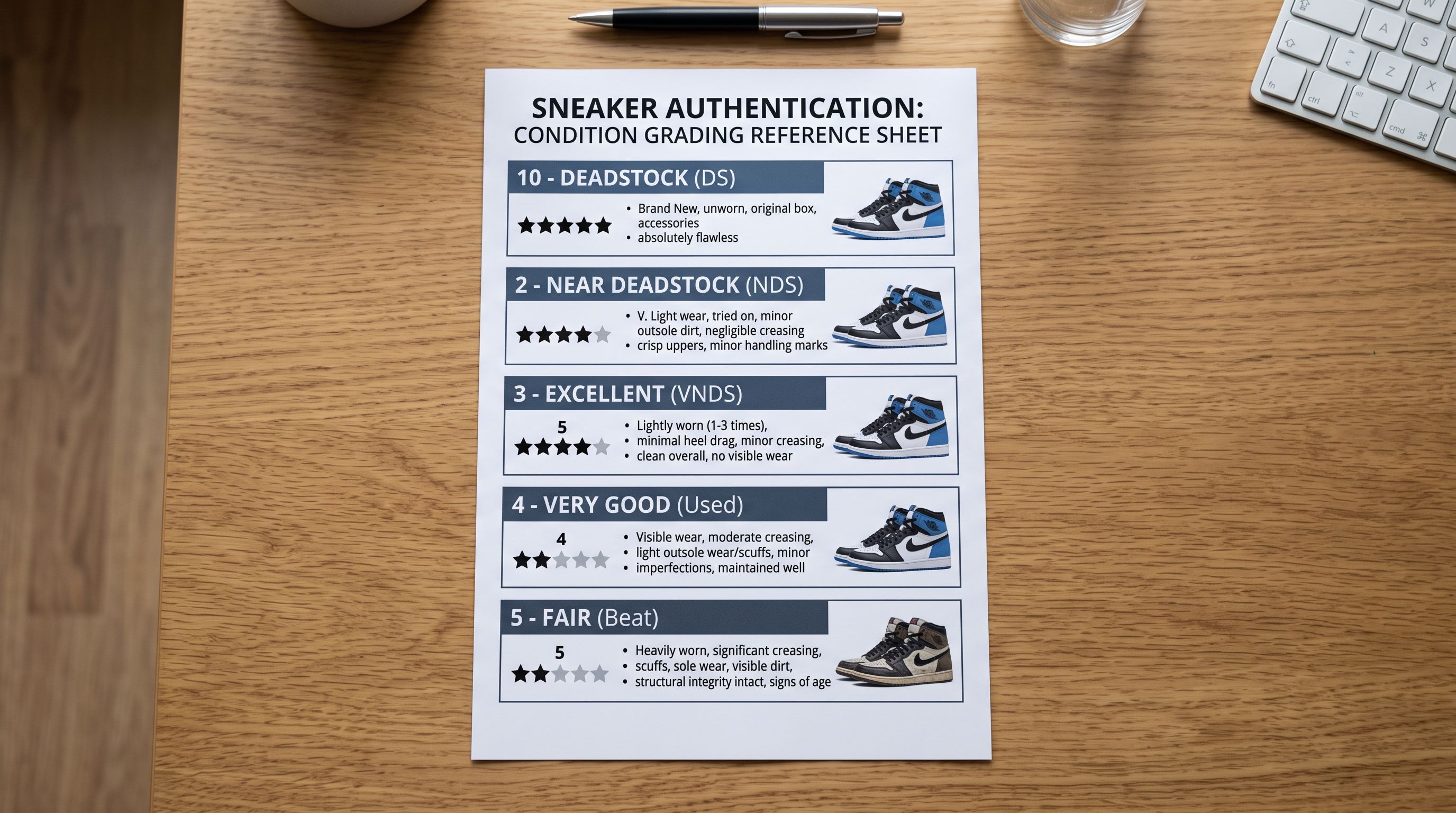
Sneaker resellers importing authenticated inventory need condition data as a structured metafield with controlled vocabulary, not as free-text in a description. Buyers in the sneaker resale market have precise expectations about condition grades. "Deadstock" (unworn, original packaging intact, all accessories present) is not equivalent to "Very Near Deadstock" (tried on briefly, never worn outside), "Excellent" (worn once, no visible wear), or "Used" (clear wear pattern present).
The condition metafield structure for resale sneaker products:
Condition Grade (single_line_text with controlled vocabulary): "Deadstock", "VNDS", "Excellent", "Very Good", "Good", "Fair". The controlled vocabulary prevents free-text variation ("DS", "Deadstock", "dead stock", "NEW") from creating filter fragmentation.
Box Condition (single_line_text): "Original box, no damage", "Original box, minor damage", "Replacement box", "No box". Buyers who collect for display care about box condition as much as shoe condition.
Accessories Included (list.single_line_text): the items present, such as extra laces, dust bag, receipt, and hang tag. Completeness affects resale value.
Condition should appear as a metafield on the product record, not as a variant option. The reason: a deadstock pair in size 10 and a VNDS pair in size 10 are separate listings with separate inventory, separate price points, and separate condition attestations. Treating them as variants of one product merges their inventory counts and creates a pricing conflict.
Condition grade is a product-level metafield, not a size variant. A deadstock pair and a VNDS pair in the same size are separate Shopify products: different price, different inventory, different condition attestation.
For resellers importing large authenticated batches, the import profile should include a condition column mapping. The supplier's condition codes ("DS", "VN", "EX") map to the controlled vocabulary values in the Condition Grade metafield definition. The mapping saves in the profile and applies on every subsequent import from that source without manual remapping.
AI Descriptions for Collaboration and Limited-Release Products
Standard sneaker descriptions follow the conventions of the broader footwear market: material, construction, intended use. Descriptions for limited-release and collaboration products use different conventions because the buyer's decision framework is different.
A buyer purchasing a Nike x Travis Scott Air Jordan 1 is not evaluating construction quality against alternative trail shoes. They are evaluating provenance, cultural moment, and condition. The description needs to establish the collaboration context, the colourway details and design signatures, and what the condition attestation means for value retention.
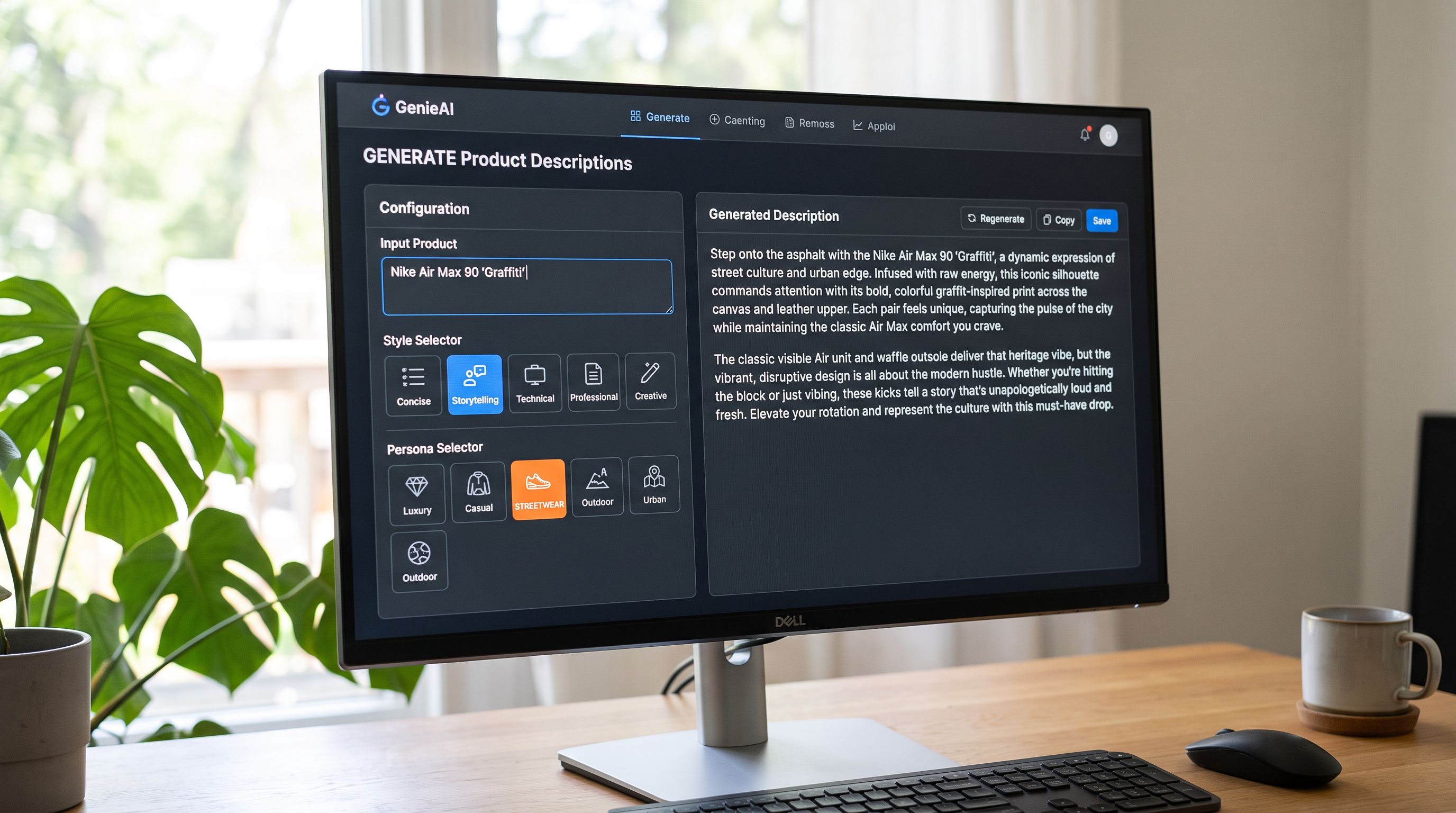
Importier's 156 expert personas across 43 industries include streetwear and collector market personas. The Streetwear Cultural Commentator persona produces descriptions that open with the cultural context of the release rather than material specifications. Combined with a Storytelling description style and the correct product title and collab metafields as context inputs, the generated descriptions match the register that sneaker buyers expect.
The critical input for accurate collaboration descriptions is a correctly structured product title. "Nike Air Force 1 Low x Off-White MCA" produces a description calibrated to the collaboration. "AF1-LOW-OW-MCA-001" (a supplier SKU code used as the title) produces a description that opens with a meaningless internal reference. Fixing the title before the description generation step, using the product title formula for streetwear (Brand + Model + Collab + Colourway), is the prerequisite for consistent AI description quality across collaboration batches.
According to Shopify's guidance on product data for commerce, the product title and description are among the most influential fields for search relevance and buyer confidence. For collaboration products in the sneaker market, those two fields must reflect the community's language rather than the supplier's internal coding system.
- Size option named 'Size' with mixed US and UK and EU values across 840 rows
- Men's and women's sizing merged into one product with 26 size variants
- Colourways as colour variants sharing one inventory pool and price point
- Collab partner, release date, and condition grade in product description body text
- AI descriptions generated from supplier SKU codes produce generic footwear copy
- Option named 'US Men's Size' with values 7 to 13 in half increments: 13 correct variants per product
- Men's and women's sizing as separate products cross-referencing via Related Sizing metafield
- Colourways as separate products in a shared collection with independent inventory and pricing
- Collab partner, release date, edition type, and condition grade as structured metafields
- AI descriptions from correct title and Streetwear Cultural Commentator persona produce culturally accurate copy
The streetwear retailer who imported 840 rows re-imported using a profile configured with the correct option name, colourway isolation, and a half-size-aware grouping key. The result was 280 products, each with 13 correctly labelled size variants. The AI description pass used the Streetwear Cultural Commentator persona and produced copy that opened with the release context and colourway details for each model. None of the 840 original rows needed to be manually edited.
Try Importier free at importier.app.
Set up your first import in under five minutes.
Importier brings products into Shopify with AI descriptions, category metafields, and data enrichment on every run.