How to Write Shopify Product Descriptions That Rank on Google in 2026
On this page
How to Write Shopify Product Descriptions That Rank on Google in 2026
For most of the past decade, the advice on product descriptions for Google was the same: include the keyword in the first 100 words, write at least 300 words, avoid duplicate content. That advice was correct in 2018. In 2026, it is insufficient.
Google's search experience has changed significantly. AI Overviews now appear above traditional search results for a large proportion of product and shopping queries. AI Mode, rolled out through 2025 and expanded in 2026, generates synthesised answers from multiple sources rather than returning a ranked list of links. The question is no longer just "does my product page rank?" but "does my product description give Google enough specific, credible information to surface it in an AI-generated answer?"
The mechanism is different. Keyword density, exact-match anchor text, and generic marketing language do not provide the signal Google's AI needs. Specificity does. A description that answers a precise buyer question with enough context for an AI system to summarise it confidently performs better in AI-assisted search than a longer description full of vague benefits.
What Changed in 2026
Google's Search Essentials documentation has not changed its core message: write for people, not for search engines. What has changed is how Google's systems extract and surface information from product pages.
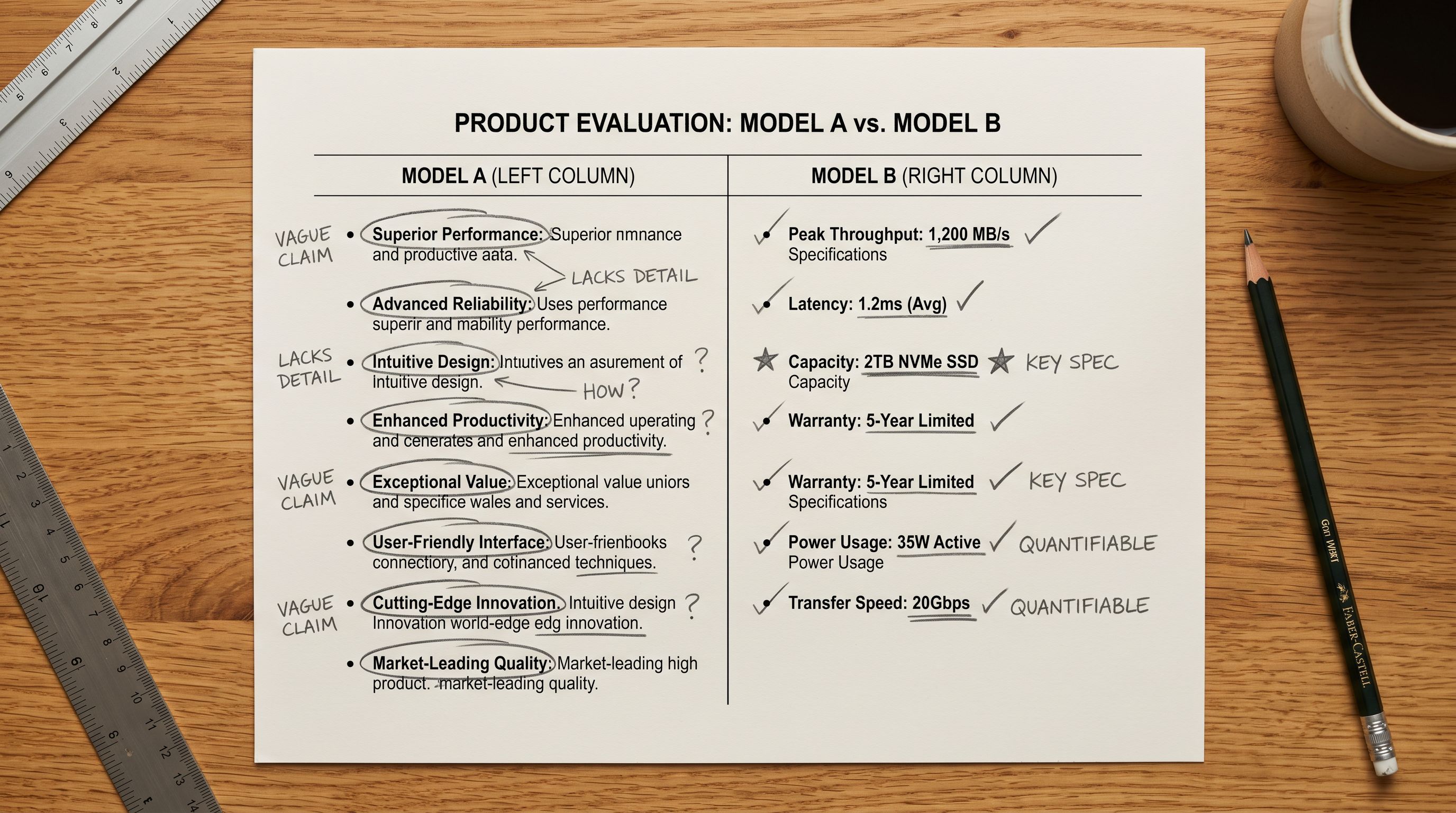
In AI Overviews and AI Mode, Google synthesises answers from multiple product pages simultaneously. To include a product in that synthesis, the system needs enough structured, factual content from the product page to make a credible claim about the product. A description that says "our premium quality headphones deliver exceptional sound" gives the AI nothing to work with: it cannot extract a specific claim about the product. A description that says "the 40mm drivers produce a frequency response of 20Hz to 20kHz, with a closed-back design that reduces ambient noise by approximately 25dB" gives the AI a specific technical claim it can include in a synthesised answer about noise-cancelling headphones.
This does not mean every product page needs engineering-level specifications. It means descriptions need at least one concrete, specific claim that is distinct from what every other competitor says. The specificity requirement varies by product category, buyer intent, and query type. A supplement product description needs ingredient specificity and use-case specificity. A clothing product description needs material specificity and fit specificity. A tool description needs specification and compatibility specificity.
Three Description Patterns That Perform in AI Overviews
Testing against AI Overview appearances for Shopify product categories in 2025-2026 has produced three description structures that consistently provide enough signal for AI-assisted surfaces to surface the product.
Pattern 1: Specification-Rich
The specification-rich pattern leads with what the product is made of, its measurable properties, and its technical parameters. It answers the implicit question "what exactly is this?" before addressing benefits.
For a stainless steel water bottle: "Constructed from 18/8 food-grade stainless steel with a 2.5mm wall thickness, the 750ml capacity maintains hot liquids above 60°C for 12 hours and cold liquids below 10°C for 24 hours. The powder-coat exterior resists chips and scratches, and the screw-top lid creates a leak-proof seal certified to IP67."
This pattern works because it gives an AI system multiple extractable facts: material, wall thickness, capacity, temperature retention times, and certification. Any one of those facts can appear in a synthesised answer about insulated water bottles.
The pattern is most effective for: tools and equipment, home goods, electronics, sports and fitness products, kitchenware, and any category where buyers use specifications to compare options.
Pattern 2: Use-Case Framed
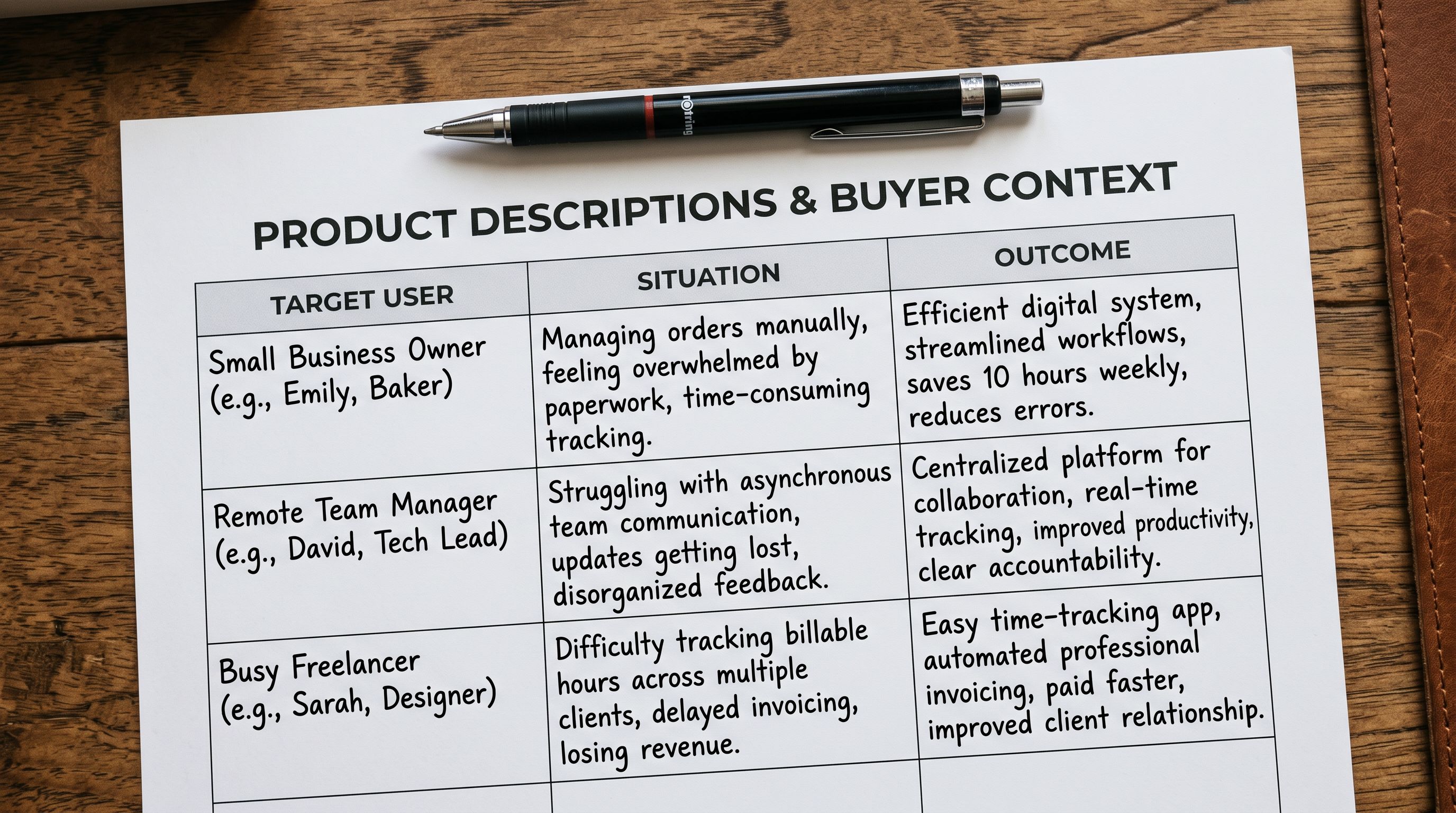
The use-case framed pattern describes who uses the product, in what situation, and what outcome they achieve. It answers the implicit question "is this right for me?" before listing features.
For a notebook: "Designed for daily journaling and meeting notes, the 192-page ruled layout with a lay-flat binding works on a desk or in hand. The 90gsm paper prevents ink bleed-through from fountain pens and markers, making it a reliable choice for writers who switch between pen types throughout the day."
This pattern works because it gives Google's AI system a specific user and situation to attach the product to. When a buyer searches "notebook for fountain pen users" or "lay-flat notebook for meetings", the use-case framing contains those exact contexts.
The pattern is most effective for: accessories, stationery, apparel, food and beverage, beauty products, and categories where buyer identity and situation determine the purchase.
Pattern 3: Comparison-Aware
The comparison-aware pattern positions the product against the implicit alternative: the thing the buyer would otherwise purchase. It answers the implicit question "why this over the other option?"
For a refillable cleaning concentrate: "Each 50ml concentrate sachet mixes with water to produce 750ml of all-purpose cleaner, reducing single-use plastic by 93% compared to pre-mixed spray bottles. One sachet replaces three standard 250ml bottles purchased individually and costs 40% less per cleaning session at full retail price."
This pattern works because it provides a comparative data point that helps Google's AI construct a "versus" or "comparison" answer when buyers search for alternatives or substitutes.
The pattern is most effective for: sustainable or eco-alternative products, premium-versus-budget decisions, subscription versus one-time purchase, and any category where buyers are explicitly comparing options before deciding.
- 01Identify which pattern fits the product category. Specification-rich for technical and measurable products. Use-case framed for identity and situation-driven purchases. Comparison-aware for alternatives and sustainability angles. Most products can use more than one; lead with the strongest signal for the primary buyer intent.
- 02Write the opening paragraph around the pattern. Get the specific claim into the first 50 words of the body description, not buried in the third paragraph. Google's AI extraction prioritises content that appears early in the page's main body.
- 03Check that at least one claim in the description is not replicable from competitor pages or supplier copy. If your description and three competitor descriptions say the same thing in different words, none of them provide a distinct signal.
- 04Write the meta description as a separate piece from the body description. The meta description is the text Google shows below the page title in search results. It should answer the query intent in one sentence, not summarise the page.
- 05After publishing, check [Google Search Console](https//search.google.com/search-console/about) for the product pages after 4 to 6 weeks. Look for impressions on specific query terms, which indicate which description claims Google found extractable and relevant to buyer searches.
- Premium quality product with exceptional results
- Suitable for all occasions and users
- Made with the finest materials
- Better than competitors in every way
- Our most popular product this season
- Specific claim answering the primary buyer intent
- Named user, situation, or use case
- Material, spec, or measurement that is extractable by AI
- Comparison point against the implicit alternative
- Supporting claim that differentiates this listing from identical supplier copy
The Meta Description Is a Separate Task
Most merchants treat the meta description as a summary of the body description. In the AI Overview era, that approach wastes one of the most valuable signals on the page.
The meta description is the text that appears under the page title in traditional Google search results. It does not directly affect ranking, but it does affect click-through rate, and Google's AI systems read it as a secondary source of product information that can supplement or confirm the body description.
A body description optimised for specification extraction and a meta description optimised for click-through rate serve two different functions. The body description needs to provide enough structured information for AI extraction. The meta description needs to make a buyer who sees the listing in search results want to click through.
For the stainless steel water bottle example: body description leads with 18/8 steel, wall thickness, and temperature retention times. Meta description: "Holds coffee at drinking temperature for 12 hours, cold drinks for 24. 750ml, IP67 certified, powder-coat exterior."
The meta is not a repeat of the body. It distils the one or two most compelling buyer-facing claims into a sentence that prompts a click.
Importier generates the meta description in a separate AI pass from the body description, treating them as two distinct writing tasks with different outputs rather than truncating the body to create the meta.
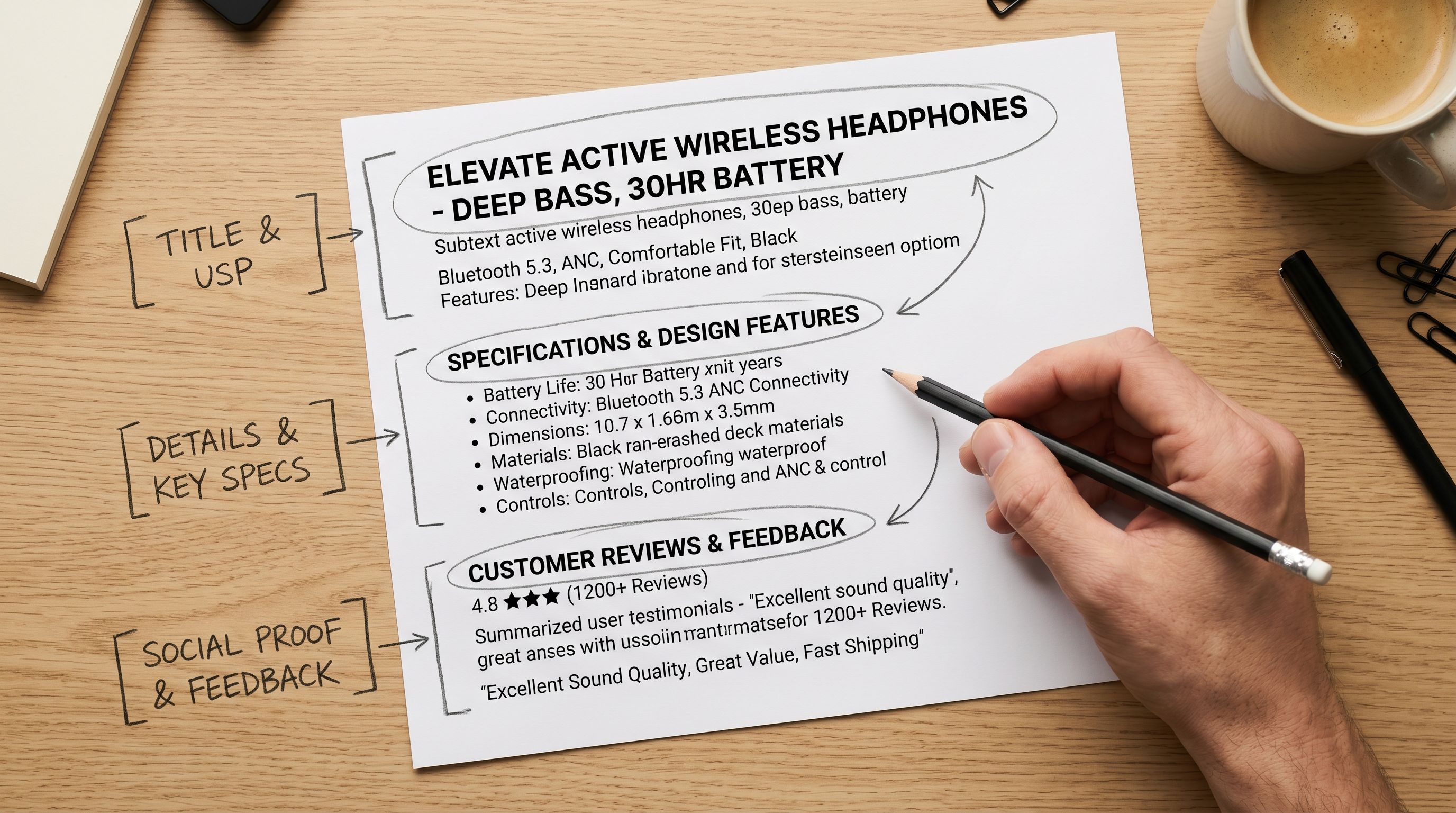
The meta description is not a summary of the body. It is the answer to "why click this result?" The body answers "what is this product?" Those are different questions for different contexts.
Writing at Scale
Writing These Patterns Across a Catalogue
The three patterns are straightforward to write for a single product. Writing them across 200 or 500 products is where the challenge lies. The common shortcuts (supplier copy, generic templates, AI-generated text with no specificity injected) produce descriptions that look complete but contain no extractable facts.
Supplier copy is the most common problem in Shopify product catalogues. The manufacturer writes one description and distributes it to every retailer. Google sees hundreds of pages with identical content, extracts the same facts from all of them, and has no reason to favour one retailer's product page over another in an AI-generated answer. The merchants who appear in AI Overviews for those products are the ones who added at least one unique signal (a use case, a comparison, a specific application) on top of the supplier's base copy.
Importier's 18+ AI models generate descriptions from the product data in the import file rather than copying supplier text. The AI takes the product title, category, specifications, and any other available data as inputs and writes a description in the selected pattern. Because the output is generated from the inputs rather than copied from a source, each product description is unique to that retailer's catalogue even when the underlying product data comes from a shared supplier.
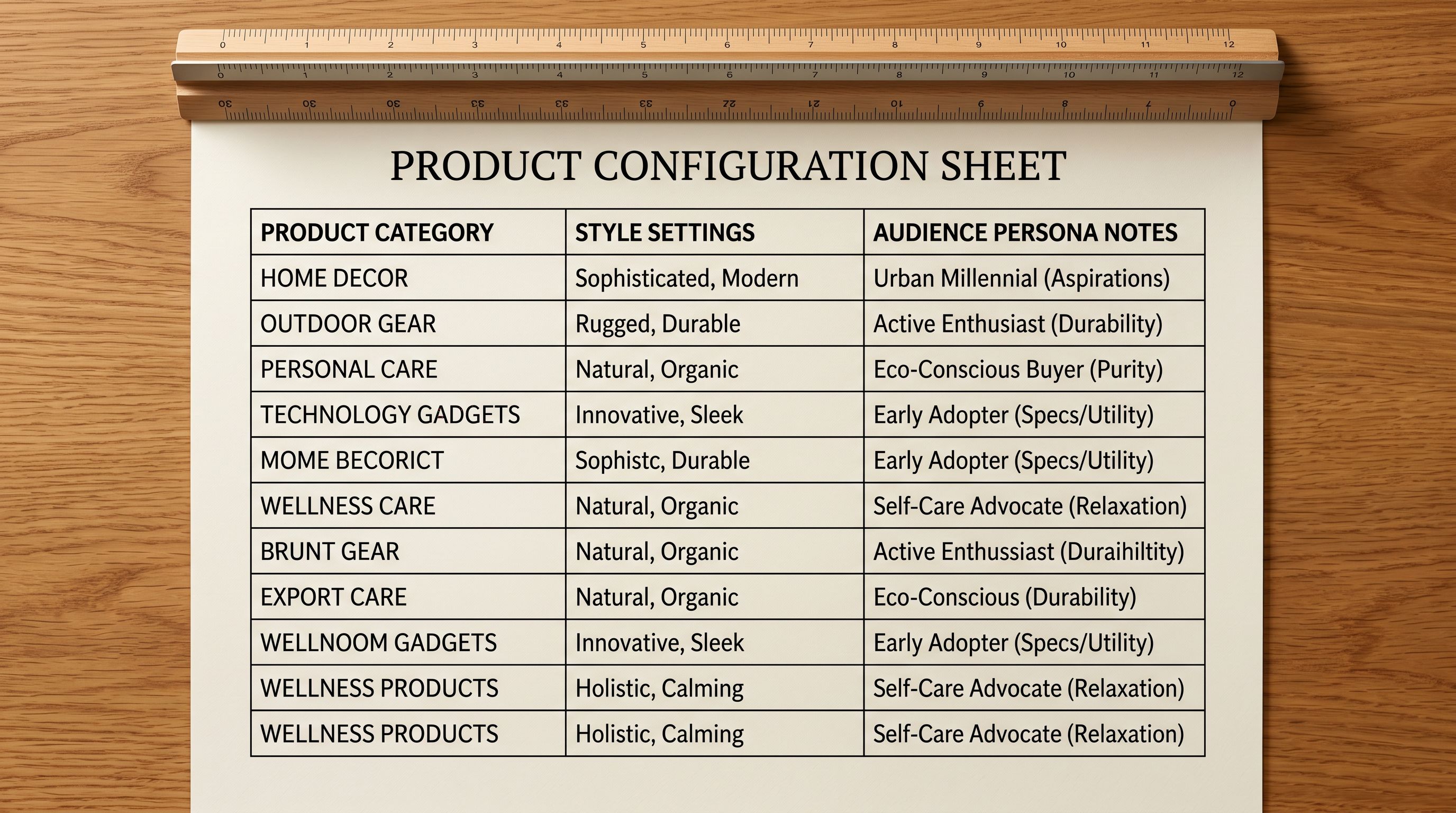
The 7 description styles correspond to the three patterns described above and their combinations: Benefits-First and Use-Case-Centric align with the use-case framed pattern; Technical and Specification-First align with the specification-rich pattern; Comparison and Feature-Versus-Feature align with the comparison-aware pattern. The 156 expert personas add category-specific vocabulary and audience-specific framing: a Culinary persona uses food-specific language for a kitchen product; a Fitness persona frames a supplement for an active buyer.
For a full catalogue import, you select the style and persona once at the session level. Every product in the batch generates a description in that pattern. For a mixed catalogue with different product types, the import can be segmented by category with a different style applied per segment.
The Importier AI product descriptions guide covers the full description generation workflow, including how to preview and edit AI output before the products go live in Shopify.
AI Shopping and Product Page Visibility
Google's AI shopping experience, which expanded significantly through 2025, surfaces product listings directly in AI-generated answers to shopping queries. The selection criteria mirror the AI Overview logic: products with structured, specific, factual descriptions are more likely to be included than products with generic marketing copy.
The data Google uses to construct AI shopping answers comes partly from Google Merchant Centre feed data and partly from the product page content itself. Merchants who maintain both (a complete, accurate Merchant Centre feed and a well-structured product page description) provide Google with two sources of consistent information about the product. That consistency is a signal in itself: when the feed data and the page content agree on key facts, Google's confidence in the accuracy of those facts increases.
For a deeper look at how AI shopping surfaces work and what product data they prioritise, the Shopify AI shopping guide covers the AI Mode and AI shopping experience in detail, including how Importier's category metafield assignment affects product visibility on AI shopping surfaces.
The Shopify product data quality guide covers the related question of how to audit and fix gaps in product data (missing barcodes, incorrect weights, incomplete taxonomy) that affect both AI shopping eligibility and Google Merchant Centre feed health.
Specificity Is the Durable SEO Investment
Generic descriptions optimised for keyword placement worked when Google's ranking signals were primarily keyword-based. That model is no longer the primary mechanism for product page visibility, and the trend is accelerating. AI Overviews, AI Mode, and AI shopping surfaces all extract factual, specific claims from product pages and use them to answer buyer queries directly.
The investment in specificity compounds over time. A description with a specific use case, a concrete specification, and a comparison point provides value across multiple query types simultaneously. A keyword-stuffed description provides value for exactly the query terms it targets and nothing else. As Google's systems extract more meaning from product pages rather than matching exact keyword strings, the specificity advantage grows.
The Shopify store scanner covers how to audit an existing catalogue for description quality gaps (thin content, supplier copy, and missing specifications) before running a description refresh.
Try Importier free at importier.app
Set up your first import in under five minutes.
Importier brings products into Shopify with AI descriptions, category metafields, and data enrichment on every run.