Shopify Alt Text, Meta Description, and SEO Title Explained
On this page
A Shopify product page has at least three SEO-related fields beyond the product description. Most merchants know one of them exists. Few know what all three do, which systems read each one, or that filling all three requires a different approach for each.
The three shopify seo fields are: image alt text (the text attribute on each product image), the meta description (the snippet text that appears below the page title in Google results), and the SEO title (the page title Google shows in search results, separate from the product title displayed on the product page). Each field serves a different audience. Each field affects a different part of how the product appears to buyers. Missing any one of them leaves a gap that the other two cannot fill.
Shopify's Three SEO Fields: How They Differ
The confusion between these fields is common because all three live in or near the SEO section of Shopify admin and all three affect how a product performs in search. The similarity ends there.
| Field | Where it appears | Who reads it | Character target |
|---|---|---|---|
| Image alt text | On each product image (invisible to sighted users) | Screen readers, Google Image search, AI shopping agents | 8–15 words per image |
| Meta description | Below the page title in Google search results | Human searchers deciding whether to click | 140–155 characters |
| SEO title | Google search result title, browser tab, social share | Human searchers, Google's title system, social platforms | 50–60 characters |
None of these fields affects product page ranking in place of another. A well-written meta description does not improve image search discoverability. A descriptive SEO title does not help screen reader users navigate product images. Each field serves its audience and system independently.
Image Alt Text: The Field Three Systems Read Simultaneously
Image alt text is the alt attribute on an HTML image element. In Shopify, it is the "Add alt text" field in the product media section. It is invisible to sighted users on a standard product page. It exists only in the page's HTML.
Google's image search best practices define image alt text as the primary text signal for image indexing. When Google crawls a product page, it reads alt text to understand what each image shows. An image with descriptive alt text ("Double-breasted charcoal wool coat with notch lapels, front view") ranks for image searches that match those attributes. An image with blank alt text or the product title repeated verbatim is indexed without specific attribute context.
Screen readers announce alt text when a visually impaired user navigates to an image. If every product image has the same alt text (the product title), the screen reader user hears the product title repeated once for every image in the gallery, with no new information from any of them.
AI shopping agents (Google AI Mode, Perplexity Shopping, ChatGPT Shopping) increasingly read image-level metadata as supplementary product signals. A product whose images are alt-tagged with colour, angle, and material attributes provides richer structured data than a product whose images all repeat the product title.
The common mistake: leaving alt text blank or setting it to the product title for every image. Both fail all three audiences.
What works: a description of what that specific image shows (the subject, distinguishing attribute, and image context), 8 to 15 words, distinct for each image in the gallery.
Meta Description: Click-Through Copy, Not a Ranking Signal
The meta description is the text Shopify places in the HTML <meta name="description"> tag. In Google search results, it appears as the 1–2 line description beneath the page title (the "snippet"). Shopify's product page SEO section includes a "Meta description" field separate from the product description.
Google's documentation on search result snippets is explicit: Google does not use the meta description as a ranking factor. It uses the meta description to generate the snippet shown below the page title, which affects click-through rate, not position.
This distinction matters for prioritisation. A merchant who spends hours writing perfect meta descriptions expecting improved rankings is investing in the wrong outcome. Meta descriptions influence whether a searcher at position 3 clicks through to the product page or scrolls past. They do not move the product from position 8 to position 3.
Meta descriptions do not affect where your product ranks. They affect whether a searcher at that position clicks through to your store. That is a meaningful difference, and it means the right length is "compelling," not "keyword-dense."
The Shopify product page SEO title and meta description fields are separate from the product title and description fields displayed on the product page itself. Leaving the SEO meta description blank does not mean it is empty. Shopify's default behaviour extracts a snippet from the product description. The extracted snippet is rarely as effective as a purpose-written one because product descriptions are optimised for buyers who are already on the page, not for searchers who are deciding whether to visit.
The character target for meta descriptions is 140–155 characters. Longer descriptions are truncated in Google results. Shorter descriptions leave available click-through copy unused.
The SEO Title: Separate from the Product Title
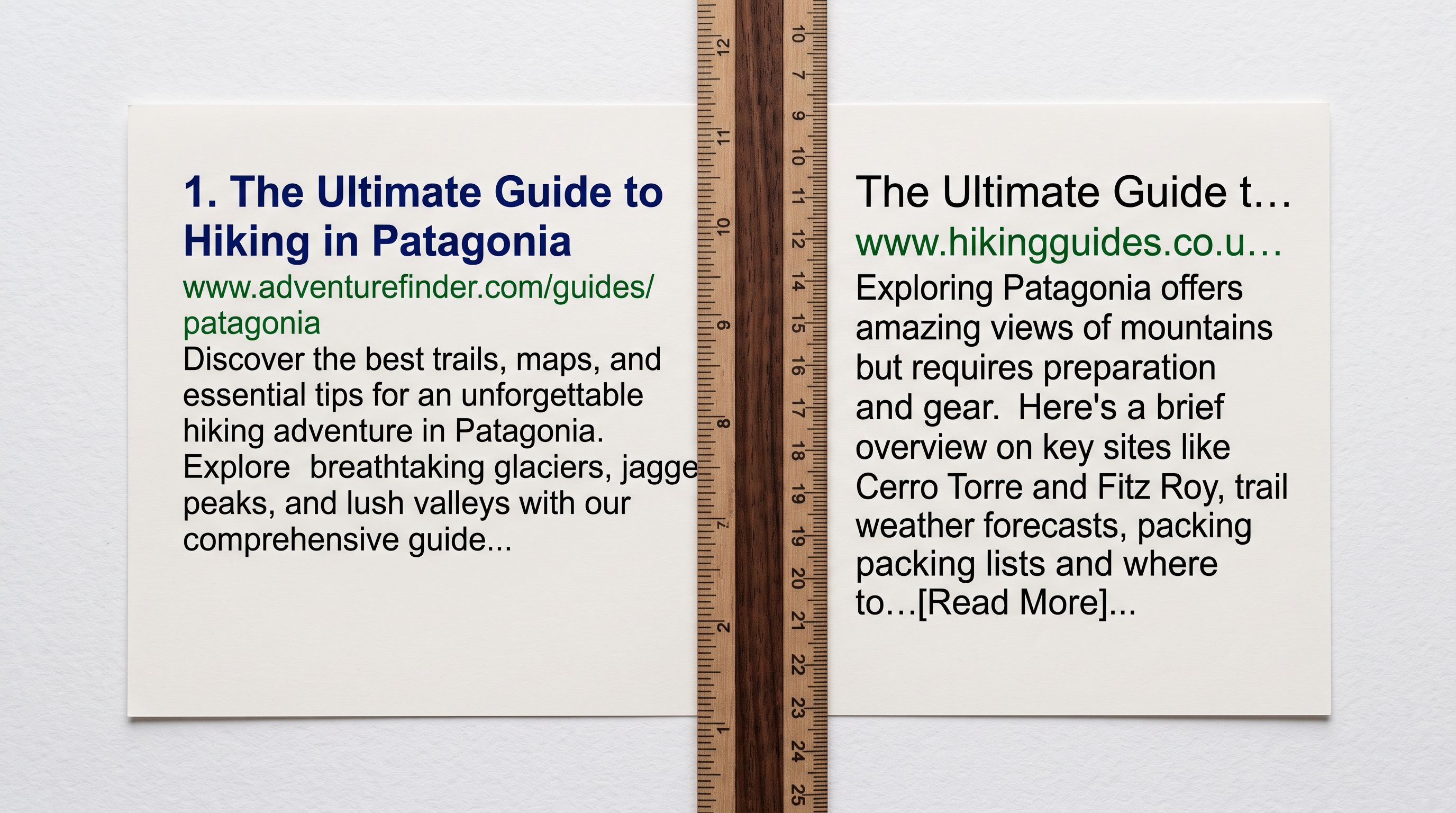
The SEO title (also called the meta title) is the text in the HTML <title> tag. It appears as the clickable blue link in Google search results, in the browser tab when someone is on the page, and as the default text when the URL is shared on social platforms.
Shopify stores the SEO title in the "Page title" field within the product's SEO section. It is entirely separate from the product title displayed on the product page itself. When a merchant leaves the SEO title blank, Shopify defaults to using the product title as the page title. For supplier-formatted titles ("PREMIUM WOOL COAT W/NOTCH LAPEL BLK 100% WOOL BLEND M/L"), this default produces search result titles that do not read as retail copy and waste the 50–60 character opportunity to include a target keyword in the title position where Google weights it most heavily.
The SEO title and meta description together form the "search listing" for a product: the two lines of text a searcher sees before deciding to click. Importier's Title Optimizer generates SEO titles within the 50–60 character target and can apply Google Merchant Centre compliance formatting (brand/type/attributes order, title case) in the same batch.

Filling All Three Shopify SEO Fields at Import Time
The complete SEO pass
The most common outcome of treating these three fields separately is that a merchant fills one, sometimes two, and rarely all three. Alt text is skipped because it requires editing each image individually. Meta descriptions are left to Shopify's auto-extraction from the product description. SEO titles default to the product title.
- Alt text blank or set to product title on all images
- Meta description auto-extracted from product description (not purpose-written)
- SEO title defaults to the supplier-formatted product title
- Image search, screen reader, AI shopping agent, and SERP snippet audiences all underserved
- Retroactive fix requires opening every product and every image manually
- Alt text generated per image position (primary, detail, lifestyle, back view) at import
- Meta description generated as 140–155 character click-through copy, separate from product description
- SEO title generated at 50–60 characters with target keyword front-loaded
- All three audiences served from the same import run
- No retroactive cleanup needed for new products
Importier handles all three fields in the same import pass. When a product import runs:
Alt text generation produces image-specific descriptions per image position. The first image gets a front-view description with key product attributes. Later images get position-specific descriptions: detail shots, lifestyle contexts, alternative angles. Each is distinct; each serves the screen reader, image search, and AI shopping agent audiences.
Meta description generation runs as a separate AI output from the product description. The product description is written for buyers already on the page. The meta description is written as search snippet copy: benefit-forward, within 140–155 characters, with the target keyword near the start.
SEO title generation via the Title Optimizer produces a 50–60 character title distinct from the product title. It front-loads the primary keyword, follows the retail title format (not supplier formatting), and stays within the character limit that Google displays without truncation.
- 01Step 1During the import configuration, enable AI description generation and confirm that meta description and SEO title generation are included in the batch. In Importier's import wizard, the AI settings panel shows which fields are queued for generation. Confirm that product description, meta description, SEO title, and alt text are all active.
- 02Step 2Select the persona and description style. Both the product description and the meta description use the same persona, so the voice is consistent. The meta description generation draws on the same product attributes but outputs in snippet format rather than body copy format.
- 03Step 3Configure the Title Optimizer for SEO title generation. Set the character limit to 50–60 characters. If Google Merchant Centre compliance mode is relevant (the store uses Google Shopping), enable the GMC title format to apply brand/type/attributes ordering.
- 04Step 4Run the import. The AI generation pass produces product descriptions, meta descriptions, SEO titles, and alt text for every image in the batch simultaneously. For a 200-product import with 4 images per product, 200 meta descriptions, 200 SEO titles, and 800 image alt text fields are generated in the same pass as the 200 product descriptions.
- 05Step 5Review the generated content by field type. In the import review step, check a sample of meta descriptions against the 140–155 character target and confirm the keyword appears near the start. Check SEO titles for the 50–60 character target. Spot-check alt text on a sample of products to confirm each image has a distinct, descriptive entry.
For stores with existing products that are missing one or more of these fields, the Store Scanner identifies gaps by field type. The SEO Audit export shows which products have blank meta descriptions, which have default SEO titles (matching the product title), and which have images with blank alt text. The audit output prioritises by traffic: high-impression products with missing fields are the highest-return retroactive fix.
Key Takeaways
The three shopify seo fields serve different systems and audiences. Filling one does not substitute for filling the others, and the work to fill all three simultaneously at import time is no greater than the work to fill one.
Key points:
- Image alt text is read by screen readers (accessibility), Google Image search (image indexing), and AI shopping agents (attribute signals). The target is 8–15 words per image, distinct for every image in the gallery.
- Meta description does not affect rankings. It affects whether a searcher at your listing's position clicks through. It should be written as click-through copy: 140–155 characters, benefit-forward, keyword near the start, different from the product description.
- SEO title is separate from the product title in Shopify admin. When left blank, it defaults to the product title. Supplier-formatted product titles rarely make good SEO titles. The target is 50–60 characters with the primary keyword front-loaded.
- All three can be generated in the same import pass. Importier produces product descriptions, meta descriptions, SEO titles, and per-image alt text from one AI batch run. No separate cleanup pass is needed for new products.
- Existing catalogues with gaps can be audited via the SEO Audit export, which identifies missing or defaulted fields by product. Prioritise high-traffic products first.
For deeper coverage of each field: the SEO title vs product title guide covers the distinction between Shopify's two title fields and how each appears in search results. The bulk meta description guide covers meta description generation at scale across an existing catalogue. The image alt text guide covers alt text generation per image position in more depth. The product SEO audit guide covers how to identify and prioritise all SEO gaps across a live catalogue.
Start filling all three SEO fields at import at importier.app. Alt text, meta description, and SEO title generation are available on the Growth plan and above.
Set up your first import in under five minutes.
Importier brings products into Shopify with AI descriptions, category metafields, and data enrichment on every run.