Shopify AI Descriptions: Stop Competitor Brand Mentions
On this page
A sporting goods merchant generates AI descriptions for 300 generic resistance bands. The products are unbranded: no manufacturer name, no licence, no affiliation with any fitness brand. Three weeks after publishing, a customer emails asking whether the product is TheraBand-compatible. The merchant reads the description and finds the phrase "resistance levels comparable to the TheraBand colour-coded system." The merchant never wrote that. It came from the AI.
The description is live on Google Shopping. TheraBand is a registered trademark. The merchant is now potentially in breach of Google Merchant Centre's trademark policy without having written a single infringing word themselves.
This is not a fringe edge case. It is a structural feature of how large language models are trained: the AI has learned that resistance bands are frequently described in relation to TheraBand because that is how the internet describes them. The association is so strong that the model reaches for it by default when describing any resistance band, including unbranded generics.
Why AI Descriptions Reference Competitor Brands
The AI generates descriptions from the product's source data: title, existing description, specifications, vendor field, tags. When those fields are present and detailed, the AI has ample material to work from. When they are sparse (a product title only, or a three-word description from a supplier), the model fills the gaps by drawing on its training data.
Training data for product descriptions is heavily concentrated in retail and marketplace content: Amazon listings, product review articles, category pages, affiliate content. Those sources routinely compare products to category leaders as a shorthand for describing specs. A 200-piece puzzle is described in terms of how it compares to Ravensburger quality. A chef's knife is described with reference to Wüsthof sharpness. A wireless speaker is described in terms of Bose sound quality. The model learned these associations as productive description patterns.
When your product's source data is thin, the AI defaults to those patterns. The product gets described in relation to the category leader even though your product has no relationship to that brand.
Which Categories Are Most at Risk
The problem is concentrated in categories where one or two brands dominate the mental model of what a "good" version of the product looks like.

- Fitness and exercise equipment: TheraBand for resistance bands, Theragun for percussion massagers, Peloton for bike trainers, Garmin for GPS fitness trackers
- Kitchen and cookware: Le Creuset for cast iron, All-Clad for stainless steel, KitchenAid for stand mixers, Vitamix for high-speed blenders
- Power tools: DeWalt and Makita for cordless tool systems, Milwaukee for professional-grade hand tools
- Consumer electronics and audio: Bose for noise-cancelling headphones, Sony for wireless speakers, Anker for portable chargers
- Outdoor and camping: Coleman for camping stoves, Yeti for insulated drinkware, Osprey for backpacks
- Health and personal care: Philips for electric shavers and toothbrushes, Braun for hair removal devices
Merchants selling generic or white-label equivalents in these categories are the most exposed. The AI fills the brand-comparison gap because the training data taught it that comparisons are how these products get described.
What Actually Goes Wrong
The competitor brand reference is usually not a full claim: it is a passing reference. "Comparable to," "similar in construction to," "achieves results similar to," "inspired by." These framings may feel like competitive positioning, but from a trademark perspective, they create ambiguity about whether the product is genuinely affiliated with or licensed by the named brand.
According to Google Merchant Centre's product data specification, product descriptions must not include "promotional or advertising content" or information about other companies. A competitor brand name in a product description can trigger a disapproval under the "misleading or false" content policy if the description implies affiliation that does not exist.
Finding the problem
How to Find Affected Descriptions
Shopify admin's product search does not support full-text search across all product descriptions simultaneously. The fastest approach to finding affected descriptions uses Importier's export function.
- 01In Importier, run an export using the SEO Audit preset. This exports product handle, title, description (Body HTML), SEO title, and SEO meta description for every product in the catalogue.
- 02Open the exported CSV in a spreadsheet. Add a filter to the description column and search for the specific brand names you are concerned about. For a sporting goods catalogue, search for the major brands in your category, the names you know are in the training data's vocabulary for your product types.
- 03Any row that returns a match contains a competitor brand reference in a published description. Note the product handles.
- 04For a quick check of a specific product, open the product in Shopify admin and read the body HTML field directly. This is slower for large catalogues but works for targeted verification.
For a catalogue of 300 products, the export-and-filter method typically surfaces affected descriptions in under five minutes, without reading every description individually.
Fixing Affected Descriptions
Once affected products are identified, the fix is a re-generation run using Importier's Store Scanner in Replace mode, with an Enrichment Context constraint that explicitly prohibits brand name references.
The Enrichment Context field accepts a freeform instruction that applies to the generation run. A short instruction is enough: "Do not mention any specific brand names, trademarks, or competitor products. Describe only the product's own features, materials, and specifications."
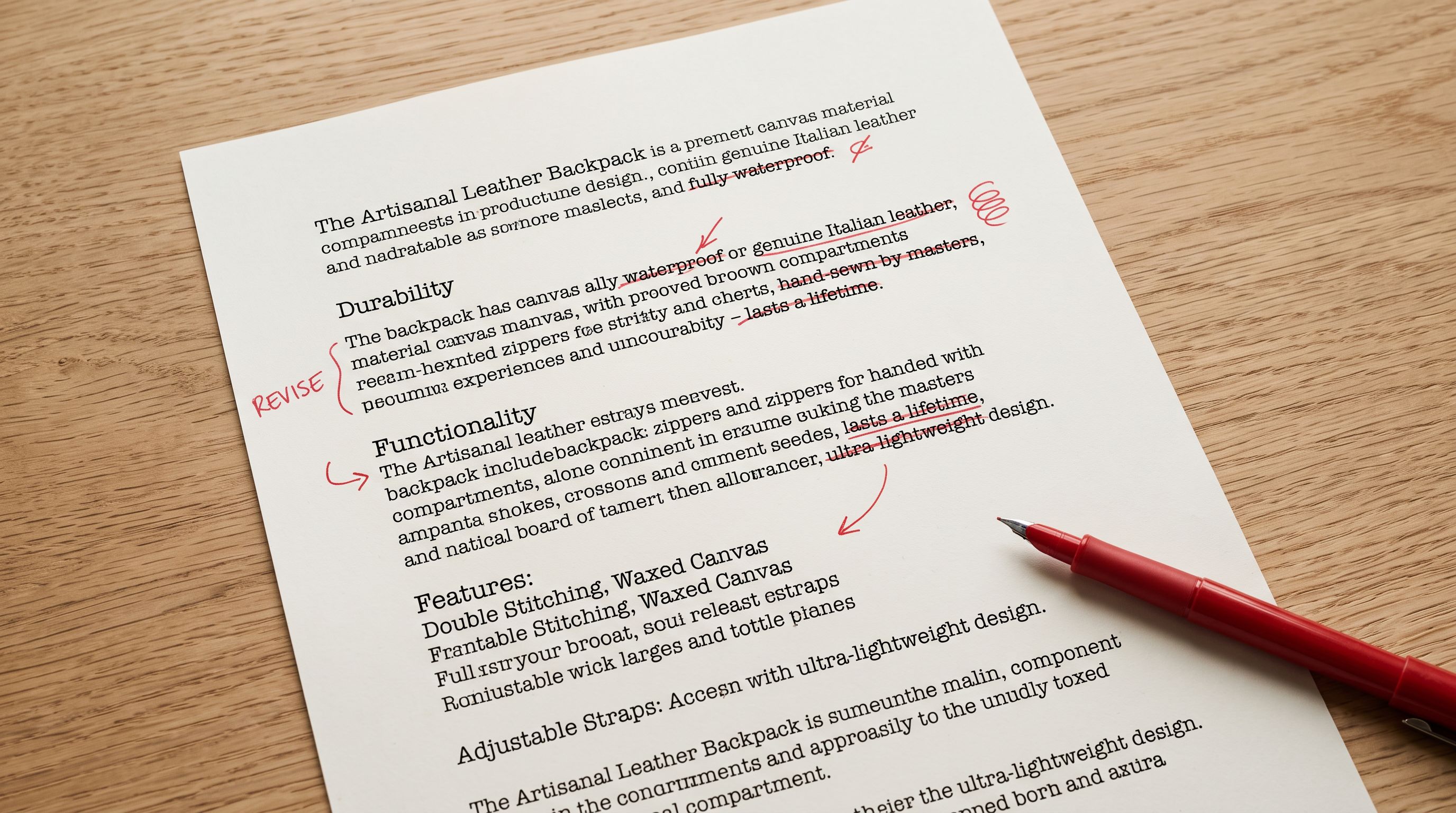
After running Replace mode with this instruction, the AI generates descriptions based on the product's own attributes without reaching for brand-comparison language. A resistance band description becomes: "Medium resistance level suitable for upper body strengthening, physical therapy, and mobility work. Latex-free construction. Dimensions: 120cm × 4cm."
That description is accurate, neutral, and free of any third-party brand reference.
For the fit check: add a review pass after the re-generation run and sample 10-15 descriptions from the affected product group. Confirm no brand names appear. For a 300-product catalogue, this takes under ten minutes.
Preventing Future Brand References
Two configuration changes prevent competitor brand references from appearing in subsequent generation runs.
- AI draws freely on category associations from training data
- Competitor brand names appear in comparisons and references
- Problem recurs on every new generation run or imported product
- Descriptions must be audited manually after each batch
- Google Merchant Centre disapprovals possible for trademark-adjacent content
- Brand Voice Avoid Words list eliminates specific brand names from all generated descriptions
- Enrichment Context instruction redirects the AI to describe product attributes without brand comparisons
- Prevention applies permanently on every subsequent run
- New product imports generate clean descriptions without re-checking
- Consistent, brand-neutral catalogue across all product categories
Brand Voice Avoid Words is a persistent, store-level filter. Any word added to this list will not appear in any generated description. For a sporting goods merchant, adding TheraBand, Theragun, Garmin, Peloton, and any other category-dominant brand names means those terms are excluded from all descriptions, including future product imports.
Adding terms to Avoid Words takes seconds. The list accepts comma-separated terms. Importier applies the filter across all generation runs (Store Scanner, direct generation, scheduled imports) without further configuration.
Enrichment Context is a per-run instruction. For a scheduled supplier import of generic fitness products, an Enrichment Context instruction of "Describe product features and specifications only. Do not compare to any other brands or products. Do not use competitor product names as reference points." ensures the instruction applies every time that import profile runs.
Brand Voice Avoid Words is the permanent filter. Enrichment Context is the per-run instruction. For most merchants, the avoid words list alone resolves the problem. The enrichment context instruction adds a second layer for import runs where thin supplier data makes the model most likely to default to brand-comparison language.
A Note on Legitimate Brand Mentions
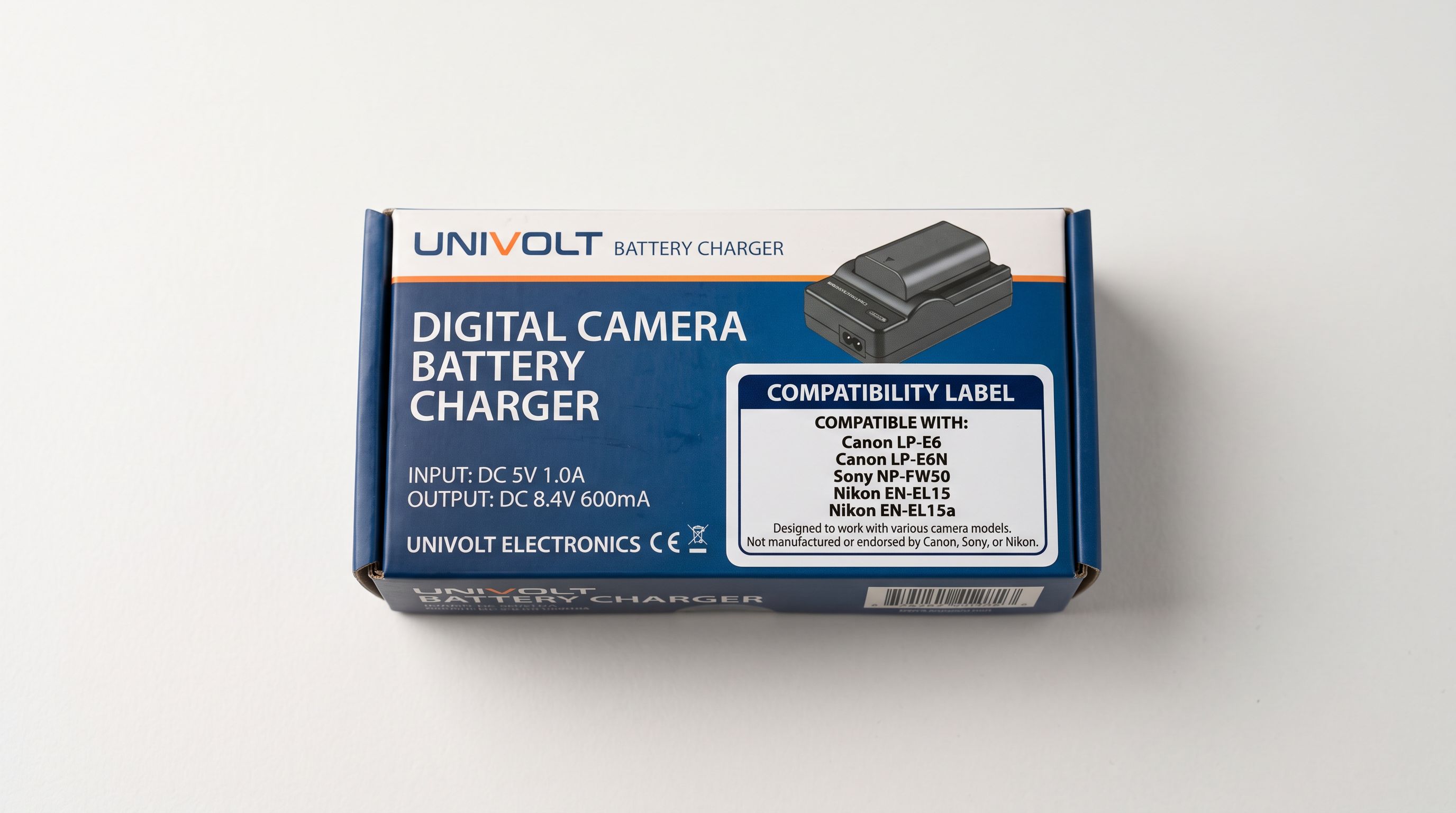
Not every brand mention in a product description is a problem. Products sold as compatible with a specific system legitimately reference the brand they are compatible with. A replacement battery for a DeWalt drill should mention DeWalt. That is the accurate and necessary product information. A screen protector for a Samsung Galaxy should mention Samsung.
The problem is unintended brand association: the AI referencing a brand not because the product is genuinely compatible or affiliated, but because the training data associated descriptions of similar products with that brand.
According to Shopify's guidance on product listing accuracy, product descriptions should accurately reflect the product being sold. A description that implies connection to a brand the product is not affiliated with is inaccurate by definition, regardless of whether a human or an AI wrote it.
For merchants whose products are genuinely compatible with brand-name systems, the Enrichment Context field supports accurate framing: "This product is compatible with DeWalt 20V MAX batteries. State this compatibility directly. Do not use DeWalt branding beyond stating the compatibility." The AI generates accurate compatibility language without implying deeper affiliation.
Key Takeaways
- AI product description models reference competitor brands because training data associates those brands with product categories. This happens even when your product has no connection to the referenced brand.
- The categories most at risk are those with dominant brand leaders: fitness equipment, cookware, power tools, consumer electronics, and outdoor gear.
- Google Merchant Centre's product data specification prohibits misleading content about other companies. Competitor brand references in descriptions can trigger disapprovals.
- Identifying affected descriptions: export the catalogue using Importier's SEO Audit preset, filter the description column by brand name.
- Fixing existing descriptions: Store Scanner in Replace mode with an Enrichment Context instruction to prohibit brand-comparison language.
- Preventing recurrence: Brand Voice Avoid Words for permanent brand name exclusion; Enrichment Context for per-run instructions on supplier import profiles.
- Compatible products are the exception: where genuine compatibility exists, Enrichment Context can frame it accurately without implying affiliation.
Generate brand-neutral product descriptions at importier.app.
Set up your first import in under five minutes.
Importier brings products into Shopify with AI descriptions, category metafields, and data enrichment on every run.