Shopify Product Reviews and AI Shopping Agent Signals
On this page
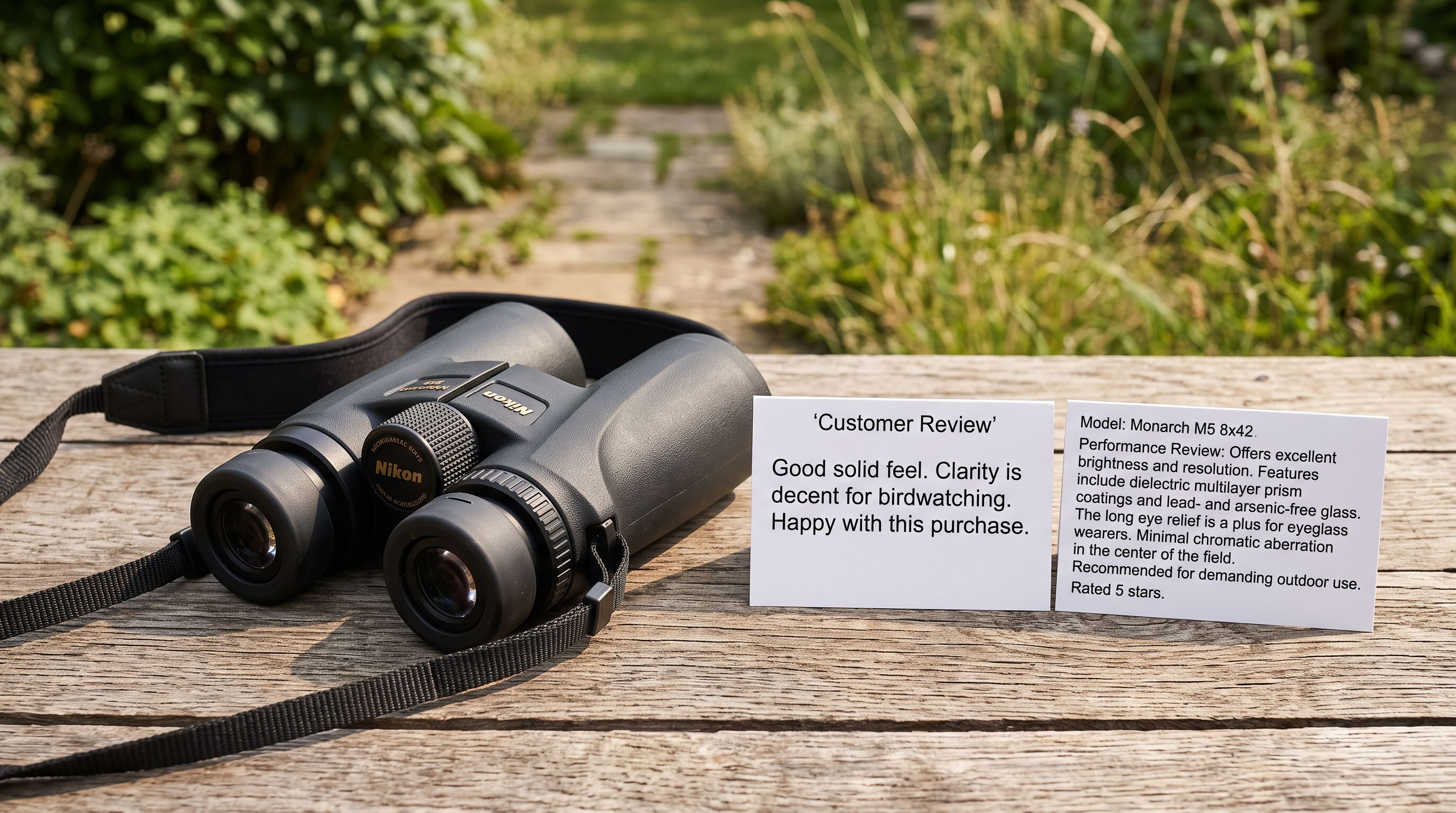
An outdoor sports merchant sells 8x42 binoculars for birdwatching. The shopify product reviews ai shopping signal for that listing comes in two flavours: "Great binoculars, really clear image, would recommend to anyone." And: "The ED glass resolved chromatic aberration even at 400m, the centre-focus wheel has minimal play, and they stayed clear after three hours in light rain." Both reviews are five stars.
A customer asks Google AI Mode: "which binoculars handle chromatic aberration well and stay clear in wet conditions?" The second review gives the model two attribute-specific matches. The first contributes nothing to that query.
Same product. Same rating. Different signal value to AI shopping agents.
What AI Shopping Agents Actually Read in Reviews
Star ratings matter. A product with a 4.8-star average from 200 reviews surfaces more confidently than a product with 3 reviews at 5.0. But for the major AI shopping surfaces (Google AI Mode, Perplexity Shopping, ChatGPT Shopping), the review data that drives product selection goes beyond the aggregated rating.
These agents read review content as an additional layer of product description. When a review mentions a specific attribute ("waterproof", "holds 20kg", "fits a 15-inch laptop"), the agent can use that attribute to answer buyer queries that the product description alone may not address. A review becomes a secondary source for product attribute data.
Google's review snippet documentation covers how structured review data feeds search features. What it does not cover is the content layer: the degree to which review text specificity, not just rating, influences which products appear in conversational AI shopping results.
shopify product reviews ai shopping: Why Content Specificity Matters
A buyer who reads "great binoculars with excellent clarity" before leaving a review writes "great binoculars with excellent clarity." That review adds nothing the product description did not already say.
A buyer who reads a description covering ED glass, chromatic aberration correction, waterproof rating, and field-of-view specifications reviews with those attributes in their vocabulary. The review mentions ED glass. It mentions chromatic aberration. It mentions rain performance. These are attributes the buyer absorbed from the description, experienced with the product, and reported back in the review.

- Adds no new attribute signal beyond star rating
- Cannot match attribute-specific buyer queries
- Contributes nothing when AI agent asks: what does this product do?
- Provides no disambiguation between similar products
- Invisible to faceted searches: waterproof? chromatic aberration correction?
- Adds attribute layer: ED glass, waterproof, centre-focus mechanics mentioned
- Can match queries: handles chromatic aberration, stays clear in rain
- Gives agent a product answer to attribute-specific questions
- Distinguishes this binocular from similar models
- Visible to faceted AI queries the description alone might not resolve
The implication for merchants is significant. Review quality is not random. It is downstream of product description quality. Merchants who write detailed, attribute-dense product descriptions receive detailed, attribute-dense reviews. Merchants with generic marketing copy receive generic reviews. Both sets of customers experienced the same product. The difference is in what vocabulary they had available when describing that experience.
The product description sets the vocabulary of the review. AI shopping agents read both. Most merchants improve only one.
This is the feedback loop that compounds over time. A merchant who improves their product descriptions does not just improve their description signal to AI agents. They shift the distribution of review content their products accumulate, improving the review signal incrementally with each new purchase.
The Description-Review Feedback Loop
The mechanism is straightforward. A buyer reading a product description absorbs its vocabulary. If the description says "ED glass eliminates chromatic aberration at long range", the buyer understands that chromatic aberration is a relevant attribute for this product. When they use the binoculars at long range and do not see chromatic aberration, they are more likely to mention it in the review because the description primed them to notice it.
A buyer reading "premium optics with exceptional clarity" has no specific attribute to look for and no attribute vocabulary to use in their review. Their experience may be identical. Their review will be generic.
This means the return on an AI description quality investment compounds beyond the description itself. A Shopify product with AI-generated descriptions that name specific attributes, use precise technical language, and address use-case scenarios produces buyers who review with that same level of specificity. Over a product's review lifetime, this shifts the product's aggregate review signal from generic to attribute-dense.

Importier's AI description generation uses industry personas to produce descriptions structured around the attributes specific to each product category. For optics, the persona generates descriptions covering magnification, glass quality, coating types, weatherproofing, and use-case scenarios. The buyer who reads it reviews at that level of specificity.
ai shopping agents review signals: How aggregateRating Markup Works in Shopify
The schema.org aggregateRating specification defines how structured review data is encoded for search engines and AI systems. Shopify does not generate aggregateRating markup natively; it requires a review app that outputs schema.org markup alongside the review display.
The aggregateRating property carries two values that AI agents use directly: ratingValue (the star average) and reviewCount (the number of reviews). A product with 200 reviews at 4.6 is preferred over a product with 4 reviews at 5.0 in most AI recommendation surfaces because the higher review count indicates the rating is statistically stable.
Beyond the aggregate, the individual Review objects (each with their reviewBody text) are accessible to search crawlers and AI systems that read the full product page. This is where review content specificity becomes load-bearing: the reviewBody text of each Review is additional attribute data the model can draw on when matching queries.
For Shopify merchants, the path to structured review markup runs through the review app:
- 01Step 1Confirm your review app outputs schema.org markup. Use Google's Rich Results Test on a product URL. The test shows whether aggregateRating and individual Review objects appear in the structured data output. If they do not, the review app may need its schema.org output enabled in settings.
- 02Step 2Improve description quality on your top-reviewed products first. Use Importier's Store Scanner to identify products with existing reviews but thin descriptions. These products have review signal already accumulating; improving the description improves future review specificity without touching existing reviews.
- 03Step 3Generate AI descriptions using a category-appropriate persona. For technical products (optics, electronics, tools), select a persona that generates attribute-dense language. For lifestyle products (apparel, homewares, beauty), select a persona that generates use-case and sensory-specific language. Both types give reviewers attribute vocabulary to work with.
- 04Step 4Add FAQs to high-traffic products using Importier's FAQ Generator. FAQ content addresses questions buyers typically ask before and after purchase. When a buyer has their question answered in the FAQ before purchasing, their review is more likely to address product performance rather than basic information queries. This shifts reviews toward attribute validation rather than question-asking.
- 05Step 5Monitor review content over a 60-90 day period after improving descriptions. Look for increases in reviews that mention specific product attributes (material, dimension, performance rating, use-case outcome). These are the reviews that add signal value to AI shopping recommendations. Generic five-star reviews with no attribute content do not improve AI recommendation visibility regardless of how many accumulate.

Category Metafields as the Structured Alternative
For products with thin review histories, category metafields provide structured attribute data that AI shopping agents can use in place of review content.
When a new Shopify product has three reviews and none of them mention specific technical attributes, the agent has no review content signal to draw on for attribute-specific queries. Category metafields fill that gap. An Industry Pack applied to the binoculars product during import produces structured attributes: magnification (8x), objective lens diameter (42mm), prism type (roof), waterproof rating (IPX7), field of view (372ft/1000yd). These appear as additionalProperty in the product's schema.org markup.
A buyer asking "8x42 binoculars that are waterproof" gets a match from the category metafield values, not from the review content. The guide to Shopify product data and AI shopping agents covers how structured attribute data functions as a complement to prose descriptions and review signals.
For merchants who import large catalogues with new products at low review volume, applying Industry Packs via Importier at import time establishes the structured attribute layer before reviews have time to accumulate. As the review history grows and buyers contribute attribute-specific content, the two signals compound.
The AI shopping landscape overview for Shopify merchants covers how Google, Perplexity, ChatGPT Shopping, and Amazon Rufus weigh different product data signals relative to each other. The consistent finding is that these surfaces are reading more data per product than traditional search, and reviews are part of that expanded reading.
Practical steps
What Review Apps to Use with Shopify
The practical requirement for review schema.org output narrows the field. Not all Shopify review apps output schema.org aggregateRating markup that Google and AI agents can read. The key check is the Rich Results Test: if the aggregateRating property appears in the structured data panel for your product URLs, the app is working. If it does not, schema.org output is either disabled in the app settings or the app does not support it.

Shopify's native product reviews feature outputs aggregateRating markup. Third-party apps including Judge.me, Yotpo, and Okendo generate schema.org markup. The shopify-product-page-faq guide covers structured FAQ content as a complement to review content for AI shopping signals.
Key Takeaways
The shopify product reviews ai shopping signal is two-layered: structured (aggregateRating count and score) and content-based (review text specificity). Merchants who improve only the star rating miss the content layer.
Key points:
- AI shopping agents read review content as a secondary product attribute source. A review that names specific attributes (material, dimensions, performance ratings) contributes to query matching beyond what the star rating provides.
- Review content specificity is downstream of product description quality. Buyers mirror the vocabulary of the description in their reviews. Improving description detail shifts future review content toward attribute-specific language.
- The feedback loop compounds: each new attribute-specific review adds to the product's content signal for AI recommendations, on top of the description's own signal.
- schema.org aggregateRating markup requires a review app that outputs structured data. Verify with Google's Rich Results Test. The markup must be present for AI agents to read the structured review signal.
- Review count matters for confidence: a 4.6 average from 180 reviews signals a more stable rating than 5.0 from 4 reviews. AI shopping surfaces account for this in recommendation confidence.
- Category metafields from Importier's Industry Packs provide structured attribute data that fills the signal gap for products with thin review histories, giving AI agents attribute-specific data before reviews accumulate.
Improve your product descriptions at importier.app and shift the vocabulary level of every review your products receive. AI description generation, Industry Pack metafields, and FAQ generation are available on the Growth plan and above.
Set up your first import in under five minutes.
Importier brings products into Shopify with AI descriptions, category metafields, and data enrichment on every run.