Shopify Scientific Equipment Import: Calibration Metafields
On this page
A scientific equipment distributor imported 400 instruments from their supplier's catalogue into Shopify. Titles, prices, vendor names, and product images transferred correctly. What did not arrive: measurement ranges, accuracy specifications, IP protection ratings, operating temperature ranges, output communication formats, and calibration certificate reference numbers. Each instrument arrived as a product with a model number and a price.
The consequence appeared within the first week. A research procurement officer arrived at the collection page looking for a dissolved oxygen analyser accurate to ±0.1 mg/L with an RS-232 output for direct data logging. Shopify's collection filters showed price, vendor, and in-stock status. There was no filter for measurement range, accuracy class, or communication interface. The buyer opened twelve product pages individually, reading specification tables buried in body HTML, and sent a quote request to the distributor's sales team instead of placing an order.
This is the structural problem with importing scientific and laboratory instruments through a standard product import workflow. The technical data that drives purchase decisions is not optional context. It is the decision itself.
Why Lab Instrument Catalogues Break Standard Import Workflows
A standard product import maps flat rows of data to Shopify's built-in product fields: title, description, SKU, vendor, price, weight. For most product categories, this covers the attributes buyers need to evaluate and purchase.
Laboratory instruments have a second tier of data with no home in standard Shopify fields. A digital pH meter has a title ("Portable pH Meter Model HI9813-6"), a price, and a vendor. It also has a pH measurement range (0.00 to 14.00), an accuracy class (±0.1 pH), a resolution (0.01 pH), an operating temperature range (0 to 50°C), an IP protection rating (IP67), a power source (1.5V AAA battery), and a calibration certificate number. That second tier is what allows a buyer to determine whether the instrument suits their application.
Without a metafield schema defined before the import, those attributes have nowhere to go except the product description body as a plain text table. Plain text tables in body HTML are invisible to Shopify's collection filter system. A buyer who needs to filter instruments by IP rating or accuracy class gets nothing from a filter panel that reads "by price" and "by vendor."
The same problem applies across the full range of scientific and laboratory instruments: balances and scales (capacity, readability, pan size), centrifuges (max RPM, g-force, rotor compatibility), spectrophotometers (wavelength range, bandwidth, light source type), pipettes (volume range, accuracy, tip compatibility), and environmental chambers (temperature range, humidity range, uniformity specification).
Specification Metafield Schema for Lab Instruments
Before importing laboratory instruments, define the metafield schema that will hold the technical specification data. The schema varies by instrument category, but a cross-category core set covers the majority of lab instrument types.
Measurement Range (single_line_text): the operating range of the instrument's primary measurement function. "0.00 to 14.00 pH", "0 to 500°C", "-80 to +200°C", "0.001 to 50 mL". This is the first criterion buyers apply when determining instrument suitability.
Accuracy (single_line_text): the accuracy at reference conditions. "±0.01 pH", "±0.1°C", "±0.5% of full scale". Store as text, not a number, because the format includes units and ± notation. Filter facets require a controlled accuracy class vocabulary rather than free text.
Resolution (single_line_text): the smallest detectable increment. "0.001 pH", "0.1°C", "0.01 mg". Relevant for buyers who need precision above a given threshold.
IP Protection Rating (single_line_text with controlled vocabulary): the ingress protection classification under IEC 60529. "IP54", "IP67", "IP68". A controlled vocabulary enables filtering for wet laboratory, outdoor field, and food processing deployments.
Operating Temperature (single_line_text): the environmental range within which the instrument meets specification. "0 to 50°C", "-10 to +60°C". Relevant for cold-room and field deployments.
Communication Output (list.single_line_text): the data output interfaces. ["RS-232", "USB", "Bluetooth", "Analogue 4-20mA"]. Multiple values apply where wired and wireless outputs coexist.
Power Source (single_line_text): power supply type. "3x AA alkaline batteries", "Rechargeable Li-ion, USB-C". Relevant for field versus laboratory deployment.
Compliance Standards (list.single_line_text): international standards the instrument meets. ["IEC 60529", "CE", "UKCA", "ASTM E1-14"]. Stored as a list to accommodate multi-standard products.
Importier's product specifications auto-fill extracts specification values from supplier data files and populates metafield definitions without manual row-by-row entry. For a 400-instrument catalogue, the alternative is a post-import bulk edit session that takes as long as the original import.
Calibration Certificate References as Product Metafields
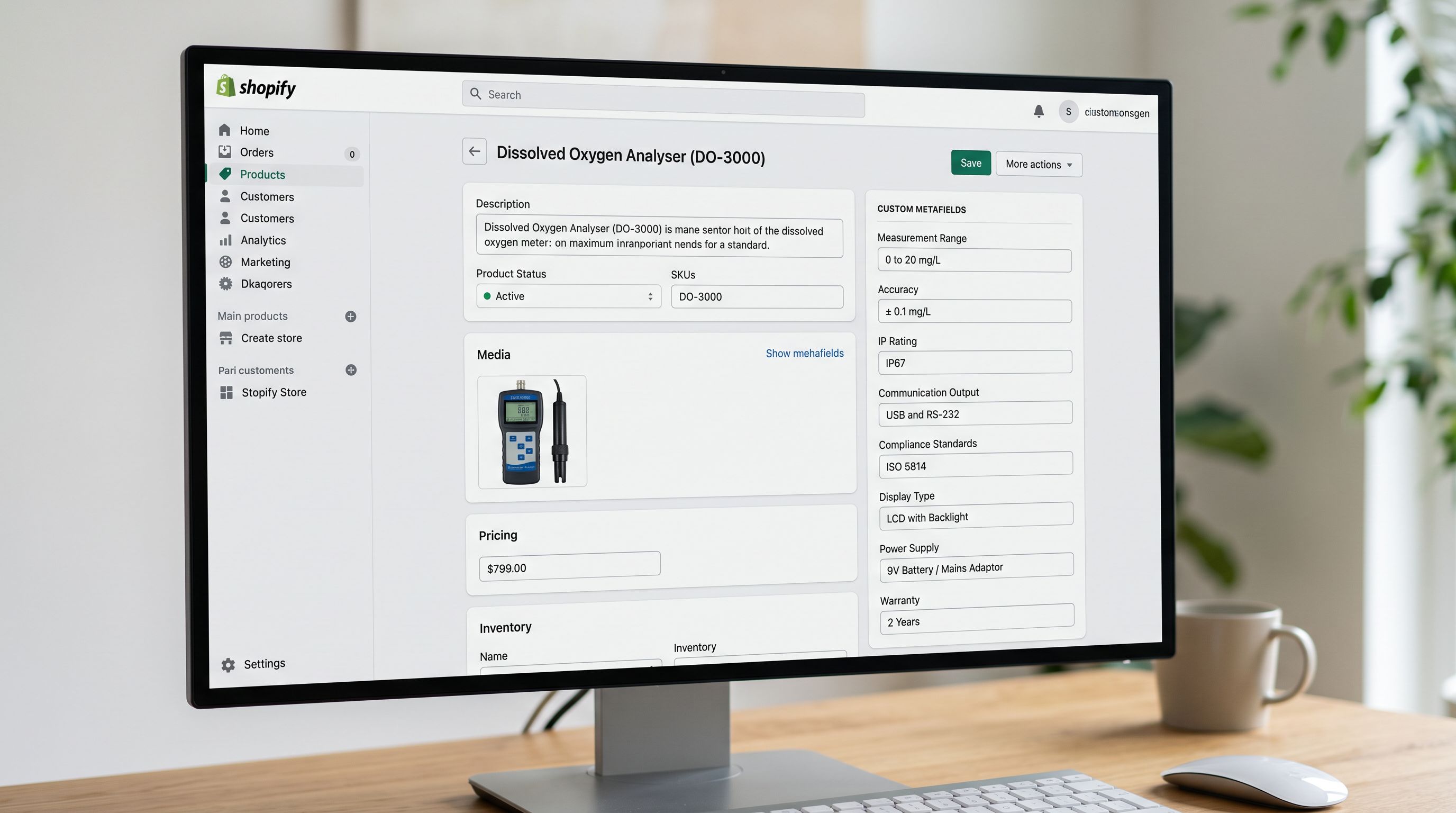
Many laboratory instruments ship with a manufacturer's calibration certificate: a document that records the instrument's measured performance against a traceable reference standard at the time of manufacture or most recent service. For buyers in regulated industries (pharmaceutical manufacturing, clinical laboratories, food processing, environmental monitoring) the calibration certificate is a procurement prerequisite.
The calibration certificate data that belongs in structured metafields:
Certificate Number (single_line_text): the unique reference number printed on the certificate. "CAL-2026-088742". This allows buyers and procurement teams to match the Shopify product to a specific certificate document without contacting the distributor.
Calibration Date (date type): the date calibration was performed. A date metafield lets a storefront display "Calibrated: March 2026" on the product page. Most quality management systems require recalibration within 12 months.
Calibration Standard (single_line_text): the traceable reference standard. "NIST-traceable", "UKAS-accredited", "ISO/IEC 17025 certified laboratory". This is the metrological traceability statement regulatory auditors look for.
Next Calibration Due (date type): the recalibration due date, when the manufacturer specifies a recalibration interval. Allows procurement teams to plan maintenance schedules before purchase.
Storing calibration data in structured metafields rather than in the product description has a practical benefit beyond filtering: product certifications displayed as trust signals directly on the product page reduce the number of pre-purchase enquiries to the distributor's technical sales team.
Configuration Variants
Handling Configuration Variants
Laboratory instruments frequently come in configuration variants that represent meaningfully different products rather than colour or size options. A digital thermometer sold in four probe configurations (general-purpose NTC, thermocouple type K, thermocouple type J, and surface probe) has different accuracy specifications, different operating ranges, and different applications for each configuration. These are not interchangeable choices like a t-shirt in different colours.
The configuration variant dimensions most common in lab instrument catalogues:
Probe or Sensor Type: the primary measurement element. A pH meter with a general-purpose glass electrode and the same meter with a combination electrode for high-protein matrices have different accuracy specifications and applications.
Measurement Range Tier: a laboratory balance in 220g/0.001g and 620g/0.01g configurations shares the same platform but represents a product-level choice between maximum capacity and readability.
Communication Interface: instruments sold with or without a specific output (RS-232, Bluetooth, 4-20mA) are distinct SKUs. The interface selection at purchase is binding.
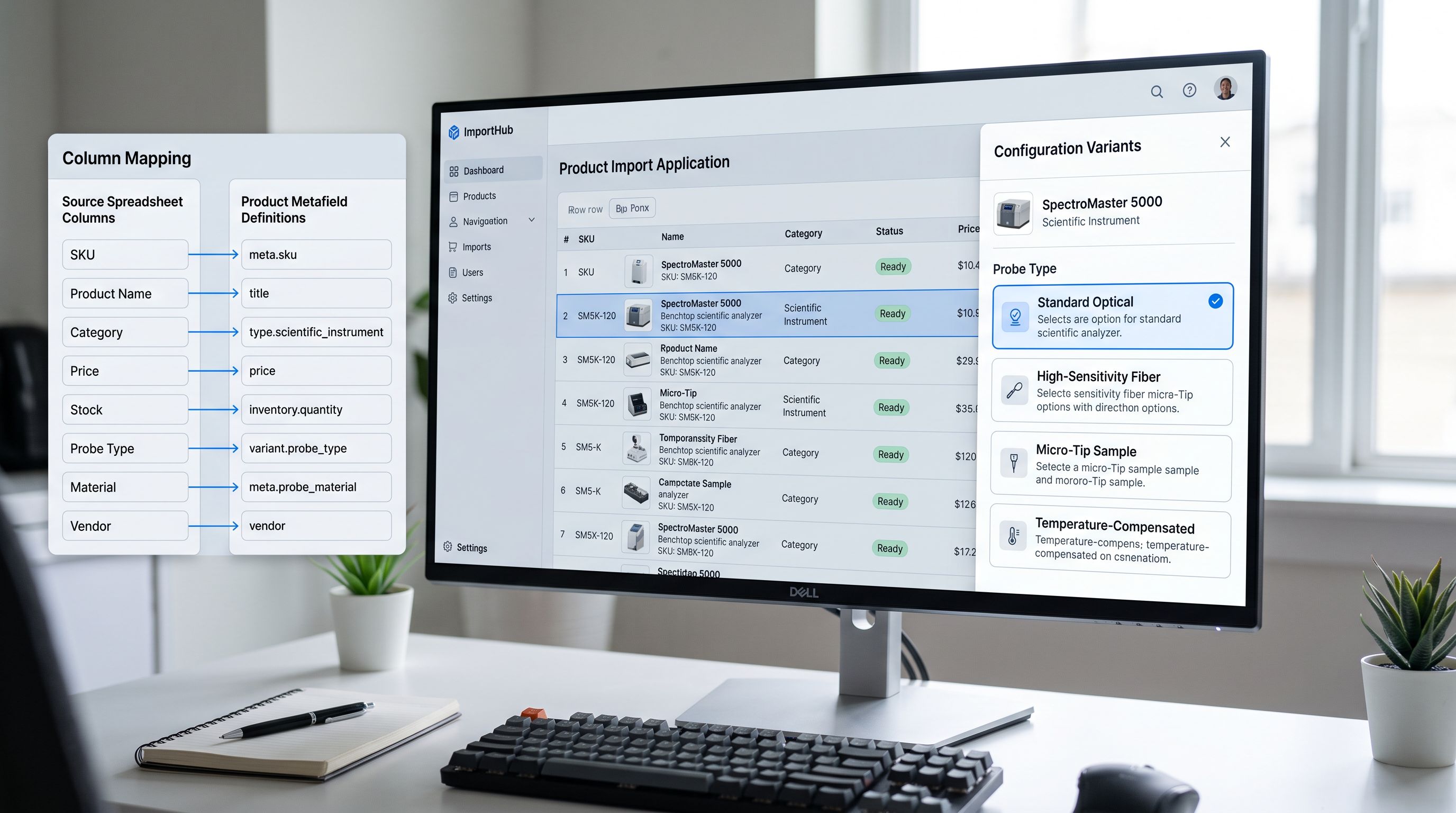
The import structure decision: configuration variants that share the same base model, the same body, and the same price bracket should be structured as Shopify variants with the configuration dimension as a named option (e.g., "Probe Type: General Purpose NTC | Thermocouple K | Thermocouple J | Surface"). Variants with substantially different price points or accuracy classes should be structured as separate products cross-referenced via a "Compatible With" or "Same Platform" metafield.
- 01Define the metafield schema in Shopify admin before beginning the importcreate definitions for Measurement Range, Accuracy, IP Rating, Communication Output, Compliance Standards, Certificate Number, and Calibration Date; set value types appropriate to each field before any import runs
- 02Map supplier file columns to metafield definitions in the import column mapping stepthe supplier's 'Accuracy' column maps to the Accuracy metafield, 'Cert No' maps to Certificate Number, 'Calibration Date' maps to the date metafield; columns absent from the supplier file are flagged for post-import enrichment
- 03Set the variant grouping key to the base model identifier, not the full SKU including configuration suffixa supplier who exports 'HI9813-6-JP' and 'HI9813-6-GP' as separate rows intends both to be variants of HI9813-6; the grouping key strips the suffix and groups the rows
- 04Configure the variant option name to reflect the configuration dimension'Probe Type' rather than the generic 'Option1'; Importier's column mapping step applies a fixed label to the option name field for all rows in the batch
- 05Run AI description generation after all metafields and variants are confirmedselect the Technical Writer or Laboratory Equipment persona; set description style to Benefits-First to open with the measurement application before the specification list
Compliance and Regulatory Standards as Filterable Attributes
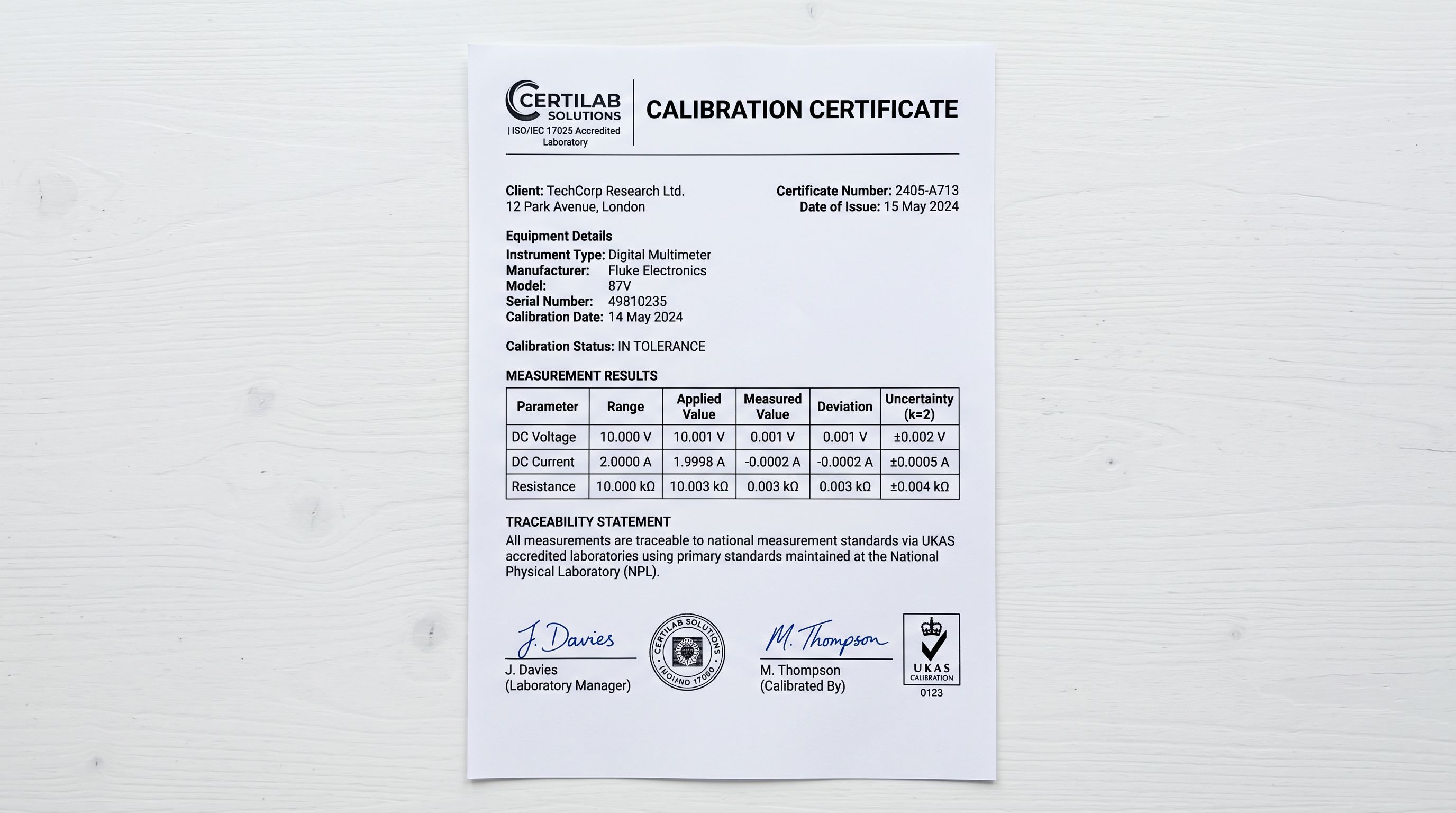
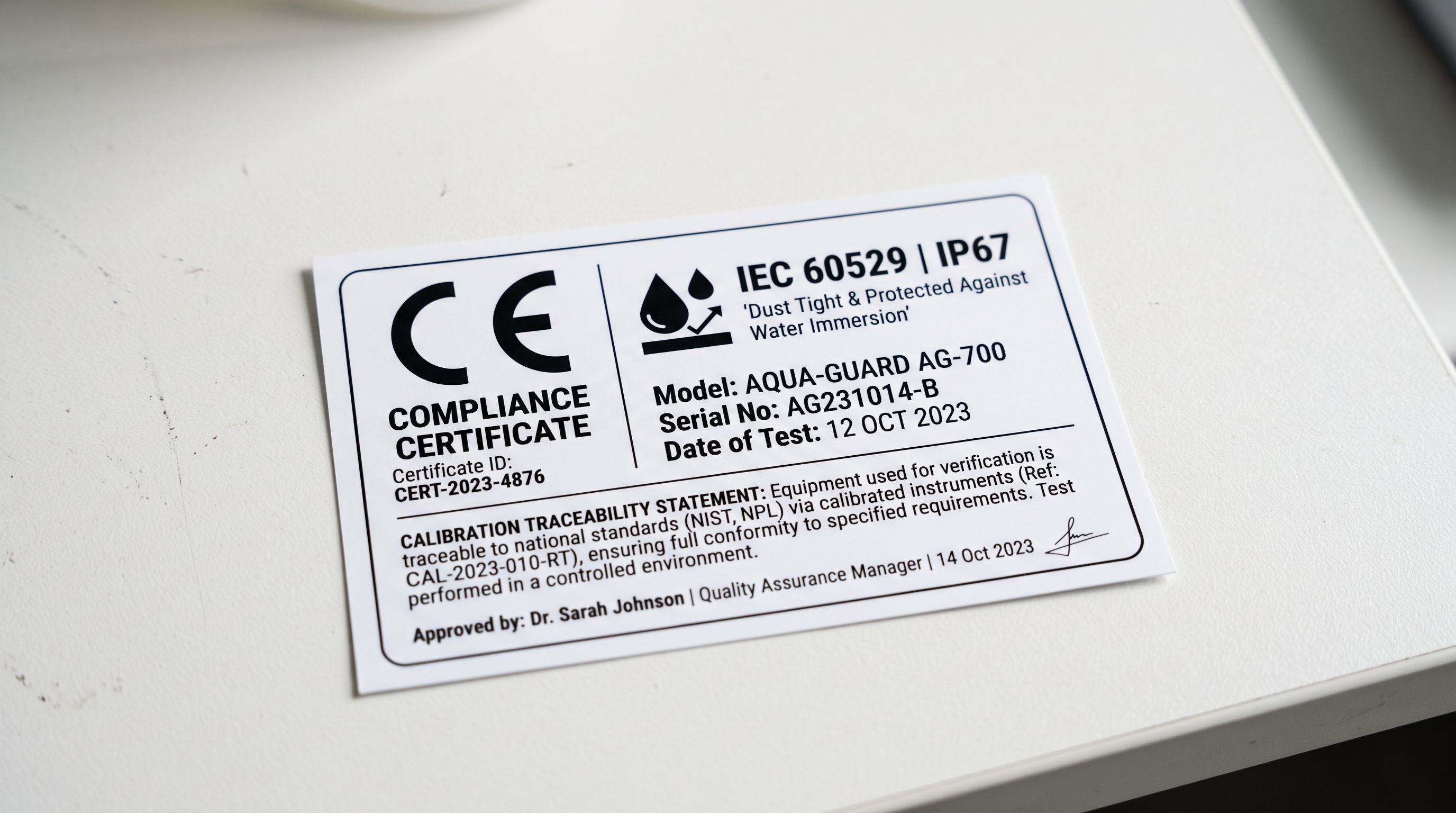
Regulated sector procurement (pharmaceutical GMP, food manufacturing HACCP, ISO 17025 accredited laboratories, environmental monitoring) requires compliance documentation before a purchase order is raised. The import product compliance workflow covers general compliance attribute handling; for laboratory instruments, the key distinction is that a single instrument may simultaneously carry CE marking, IP67 certification under IEC 60529, and conformance to a measurement standard such as ISO 5814. These are distinct certifications with distinct meanings.
Storing the compliance list in a list.single_line_text metafield (one standard per item) enables simultaneous multi-standard filtering: "CE AND IEC 60529 IP67". A plain text "Compliance: CE, IP67, ISO 5814" in the body HTML cannot support that query.
Regulatory procurement requirements are structured constraints, not text notes. Storing compliance certifications as individual list values, not as a comma-separated string in body HTML, is what allows a buyer to filter an instrument catalogue by certification before reading a single product description.
AI Descriptions for Technical Instruments
The failure mode for AI-generated descriptions of laboratory instruments is specification recitation: a description that lists measurement range, accuracy, resolution, IP rating, and power source in sequence without connecting those specifications to the buyer's application. Specification recitation is a catalogue page, not a product description.
The difficulty is that the buyer's application is the right starting point, but the application is not always obvious from the instrument title. A dissolved oxygen analyser with a measurement range of 0 to 20 mg/L and an IP67 rating is used by aquaculture operators monitoring tank oxygen levels, environmental scientists sampling river water in the field, and wastewater treatment operators verifying effluent quality. The same specifications serve three different buyers with three different end uses.
Importier's approach: select a description persona matched to the instrument's primary buyer category, then allow the specification metafields to appear as supporting evidence for the application claim rather than as the opening statement. The Personnel-in-Environment description pattern, which opens with the measurement scenario rather than the instrument, produces copy that reads as a technical recommendation rather than a datasheet excerpt.
An application-first description for a field-portable dissolved oxygen analyser: "Aquaculture operators and field researchers working in wet environments need a dissolved oxygen meter that performs reliably through rain, humidity, and temperature variation. This analyser measures from 0 to 20 mg/L at ±0.1 mg/L accuracy, carries an IP67 waterproof rating (IEC 60529), and connects to data loggers via RS-232 or USB. Calibration certificate NIST-traceable, issued March 2026."
This description opens with the deployment scenario before the specification. The specifications appear as evidence that the instrument suits the scenario. The calibration certificate reference appears at the close as a procurement-relevant detail.
The critical input for accurate descriptions is a product title that names the instrument's primary measurement function and application category rather than a model code. "Field Portable Dissolved Oxygen Analyser with RS-232 Output" produces application-oriented descriptions; "DOA-H98-JP-232-IP67" does not.

Consumables and Accessories as Related Products
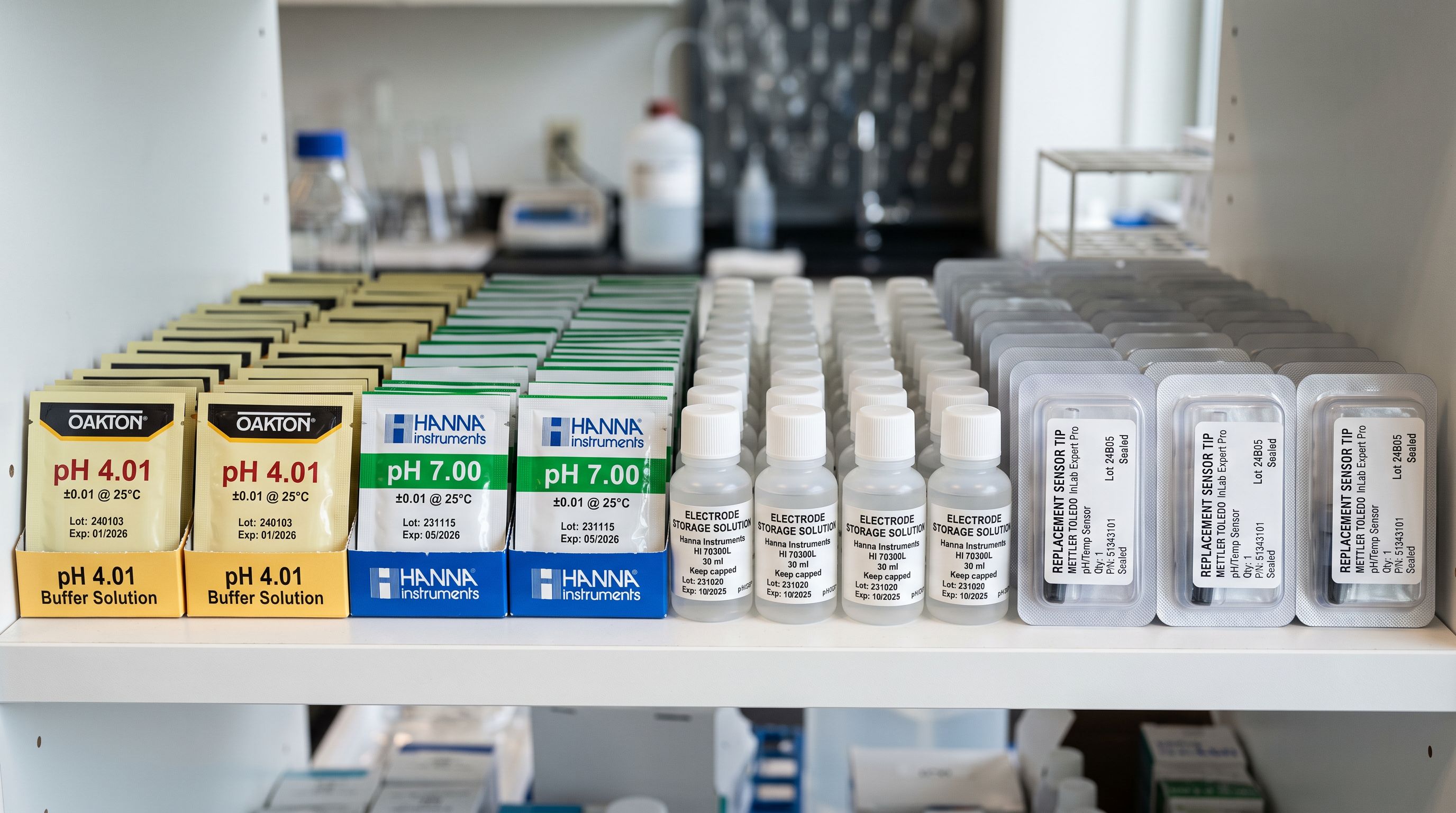
Laboratory instruments generate recurring purchases: calibration buffers, replacement probe tips, reagent kits, and electrode storage solutions. A buyer who purchases a pH meter returns for consumables on a predictable schedule.
Connecting instrument products to compatible consumables via a required_consumables metafield (list.single_line_text, populated with consumable SKUs) allows storefront themes to display a "Required Consumables" section directly on the instrument product page. This cross-reference data typically arrives in a separate supplier compatibility table rather than columns in the main product file.
- 400 instruments imported with title, SKU, vendor, and price; specification data in body HTML as plain text tables invisible to filters
- Buyers cannot filter by measurement range, accuracy class, or IP rating: each instrument must be read individually to determine suitability
- Calibration certificate numbers in description text: buyers must contact sales to verify certification status
- Compliance standards as a comma-separated string in body: cannot filter by individual standard
- Configuration variants grouped by SKU suffix with generic Option1 label; option names do not reflect the configuration dimension
- AI descriptions open with model code and feature list; no connection to the buyer's deployment scenario
- Specification metafields populated at import: Measurement Range, Accuracy, IP Rating, Communication Output, Compliance Standards all filterable in collection facets
- Buyers filter dissolved oxygen analysers by IP67, RS-232 output, and accuracy class before opening a single product page
- Calibration Certificate Number and Calibration Date as date-typed metafields; storefront displays calibration status and due date on the product page
- Compliance standards list enables filtering by individual standard: CE AND IEC 60529 AND ISO 5814 simultaneously
- Configuration variants correctly named: Probe Type option with General Purpose, Thermocouple K, Thermocouple J, Surface values
- AI descriptions open with the measurement application and deployment scenario; specifications as supporting evidence
The scientific equipment distributor rebuilt their 400-instrument catalogue with a metafield schema defined before the import: eight specification fields, three calibration certificate fields, and a compliance standards list. Importier's column mapping populated the specification fields from the supplier's existing specification columns. Calibration certificate data arrived in a separate column that mapped directly to the Certificate Number metafield. AI descriptions generated using a Laboratory Equipment persona with a Benefits-First style produced application-oriented copy across the full catalogue in a single pass. The procurement officer who had previously requested a sales call returned, applied three filters to the dissolved oxygen analyser collection, and placed an order within four minutes.
Try Importier free at importier.app.
Set up your first import in under five minutes.
Importier brings products into Shopify with AI descriptions, category metafields, and data enrichment on every run.