# Shopify Product Data and Customer Retention: LTV Impact
> How product data decisions made at import time directly affect returns rates, support ticket volume, repeat purchase rates, and customer LTV.
- Published: 2026-09-29
- Author: Importier Team
- Category: Store Management / Compliance & Logistics
- Canonical: https://www.importier.app/blog/shopify-product-data-customer-retention
---
A homewares retailer imported 800 products from their supplier's catalogue into Shopify. The import took two days. Titles, images, prices, and SKUs transferred correctly. Dimensions, materials, care instructions, and compatibility notes stayed in the supplier file. The product data that buyers use to evaluate purchases at the point of decision was absent from the live store.
Ninety days later, the returns rate for the imported catalogue was 14.2%. The post-return survey showed 38% of returns citing "dimensions different from expected" or "product not as described." In the same period, the support inbox received 847 tickets. A review of those tickets found that 31% contained questions the supplier file had already answered: what materials the product uses, what care instructions apply, what size variants fit which spaces.
The data that would have prevented those returns and support tickets was never imported. The product data decisions made in the initial import determined the post-purchase experience for every customer who bought from that catalogue over three months.

## Why Returns Point Back to Import Decisions
Returns and support tickets are trailing indicators. By the time they arrive, the product data decision that caused them was made weeks earlier, during the import mapping step. The connection is rarely visible to the teams handling returns and support. They see the symptom, not the cause.
The most common cause of dimension-related returns is not that buyers misread the product page. It is that the product page shows dimensions in body HTML as a prose sentence ("This table measures approximately 180cm wide by 90cm deep") while the buyer was filtering by a dimension range in a collection. The filter used a structured metafield. The product page used plain text. The filter correctly excluded the product; the buyer found it by searching anyway and purchased without seeing the structured filter values.
Structured specification data and body text in product descriptions serve different functions. Structured metafields feed collection filters, recommendation engines, and comparison tools. Body text describes the product for a buyer who has already decided to read. A buyer who found the product through a filter implicitly trusted the filter criteria. When the product page does not confirm the filter criteria because the dimensions are in a paragraph rather than a metafield, returns follow.
Returns and support tickets are trailing indicators of import-time decisions. The specification data that prevents returns (dimensions, materials, compatibility) needs to be in structured metafields, not in body text, to serve the filter-driven buyer who purchased based on collection criteria.
## The Three Specification Gaps That Drive Returns
Not all missing product data drives returns at the same rate. Three specification categories consistently appear in post-return surveys across product types.
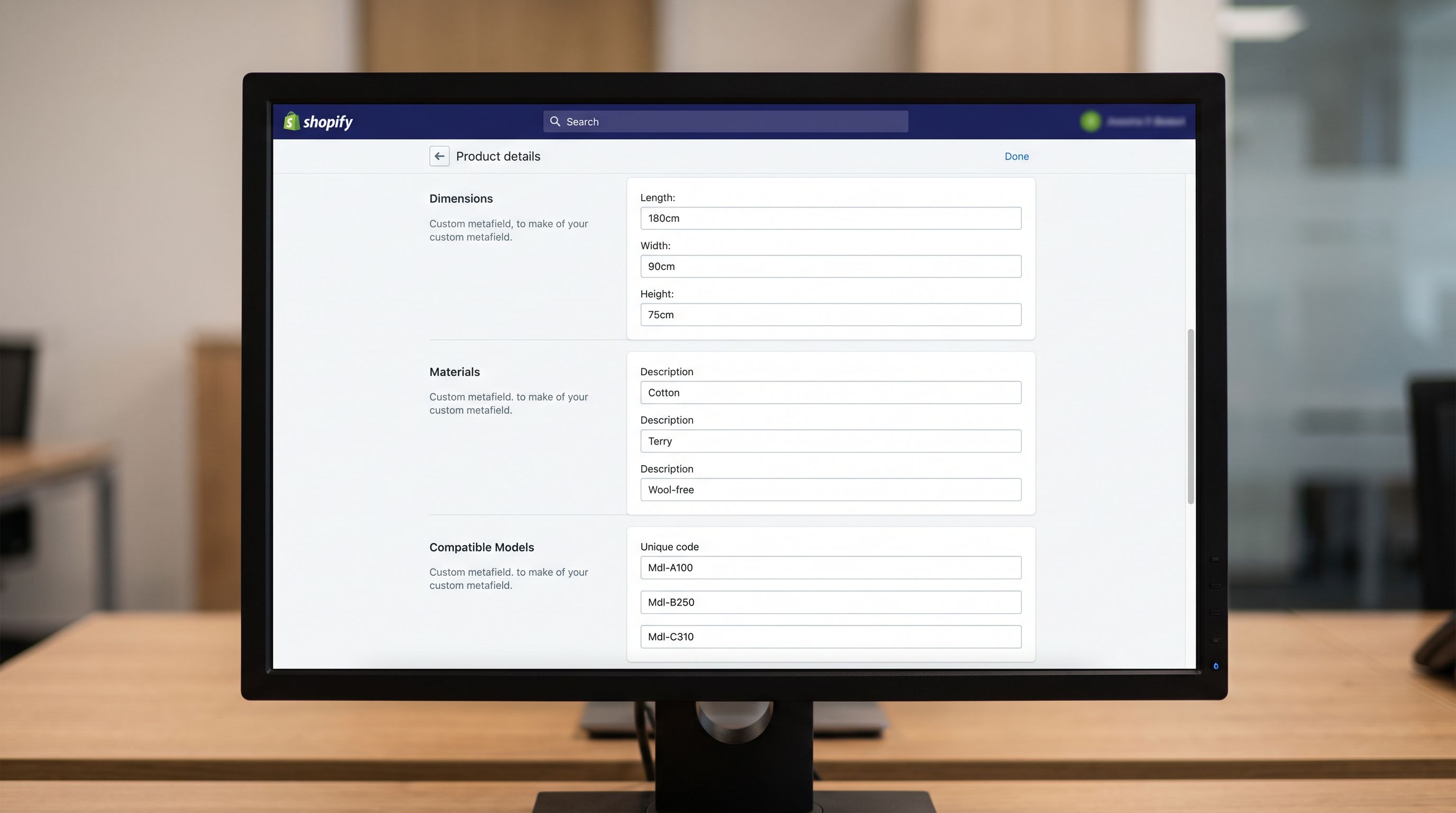
**Physical dimensions in body text rather than metafields.** A buyer who filters a rug collection by "200cm x 300cm" and finds a product with those values in a "Dimensions" metafield purchases with confidence. A buyer who finds the same product through a search, reads "approximately 2m x 3m" in the description, purchases, and receives a product that does not fit the space they measured has a dimension-related return. The specification was present; it was not in a structured field that the buyer's decision process could verify.
**Material and composition as a non-searchable attribute.** A buyer with a specific requirement (wool-free, latex-free, food-safe certification) searches for that requirement. If the product has the attribute in a flat description paragraph but not in a searchable metafield, the buyer cannot filter for it. They may purchase a product that does not meet their requirement based on an assumption rather than a confirmed attribute. Material-related returns are systematically preventable by importing the material composition column from the supplier file to a structured metafield rather than merging it into the description body.
**Compatibility fields missing or unlinked.** Replacement parts, consumables, accessories, and components have compatibility requirements. A replacement filter that fits three specific appliance models has three model numbers in the supplier file. Those three model numbers imported as a `compatible_models` list metafield allow a buyer to confirm compatibility before purchase. The same three model numbers in a description paragraph ("compatible with Model X, Model Y, and Model Z") are readable but not searchable, not filterable, and not available to recommendation engines.
## Support Ticket Volume as a Data Completeness Metric
Support tickets that answer questions already present in the supplier file represent a measurable overhead cost with a preventable cause. The cost is not just the support team's time per ticket. It includes the delay between purchase and question, the delay between question and answer, and the buyer experience of purchasing without the information they needed.
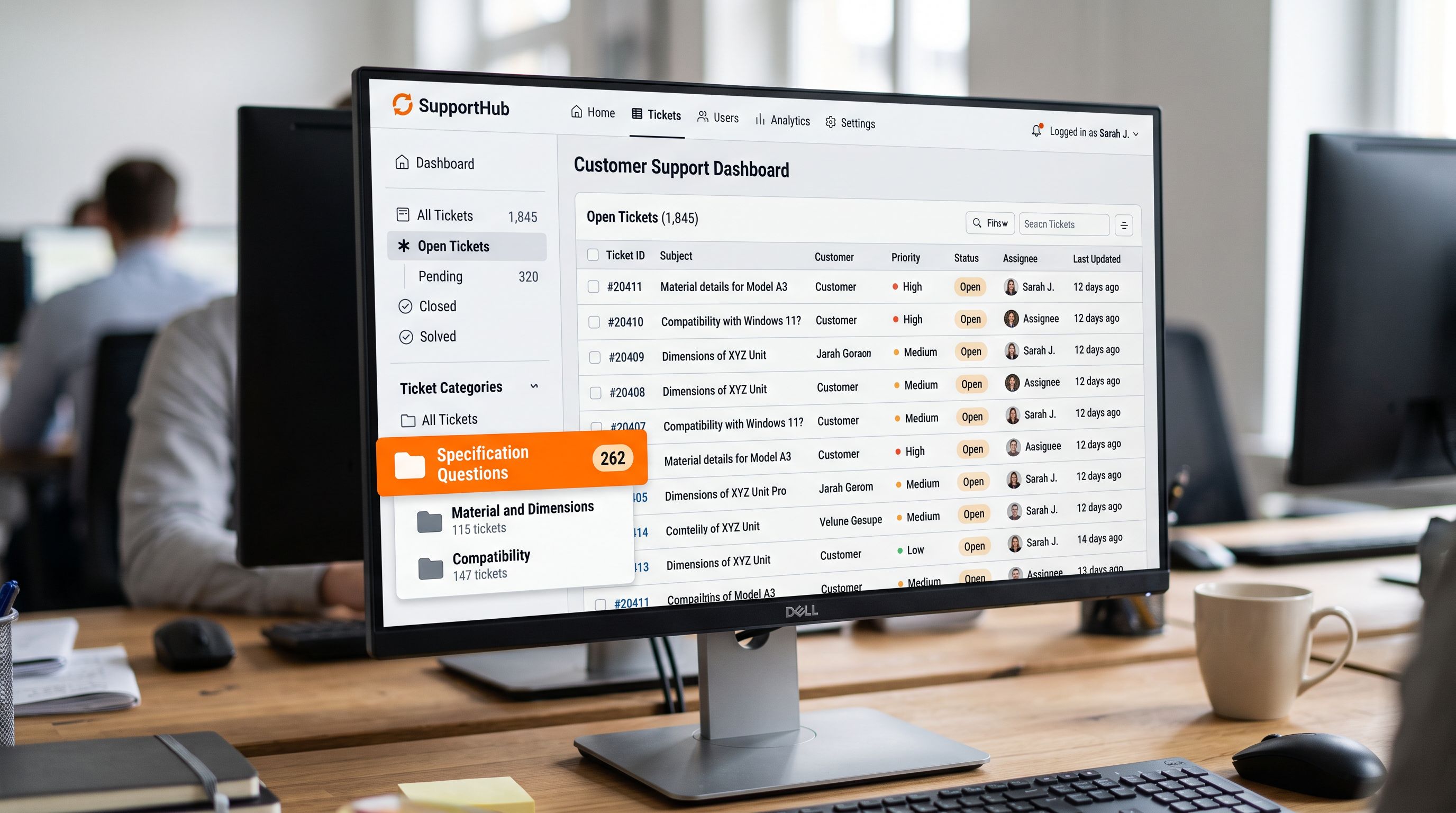
For the homewares retailer's 847 tickets over 90 days, 262 were specification questions with answers in the supplier file. At an average handling time of 8 minutes per ticket, the specification-related tickets consumed approximately 35 hours of support time in 90 days. The specification data was present in the original import file and would have taken under an hour to map to the appropriate metafields during the import process.
The support ticket deflection model works in one direction: complete specification data reduces inbound support volume. It does not mean buyers never have questions, but it reduces the proportion of questions that arise from gaps in product data rather than from genuine product complexity.
Three supplier file columns that consistently deflect support tickets when imported as structured fields:
**Care and maintenance instructions.** A textile product's care instructions are the most common inbound support question category for homewares, apparel, and soft furnishings. Importing care instructions as a `care_instructions` metafield that renders on the product page reduces inbound questions to edge cases rather than standard-product questions.
**Technical specifications for electronics and appliances.** Power requirements, input/output specifications, compatibility standards (USB-C, Bluetooth version, Wi-Fi protocol) are frequent pre-purchase questions. These specifications are present in nearly every supplier file for technical products and are consistently ignored at import.
**Assembly and installation requirements.** Furniture, fixtures, and flat-pack products generate assembly-related pre-purchase questions: "Does this require tools?", "Is it wall-mounted or freestanding?", "What fixings are included?" Assembly requirements in a structured field reduce these questions and also reduce returns from buyers who purchase without realising the installation requirements.
Specification questions represent the most preventable category of support inbound. Every question answered by a metafield on the product page is a support ticket that does not need to be raised.
## How Metafields Enable Repeat Purchase
Repeat purchase rates are driven by recommendation relevance. A buyer who purchases a bath mat from a homewares store and receives a recommendation for a matching bath towel in the same material and colour family is more likely to return than a buyer who receives a recommendation for a random item from the same collection.
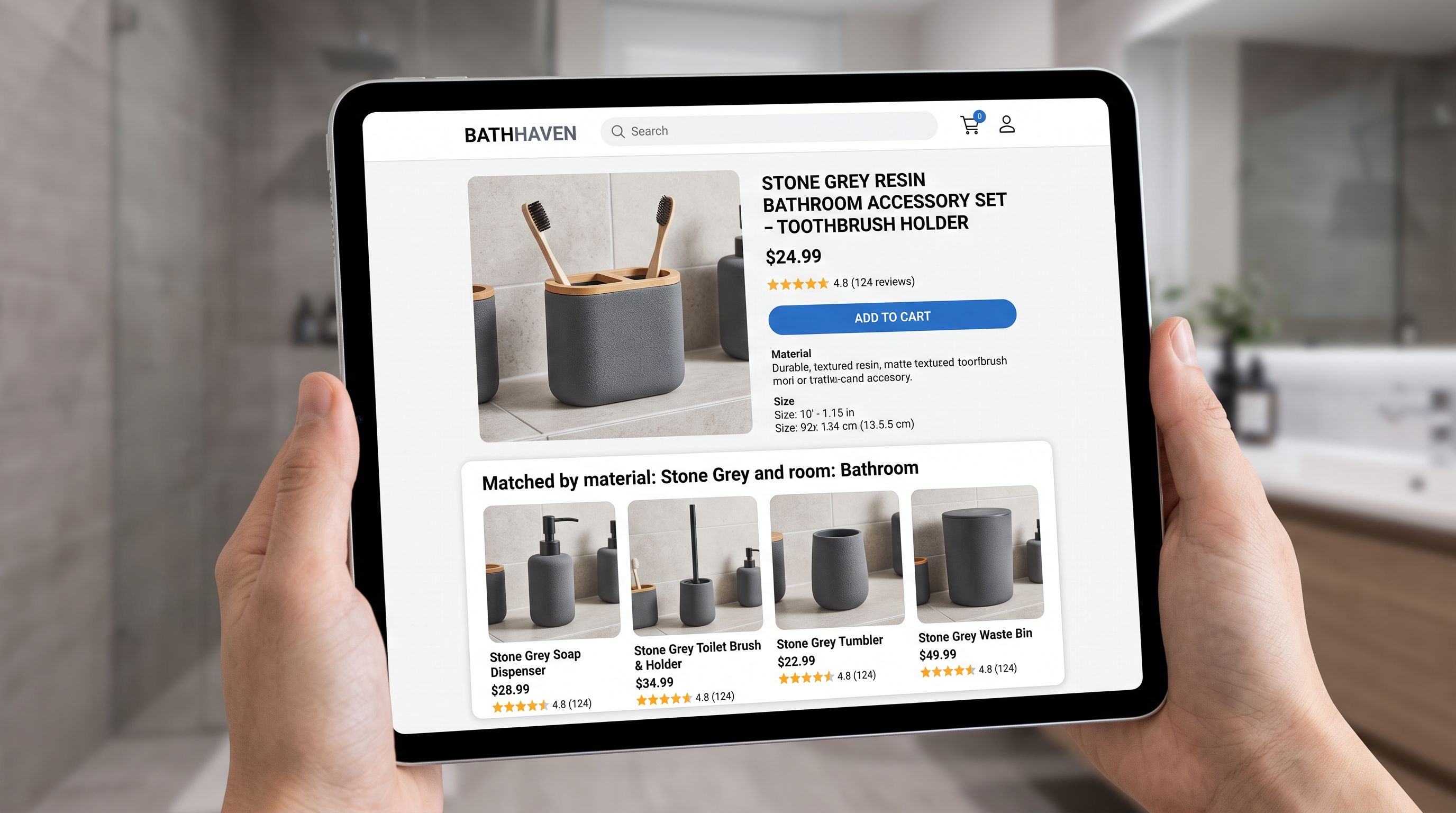
Structured metafields are the data source that makes material-and-colour-family recommendations possible. A `primary_material` metafield with a value of "cotton terry" and a `colour_family` metafield with a value of "stone grey" give a recommendation engine two filterable dimensions for matching products. A description paragraph that says "crafted from soft cotton terry cloth in a natural stone grey colourway" is not queryable by a recommendation algorithm.
The relationship between import-time decisions and repeat purchase rates operates through three recommendation types:
**Category affinity recommendations.** A buyer who purchases from the bath accessory category sees recommendations from bath accessories. If all bath accessories have a `room` metafield with value "bathroom" imported from the supplier taxonomy, the recommendation filter is precise. Without the metafield, the recommendation relies on collection membership, which may include products from multiple room categories.
**Material consistency recommendations.** A buyer who purchases a natural-fibre product is more likely to respond to other natural-fibre products. A `fibre_type` or `material_type` metafield imported from the supplier's specification column enables this filter. Body text descriptions that describe "luxurious natural materials" do not.
**Variant-specific recommendations.** A buyer who purchases the queen-size variant of a bedding product may respond to recommendations for the matching pillow case in the same size. [Variant-specific descriptions and metafields](https://importier.app/blog/shopify-variant-descriptions) imported at the variant level (rather than at the product level) give recommendation systems the variant dimension to match on.
## Building a Product Data Standard for LTV
A product data standard that optimises for LTV rather than just conversion treats specification data as retention infrastructure rather than optional description context. It is established at the import mapping step and applied consistently across every import from a given supplier category.
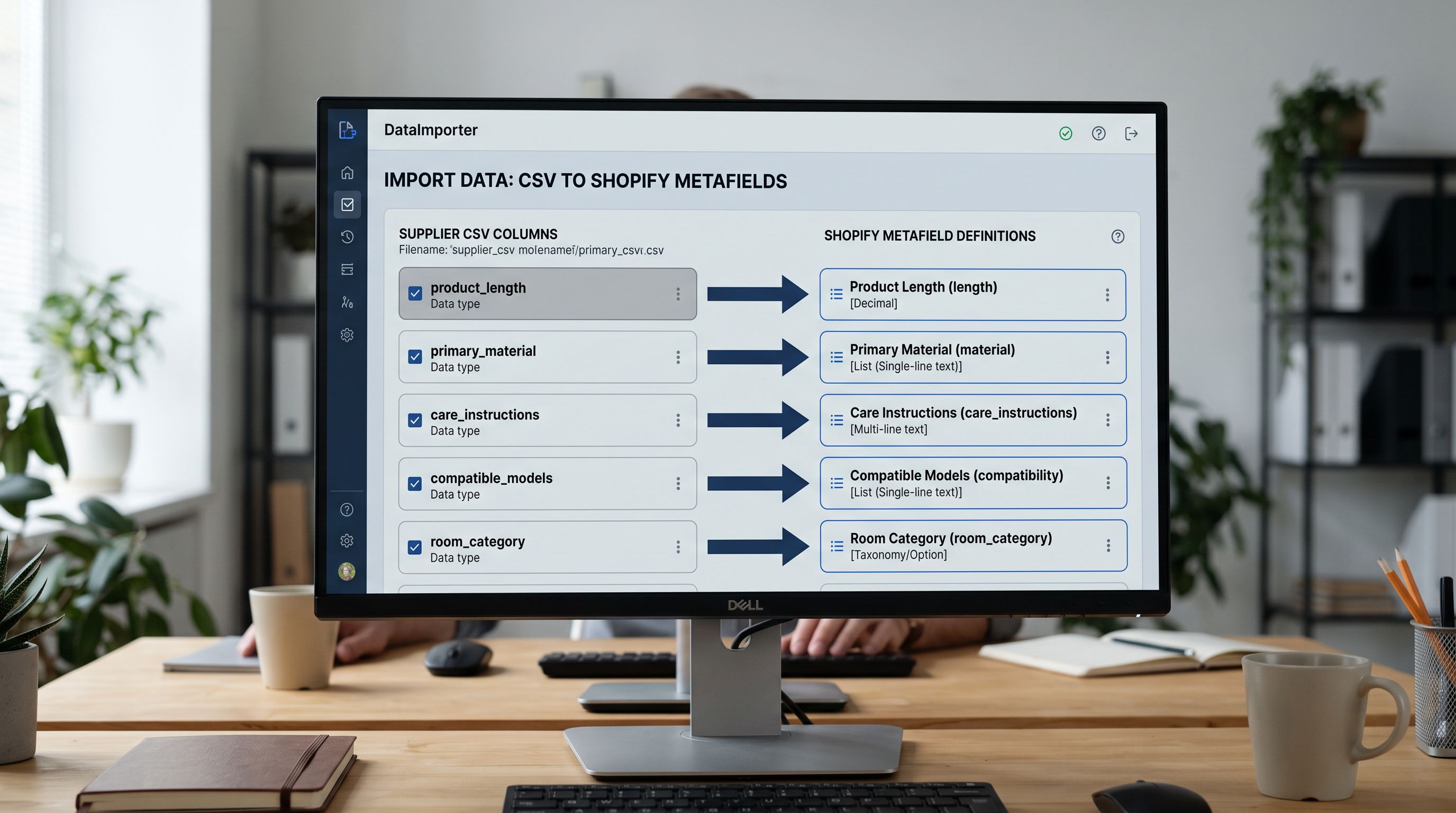
The five-field retention standard for homewares and general merchandise:
**Physical dimensions as structured metafields.** Separate fields for length, width, height, and weight. Not a combined "Dimensions" text field. Each dimension as a number_decimal metafield with a unit. Enables filtering, reduces dimension-related returns.
**Material composition as a list metafield.** Primary material as a single_line_text field. Secondary materials as a list.single_line_text for multi-material products. Enables material-based filtering and recommendations, reduces material-related returns and support questions.
**Care instructions as a structured field.** A single_line_text metafield rendering as a formatted section on the product page. Deflects the highest-volume support ticket category for soft goods and apparel.
**Compatibility or fit guide.** A list.single_line_text metafield for product codes, model numbers, or size references the product is compatible with. Reduces compatibility-related returns and enables cross-sell recommendations.
**Category and room/application taxonomy.** A controlled vocabulary metafield matching the Shopify standard taxonomy. Enables collection filter precision and recommendation engine filtering by application category.
A [product data quality audit](https://importier.app/blog/shopify-product-data-quality) before an import run identifies which of these five fields the supplier file contains and which require post-import enrichment. Supplier files vary: some include all five in separate columns, others include one or two, others include none. The audit determines the scope of the enrichment pass required to reach the retention standard.
For products where the supplier file does not include structured specification data, Importier's AI enrichment can extract dimension values from product title text, infer material composition from product type and description, and populate the five retention fields from the available product data.
According to [Shopify's research on ecommerce returns](https://www.shopify.com/blog/ecommerce-returns), providing complete product information is among the most effective interventions for reducing returns rates, more so than lenient return policies. Product information is a pre-purchase intervention; return policies are a post-purchase intervention. A well-written [delivery and returns policy on the product page](https://importier.app/blog/shopify-delivery-returns-product-page) manages expectations, but it cannot substitute for the specification data the buyer needs to make the right purchase decision.
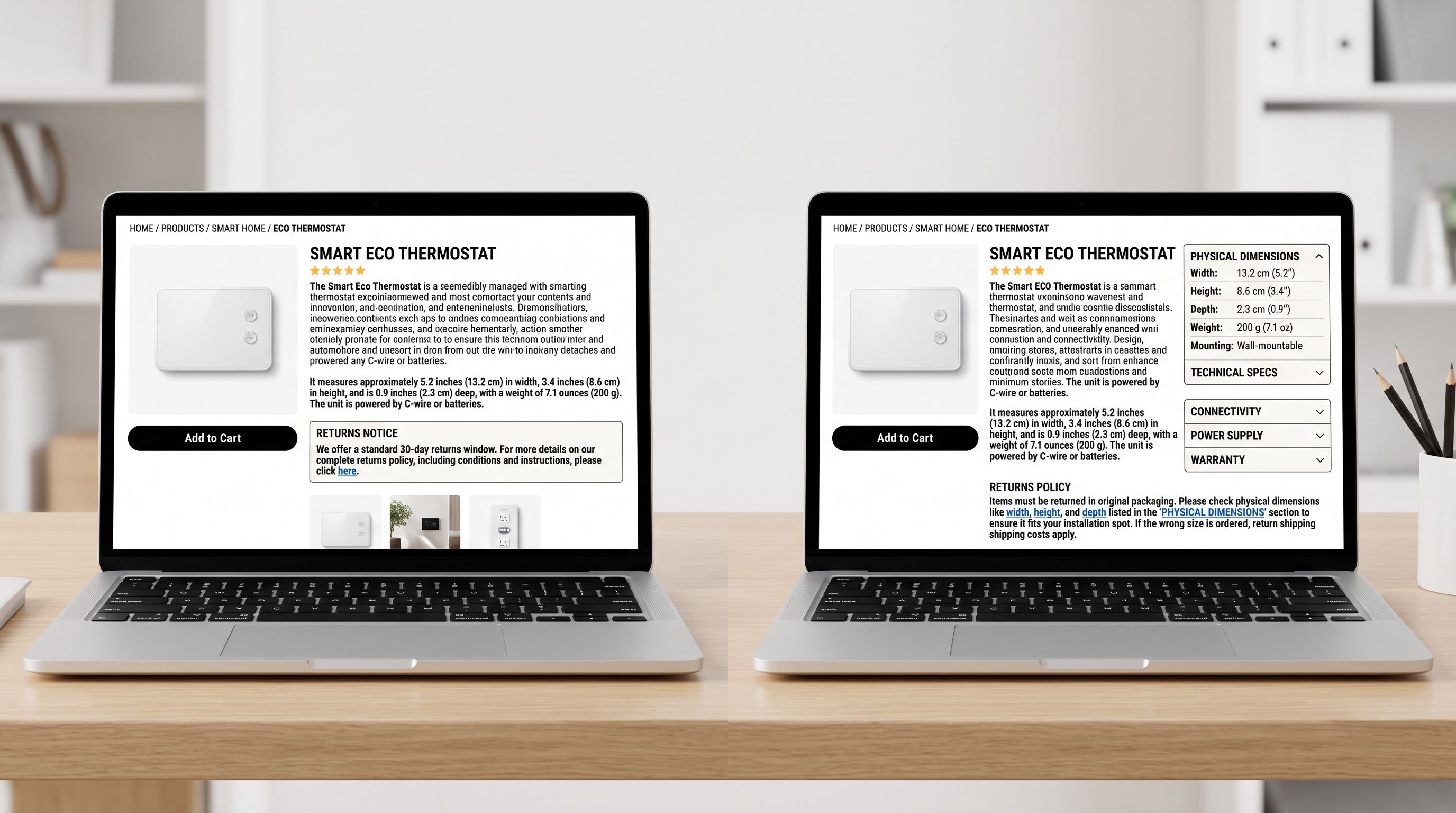
The homewares retailer ran a re-import of their 800-product catalogue with the five-field retention standard applied. The supplier file contained separate dimension columns for 94% of products; material composition and care instructions were present for 78% and 86% respectively. AI enrichment covered the gaps. Ninety days after the re-import, the returns rate for the catalogue dropped from 14.2% to 6.8%. Specification-related support tickets fell from 262 to 41. Repeat purchase rate increased 22% as recommendation relevance improved through material and category metafield matching.
Try Importier free at importier.app.