# Shopify Luxury Goods Import: Provenance and Materials Data
> Luxury buyers expect provenance, materials, and authentication as structured fields. Here is how to import high-value products with the data that converts.
- Published: 2026-07-27
- Author: Importier Team
- Category: Industry Guides
- Canonical: https://www.importier.app/blog/shopify-luxury-goods-import
---
A fine jewellery brand launches on Shopify after years selling through boutiques and a wholesale catalogue. Their product pages go live, but the listings read like generic e-commerce entries. The 18-carat gold content, the Italian goldsmith workshop, the hand-setting technique, the edition count on a limited run: all of it is buried inside a single unstructured description field. Buyers who know the category read the page and move on. The data that would have converted them is there, but it is invisible to both buyers scanning product attributes and shopping platforms reading structured fields.
The shopify luxury goods import problem is not missing data. It is data in the wrong place.
## What Luxury Product Data Requires
Luxury buyers apply a different evaluation framework than mass-market buyers. Provenance, materials, and authentication are primary decision factors, not secondary details. A buyer considering a €4,000 ceramic watch cares about the Swiss manufacture, the movement specification, the case material, and the limited-edition numbering before they consider the styling copy.
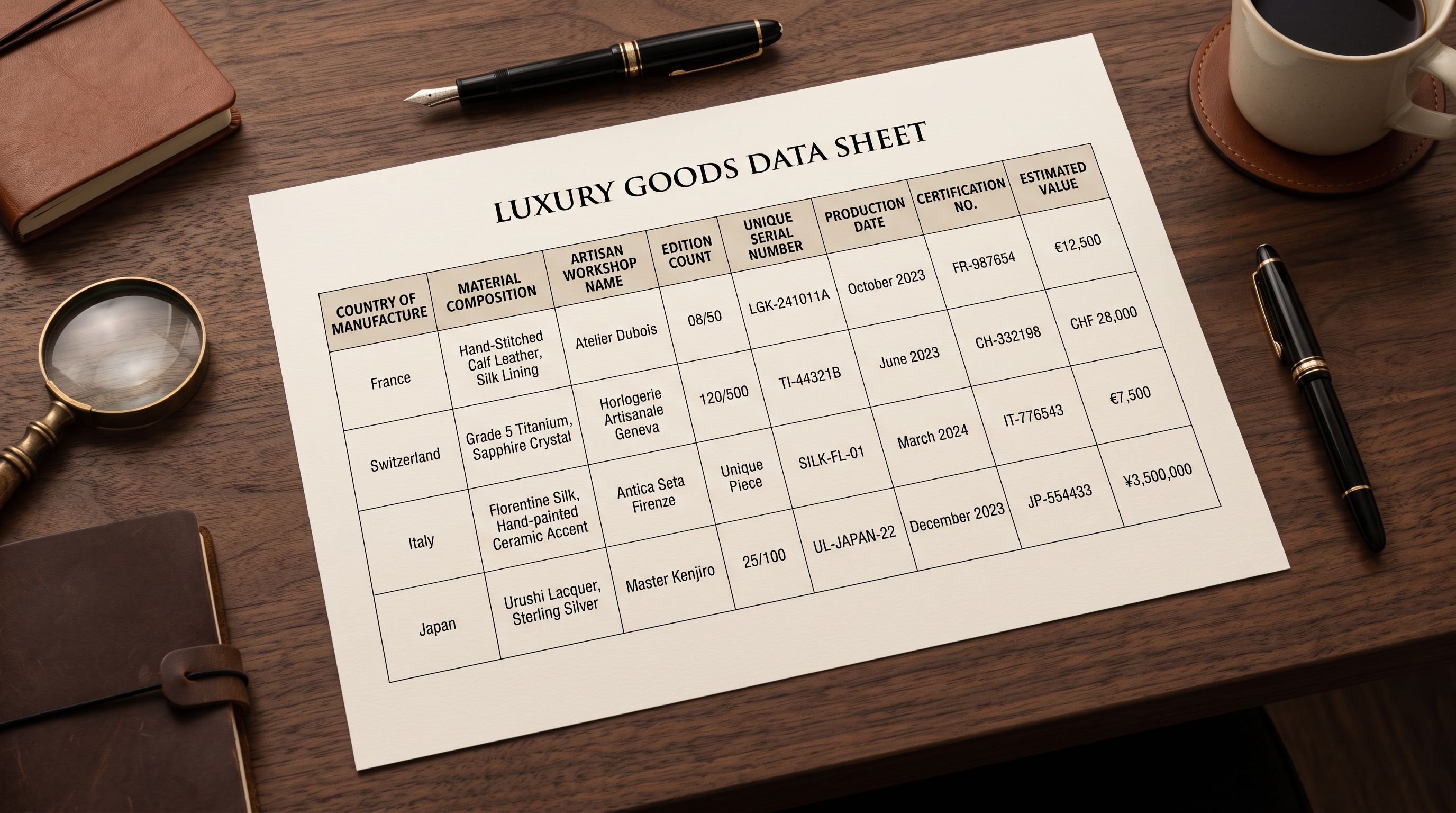
The five data categories that define a complete luxury product listing:
**Provenance.** Country of manufacture, region or city of origin, artisan or workshop name. For heritage brands, the founding year and the lineage of the maker. For contemporary artisan goods, the individual maker's name and location. Provenance is not a marketing claim; it is a verifiable fact that buyers cross-reference.
**Materials and craftsmanship.** Primary material composition (18k gold, 925 sterling silver, full-grain leather, borosilicate glass), secondary materials, finish type, and construction method. For textiles: fibre content and weave. For ceramics: clay body and firing method. For watches: movement type, case material, crystal type. These belong as structured attribute fields, not embedded in prose.
**Authentication metadata.** Serial number structure, certificate of authenticity format, authorised dealer designation, hallmark codes. For items that enter the secondary market (watches, jewellery, art), authentication metadata determines resale eligibility on platforms such as Chrono24 and 1stDibs.
**Edition and inventory designation.** Limited-edition items carry a production run count and an individual piece number (1/500, 47/500). One-of-a-kind items require explicit designation. These affect pricing, search behaviour, and buyer urgency differently from standard in-stock items.
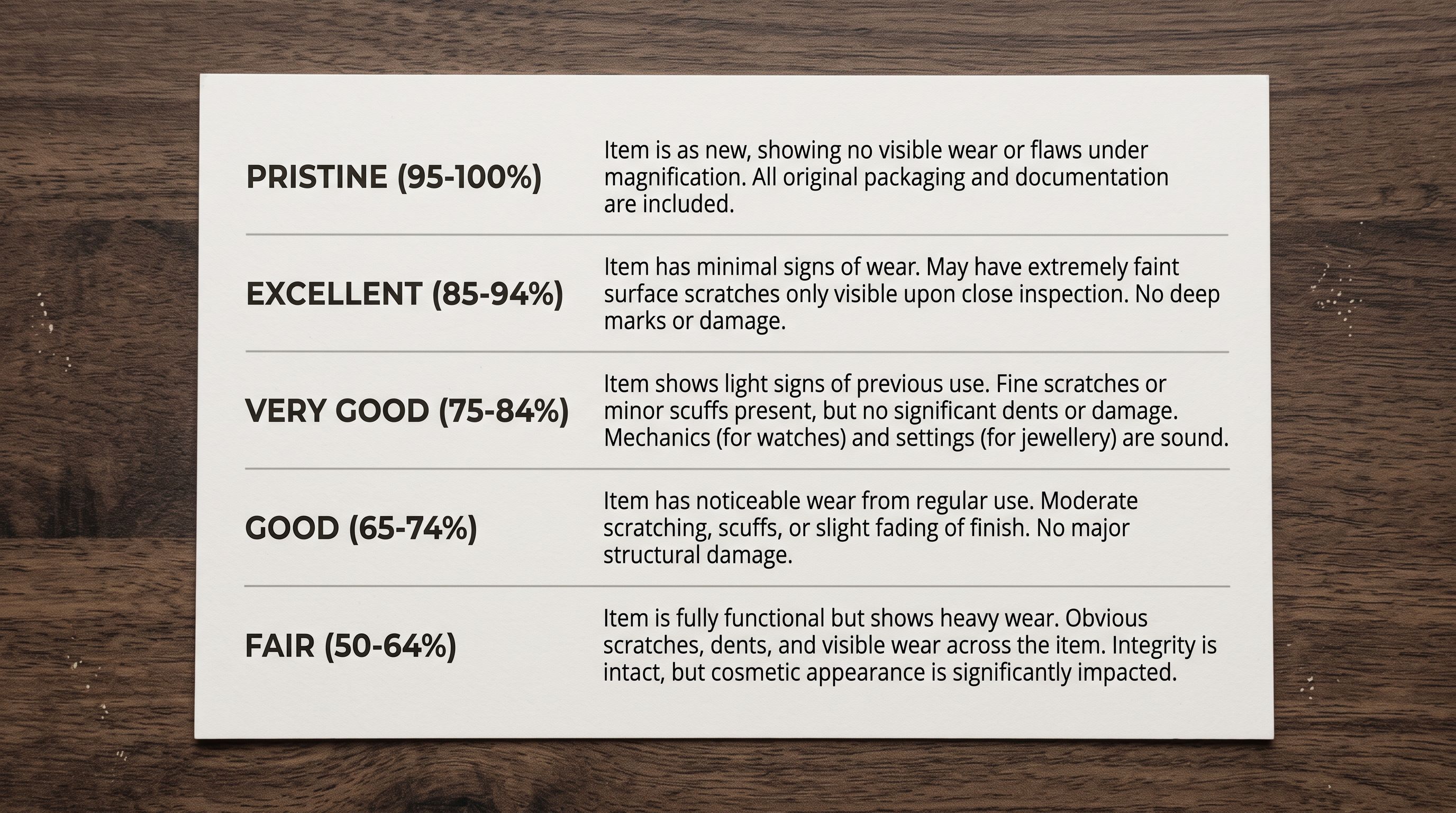
**Condition and warranty.** For new luxury goods: warranty period, servicing network, repair policy. For pre-owned: condition grade, service history, previous ownership count. Condition is a structured field in every luxury resale marketplace; it needs to be a structured field in Shopify as well.
A buyer searching a luxury marketplace for "Italian leather goods handmade Florence" is matching against structured attribute fields, not scanning description prose. Provenance data embedded in a paragraph does not surface in attribute-filtered search. The same data in structured metafields is findable, sortable, and parseable by every platform that reads the product feed.
## Why Standard Import Patterns Miss Luxury Data
Most import workflows are designed for volume. Column mapping tools look for standard fields: title, description, price, SKU, variants, images. A mass-market CSV import can complete successfully without capturing a single luxury-specific attribute.
The result is a technically complete import with a data quality gap. The product exists in Shopify with a title, a price, and a description. The provenance, materials, and authentication data that justified the price point either sits in an unstructured description field or is absent entirely.
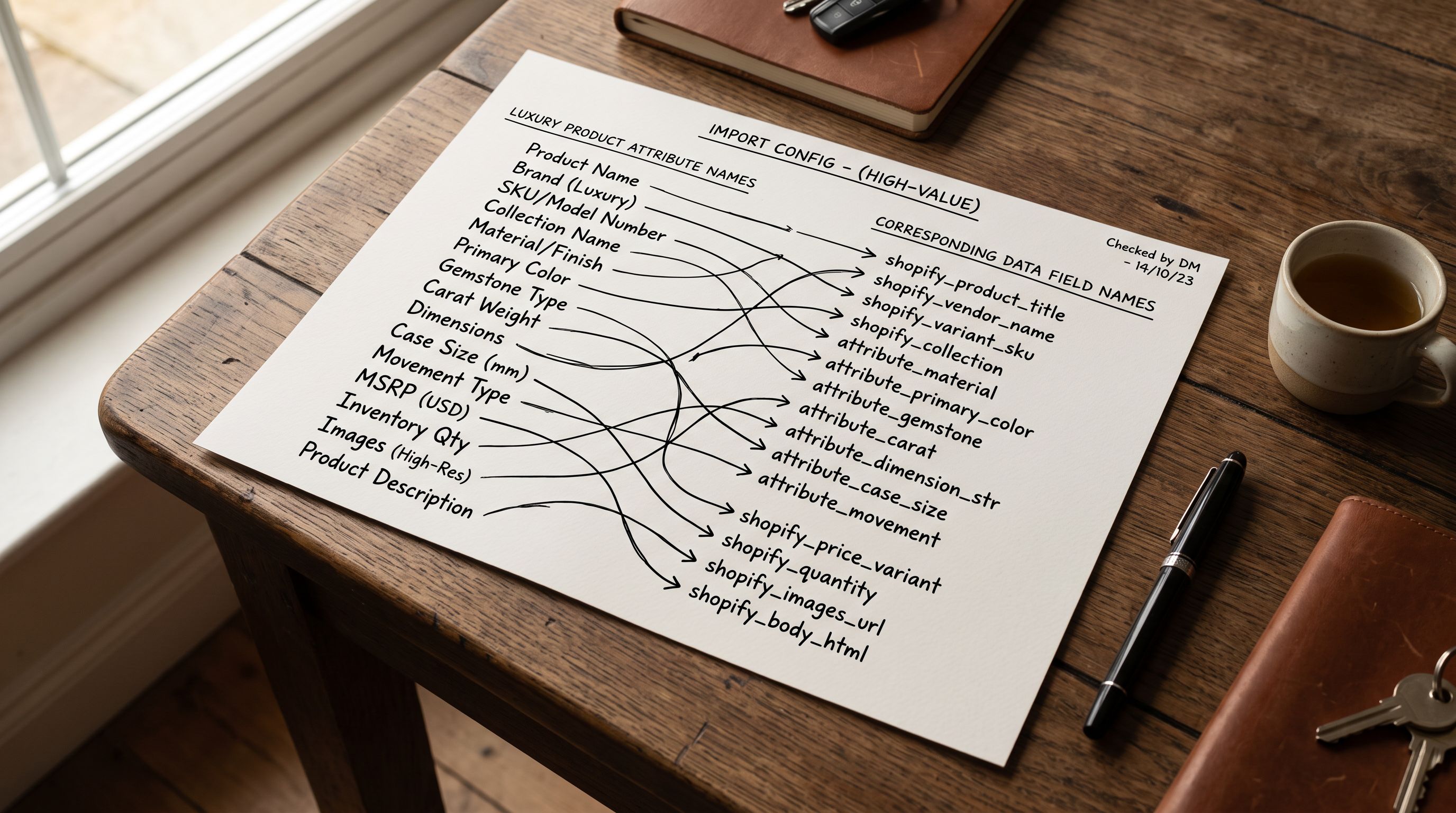
Luxury supplier data files compound this. A heritage watch brand may export a catalogue with columns labelled "Movement Reference", "Case Diameter", "Lug Width", "Water Resistance ATM", and "Crystal Type", none of which map automatically to any standard Shopify field. Without deliberate column assignment at import, this data is either ignored or dumped into the description as a formatted block of text.
## Structuring Luxury Data as Shopify Metafields
The correct destination for luxury-specific data is Shopify's metafield layer, not the description field. Shopify's product data model supports custom metafields on every product and variant, allowing merchants to store structured attribute data that the storefront, search integrations, and marketplace connections can read independently of the description.
[Shopify's product object](https://shopify.dev/docs/api/liquid/objects/product) exposes metafields directly to the theme layer, meaning provenance, materials, and authentication data set as metafields render correctly in themed product page sections without requiring any manual formatting in the description.
For luxury goods, the key metafields to set at import are: `provenance.country`, `provenance.maker`, `provenance.edition_count`, `materials.primary`, `materials.secondary`, `auth.serial_prefix`, `auth.certificate_type`, and `condition.grade` for pre-owned items. Importier's column mapping step routes each supplier column to the correct metafield at import, rather than allowing the data to default into the description.
For limited-edition items, the edition number belongs at the variant level (each numbered piece is a distinct variant) or as a product-level metafield with the edition count and the specific piece number stored separately. This structure allows the storefront to display "Piece 47 of 500" as a formatted attribute rather than as a sentence buried in copy.

## AI Description Styles for Luxury Products
Luxury product descriptions serve a different function from mass-market descriptions. They do not need to explain what a product is; the buyer already knows. They need to justify the price point, establish the maker's authority, and communicate the intangible value that separates a craft object from a commodity.
Two Importier description styles serve luxury content well.
**Emotional Storytelling** builds the narrative arc from the maker's context to the object's meaning. For a heritage leather goods brand, this style opens on the workshop (the city, the lineage, the craft tradition) and closes on the object's role in the buyer's life. It does not lead with features or specifications. The structured metafields carry the specifications; the description carries the story.
**Ingredient Spotlight** works for material-led luxury goods where the composition is the argument. A piece of 18-carat gold jewellery set with conflict-free gemstones requires a description that leads with the gold purity, the gemstone provenance, and the setting method before discussing the aesthetic. Ingredient Spotlight generates exactly this structure, drawing from the material and provenance metafields already populated at import.
The structured metafields carry the specifications. The AI description carries the story. Combining both on the product page gives luxury buyers the factual verification and the emotional context they need to convert at high price points.
Google's [product structured data guidelines](https://developers.google.com/search/docs/appearance/structured-data/product) specify how product attributes (including material, brand, and condition) feed into Google Shopping rich results and AI-powered product carousels. Luxury products with complete structured data signal authenticity and product richness to both search algorithms and the buyers who find them.
## Pre-Owned and Secondary Market Luxury
The luxury import workflow extends to pre-owned inventory, which carries its own structured data requirements. A pre-owned watch import requires condition grade, service history date, original papers status, and whether the original box is included. A pre-owned handbag import requires condition grade, interior condition, hardware condition, and any restoration notes.
These fields matter for two reasons. First, they directly affect the buyer's purchase decision: a pre-owned Submariner in unworn condition with box and papers sells at a materially different price from one without. Second, they determine eligibility for listing on secondary market platforms (Chrono24, Vestiaire Collective, 1stDibs) that require condition data as structured fields in their product feeds.
Importier's column mapping handles pre-owned condition fields the same way as provenance fields: map the supplier's condition column to a `condition.grade` metafield, and the service history column to a `condition.last_serviced` metafield. The values are stored as structured data on the Shopify product, accessible to any integration reading the product feed.
Importier's [product data quality guide](https://importier.app/blog/shopify-product-data-quality) covers the broader approach to data completeness before import. For international luxury sellers managing compliance across multiple markets, Importier's [import product compliance settings](https://importier.app/blog/shopify-import-product-compliance) address the country-specific product declaration requirements that affect high-value goods shipments.
## Shopify Luxury Goods Import: Key Takeaways
Getting shopify luxury goods import product data right requires treating provenance, materials, and authentication as structured fields from the first import, not as description content.
- Luxury buyers evaluate provenance, materials, and authentication as primary decision factors. Data embedded in prose is invisible to buyers scanning attributes, to marketplace integrations reading structured fields, and to search algorithms matching product data against buyer queries.
- The five data categories every luxury import must address: provenance (country, maker, workshop), materials and craftsmanship (composition, finish, construction), authentication metadata (serial structure, certificate type, hallmark), edition and inventory designation (run count, piece number), and condition/warranty for pre-owned goods.
- Importier's column mapping step routes each luxury attribute column to a named metafield key at import. Provenance, materials, and authentication data lands in structured metafields rather than defaulting into the description.
- For limited-edition items, the edition count and piece number belong at variant level (each numbered piece as a variant) or as product-level metafields stored separately from the description.
- Emotional Storytelling generates heritage and craft narrative for the description field. Ingredient Spotlight generates material-led content where composition is the primary argument. Both styles draw from the metafields populated at import, keeping specifications in structured data and story in the description.
- Importier's Industry Packs (Jewellery and Watches, Bags and Luggage) activate Shopify's Standard Product Taxonomy attribute fields for luxury product categories, pre-configuring the metafield structure before AI description generation runs.
Import luxury goods with complete provenance and authentication data at [importier.app](https://importier.app). The structured metafields set at import determine what buyers see on the product page and what every platform downstream can read.