# Shopify Localised Product Import for Multiple Markets
> How to structure import data, descriptions, pricing, and compliance fields when expanding your Shopify store to the UK, EU, and other markets.
- Published: 2026-10-01
- Author: Importier Team
- Category: Import Guides / File Imports
- Canonical: https://www.importier.app/blog/shopify-localised-product-import-markets
---
A furniture merchant in Melbourne had been selling domestically for three years. Q1 was their EU expansion. They ran their 240 product descriptions through Google Translate into German, converted AU$ prices at the mid-market rate, connected Shopify Markets for the DE region, and launched.
Three months later, the German market had a 0.4% conversion rate. The AU store was at 2.1%.
The problem wasn't technical. The translations were grammatically correct. The prices were mathematically correct. Neither was market-correct.
German furniture buyers evaluate products on four criteria that differ from AU buyers: dimensions listed upfront in centimetres (not mentioned in a general "quality construction" description), material specification with grade rather than just species name, delivery timeframe in weeks (EU fulfilment from AU takes 4-6 weeks, not "fast shipping"), and an explicit 14-day return right statement (required under EU consumer law). The translated descriptions answered none of these. They were correct translations of the wrong content.
The pricing problem was different but equally structural. AU $3,299 for a sofa converted to EUR 1,978. German premium furniture retail clusters at EUR 1,999 and EUR 2,499. EUR 1,978 doesn't read as a deliberate price point. The market expectation wasn't the conversion; it was the convention.
Both problems have the same root cause: the source content and price structure were designed for one market and applied to another without modification. Solving them requires two things at import time: correct price data structure and source descriptions that are ready for the market they're entering.
## Why Translation Is Not Localisation
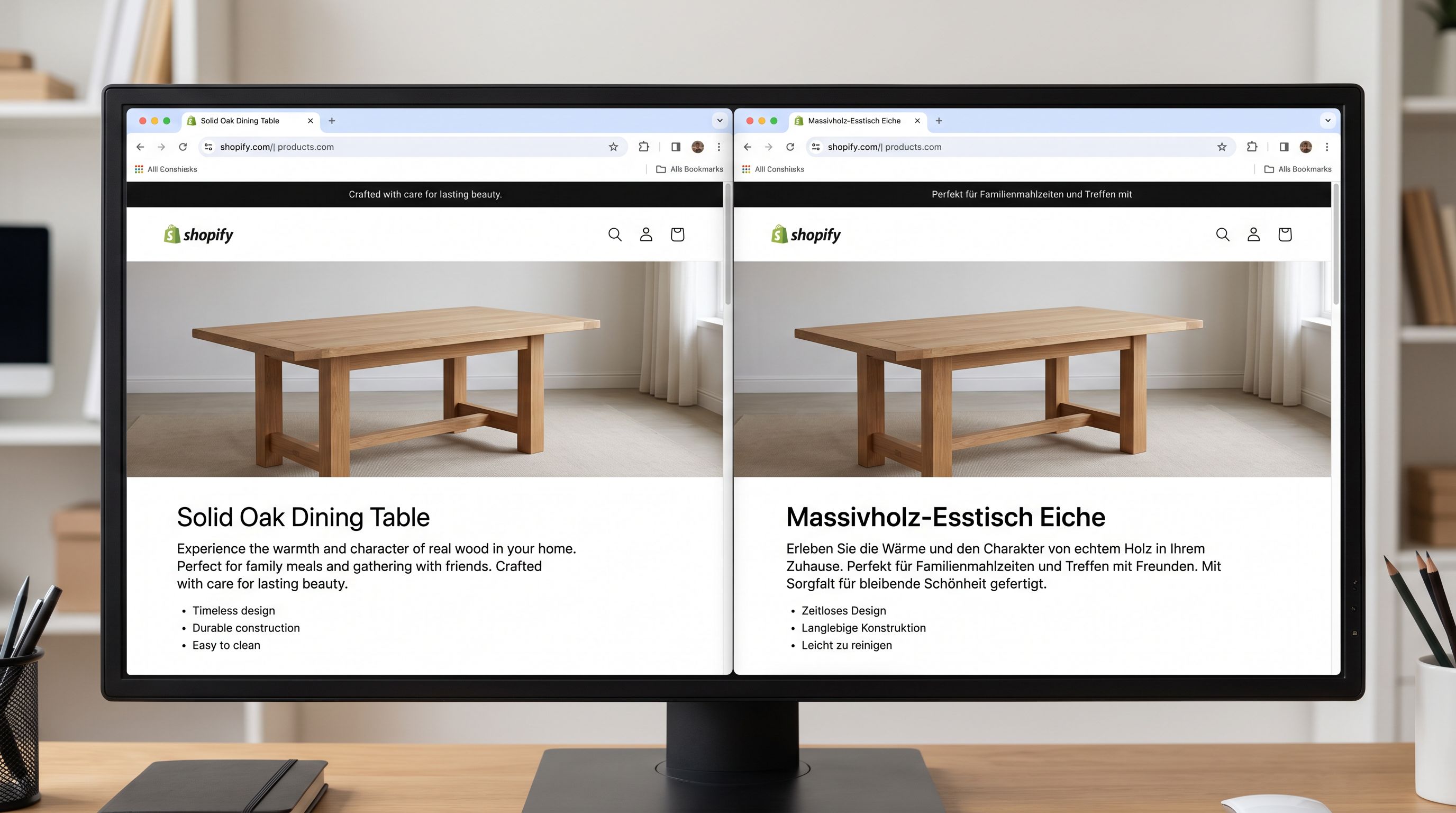
Shopify Translate & Adapt converts text between languages. It does not convert buyer intent.
A German buyer searching "Echtholz Esstisch 180cm" (solid wood dining table 180cm) expects results that state dimensions first, wood species second, grade of wood third. An EN description that says "Beautiful solid oak dining table with traditional craftsmanship" translates to "Schöner massiver Eichentisch mit traditionellem Handwerk." Grammatically correct. Zero match for the search signal German buyers use.
The [import-first, translate-second workflow](https://importier.app/blog/shopify-translate-and-adapt) applies here: the quality of the translation is bounded entirely by the quality of the source. A description that doesn't carry the structural signals a market expects cannot become a description that does, regardless of translation quality.
Translation and localisation are different operations. Translation converts language. Localisation converts buyer intent: the decision criteria, vocabulary, and information structure that a specific market's buyers use when evaluating a product. Both are necessary for a successful international launch. Only translation is automatic.
Market localisation for product descriptions means generating source descriptions that carry the correct structural signals for the target market before any translation runs. For the German furniture market, that means dimension-first structure, wood grade vocabulary, and EU return rights language (written in EN, then translated) rather than translating descriptions that lack all three.
## Pricing: Structure Before Currency
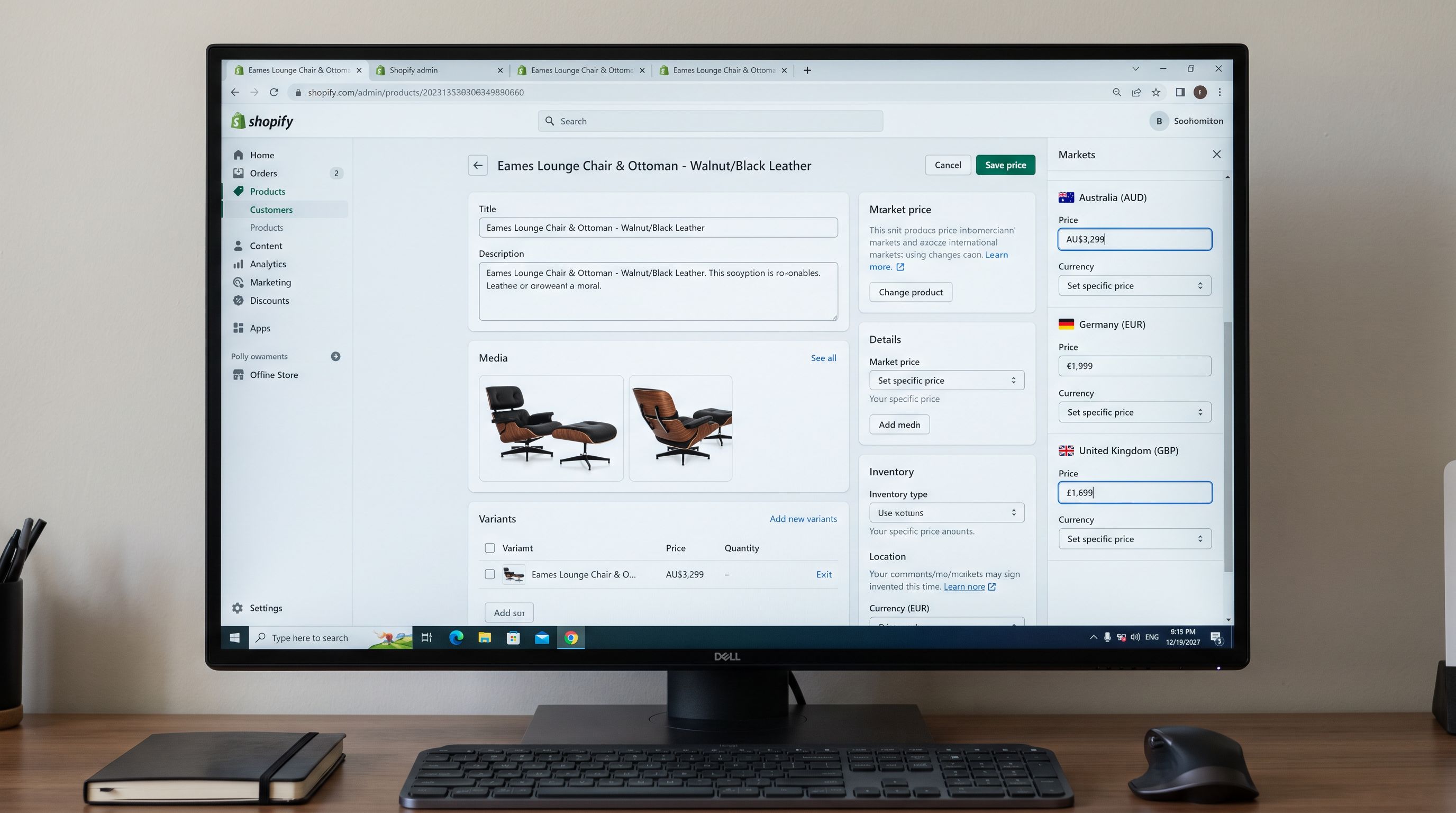
The second problem is pricing structure. Market-specific pricing in Shopify is not currency conversion; it is a separate price decision per market.
Shopify Markets allows merchants to set per-market price overrides for each product. The mid-market AU$/EUR rate is one input. The other inputs are:
**Retail price conventions.** German furniture retail clusters at EUR X,999, X,799, and X,499 price points. EUR 1,978 sits between convention points and reads as a converted number. EUR 1,999 sits at a convention point and reads as a priced product.
**VAT-inclusive pricing.** German prices are displayed VAT-inclusive by law (Gesamtpreis). A product priced at EUR 1,978 ex-VAT becomes EUR 2,355 on the product page. EU buyers expect to see the total price. Setting the per-market price to EUR 1,999 VAT-inclusive means the product page shows EUR 1,999, not a surprise EUR 2,355 at checkout.
**Competitor context.** A sofa priced at EUR 1,978 sits in the same range as products from well-known EU furniture brands priced at EUR 1,999-2,199. A price that reads as a currency conversion rather than a deliberate price point signals that the merchant hasn't engaged with the market.
The import file for a multi-market catalogue should carry separate price columns per market rather than a single price that Shopify converts. For the furniture merchant: `price_aud`, `price_eur`, `price_gbp`. Importier's column mapping step assigns each price column to the appropriate Shopify field. The configuration saves as part of the import preset, so every subsequent import applies the same per-market price structure automatically.
## What Each Market Requires in the Product Record
Compliance requirements differ by market. These are not optional; they affect customs clearance, consumer protection law, and sales channel eligibility (Google Shopping, Meta catalogue).
**EU (Germany, France, Netherlands, etc.):**
- HS code: required for customs classification and IOSS VAT reconciliation on sub-€150 shipments. Importier's Data Enrichment fills HS codes at import using the product description and barcode.
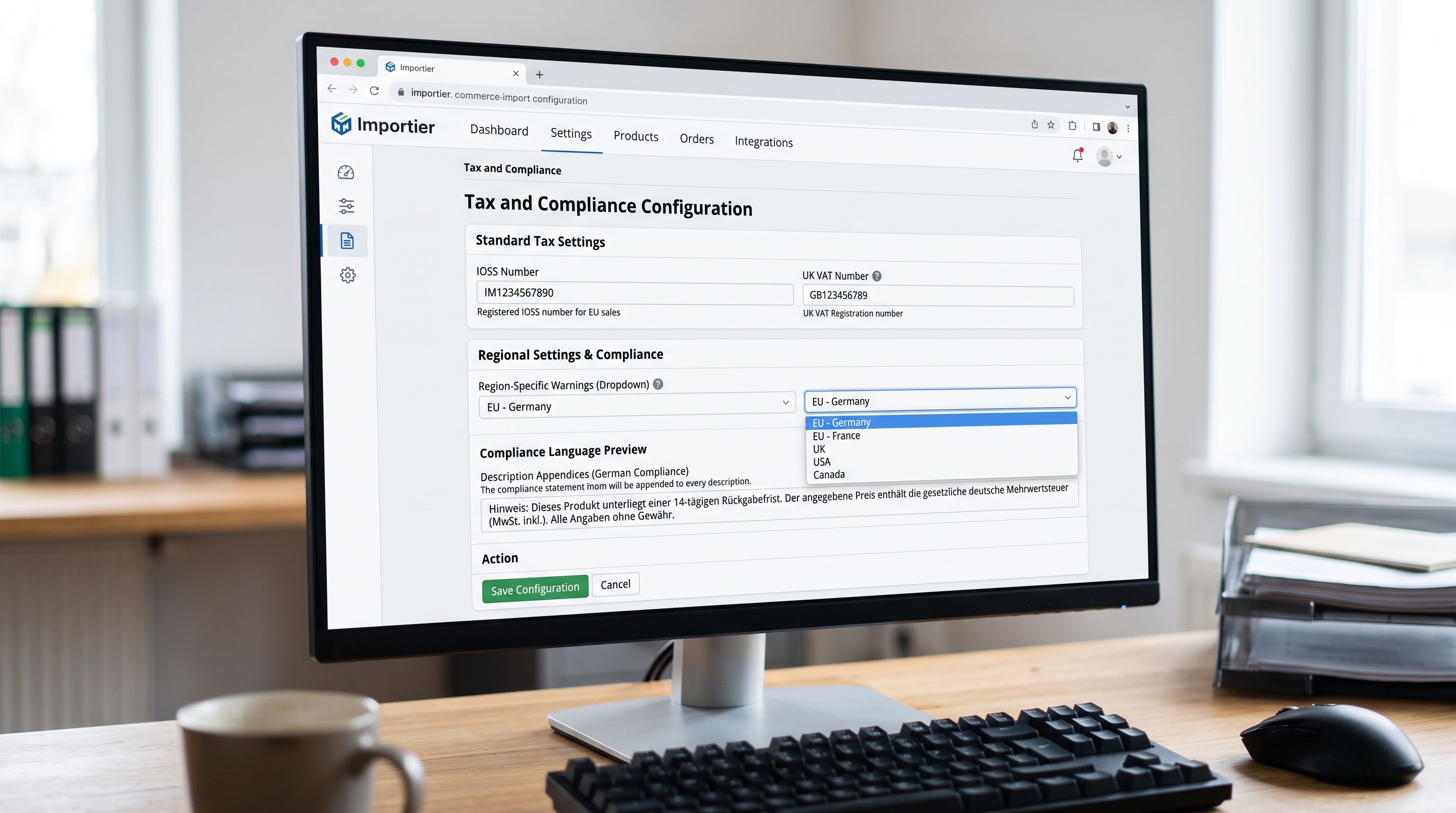
- IOSS number: the EU's Import One Stop Shop scheme centralises VAT registration for cross-border merchants. Importier's Tax and Compliance feature appends the IOSS number and relevant VAT language to descriptions and the delivery section.
- Country of origin: required to be stated on regulated product categories (leather goods, textiles, food). The `country_code_of_origin` Shopify field and a `custom.origin_statement` metafield carry the correct declaration.
**United Kingdom:**
- UKCA marking: for product categories that required CE marking under EU law, UKCA marking is required for UK sales. Importier's region-specific compliance warnings include UKCA language for affected product categories.
- UK VAT registration: if the merchant is VAT-registered in the UK, the registration number appears in the delivery section. Importier's Tax and Compliance stores the UK VAT number per connected Shopify store.
**Australia (base market):**
- Country of origin: the Australian Consumer Law requires accurate country of origin claims. "Designed in Australia, Made in Vietnam" is the correct claim for products with AU design and overseas manufacture (not "Australian brand"). Importier's column mapping assigns the supplier's origin column to the `custom.origin_statement` metafield.
Each of these fields can be mapped at import time rather than filled manually per product. For a 240-product furniture catalogue, filling HS codes, origin statements, and VAT language manually would take 8-15 hours. Importier's Data Enrichment fills HS codes at import from product descriptions and barcodes. The Tax and Compliance configuration appends compliance language to every generated description automatically.
The [international product compliance guide](https://importier.app/blog/shopify-international-product-import) covers HS codes, GTIN, and EU IOSS requirements in detail. The [Shopify Markets product import guide](https://importier.app/blog/shopify-markets-product-import) covers the four critical fields Shopify Markets reads from each product.
## Preparing Descriptions for Multiple Markets
Importier's 156 expert personas across 43 industry categories produce descriptions structured around how that industry's buyers evaluate products. For a furniture merchant, the Homewares Retailer or Interior Design Store persona produces descriptions that open with the product's primary function and spatial context rather than a generic marketing opener (which is closer to the structure German and UK buyers use than a general retail persona).
The import workflow for source description quality follows three principles:
**Persona selection for the broadest appeal.** Select the persona closest to the target market's buyer psychology. A persona written for wholesale buyers (MOQ, minimum order value, lead time) produces the wrong structure for a B2C EU launch. A persona for the product category (furniture, homewares, outdoor living) produces descriptions that carry the right decision signals.
**Brand Voice avoidance list for cross-market language.** Words and phrases that work in AU retail may create problems in other markets. "Coastal style" maps to an AU and US concept with no equivalent in German interior design vocabulary. Adding AU-specific idioms to the avoidance list in Brand Voice ensures generated descriptions avoid language that doesn't translate to a market context.
**Benefit-first structure for translatability.** As the [Translate & Adapt product data guide](https://importier.app/blog/shopify-translate-adapt-product-data) covers, Benefits-First and Technical Gadget description styles produce factual, structured output with minimal idiom that translates more cleanly than Emotional Storytelling or Sensory-Rich styles. For a multi-market launch, selecting a translation-ready description style at the import step reduces the amount of post-translation editing required per market.
The description that translates most clearly is not the most creative description. It is the most structurally clear one: specifics first, idiom minimised, benefit stated before reasoning.
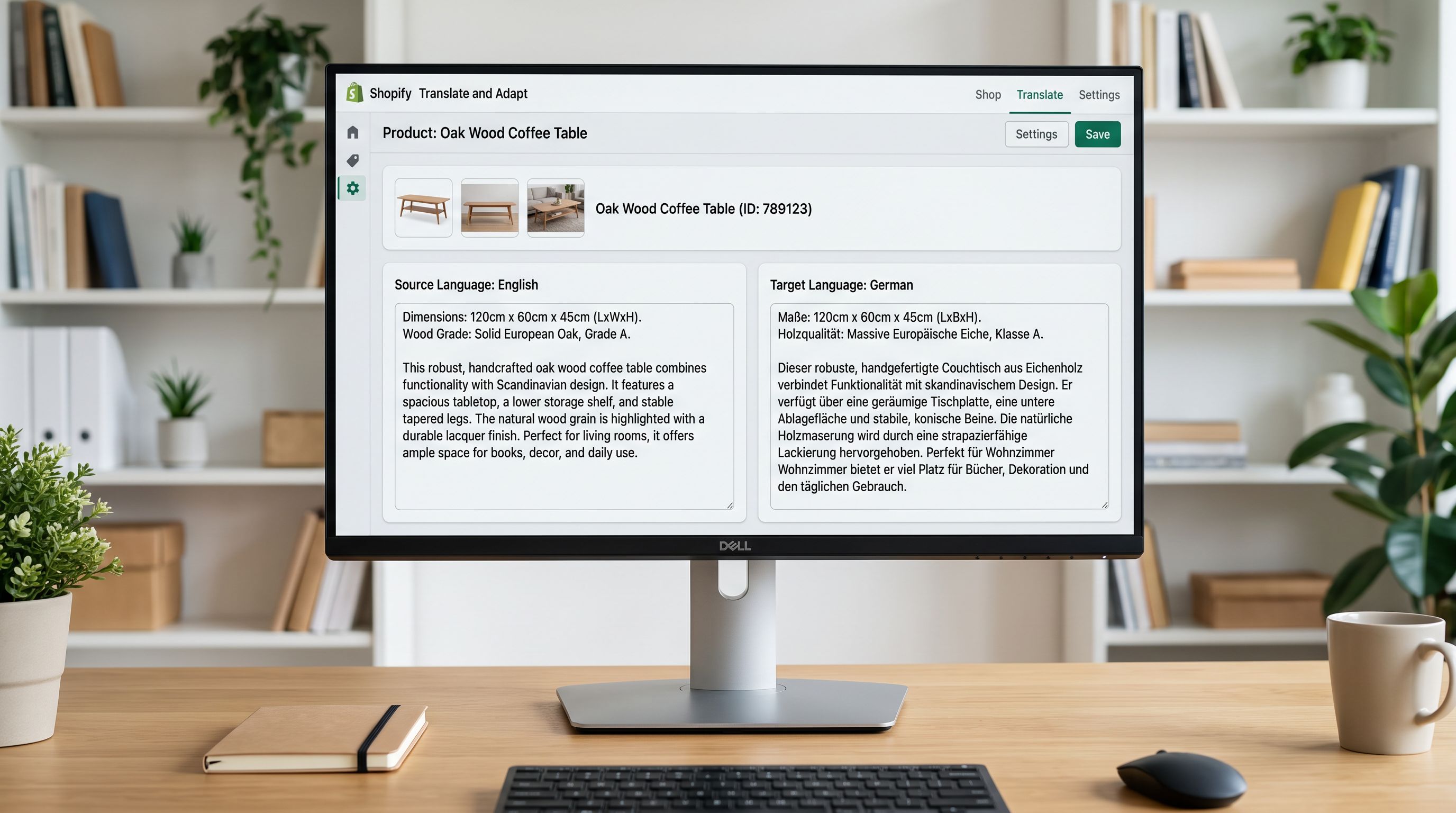
After generating descriptions in Importier, Shopify Translate & Adapt runs the translation layer. The output quality scales directly with the source quality. A 240-product catalogue with descriptions that state dimensions, material grade, and function clearly before any styling language translates into better German, French, and UK product pages than a catalogue with marketing-led openers.
## The Multi-Market Import Workflow
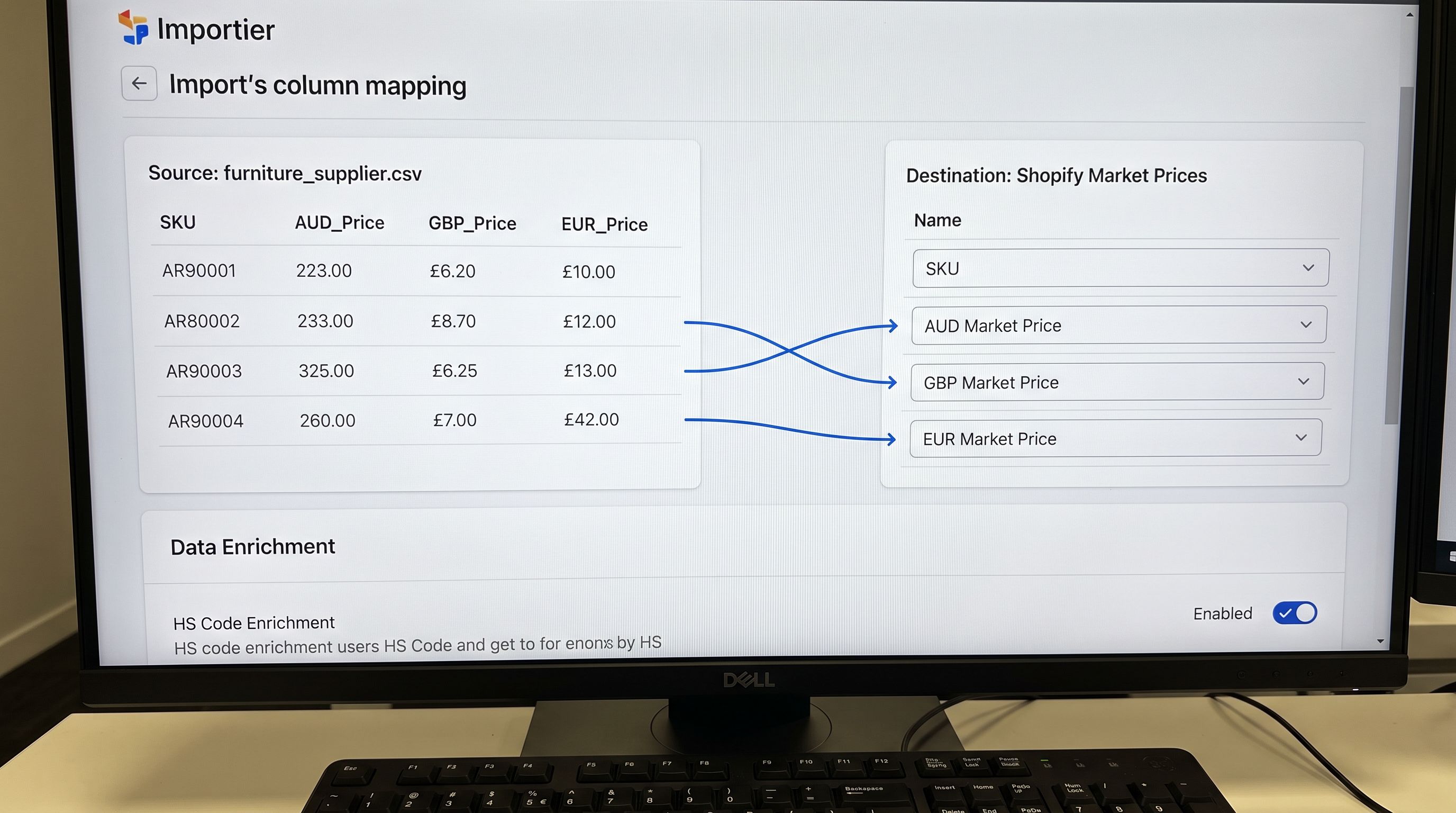
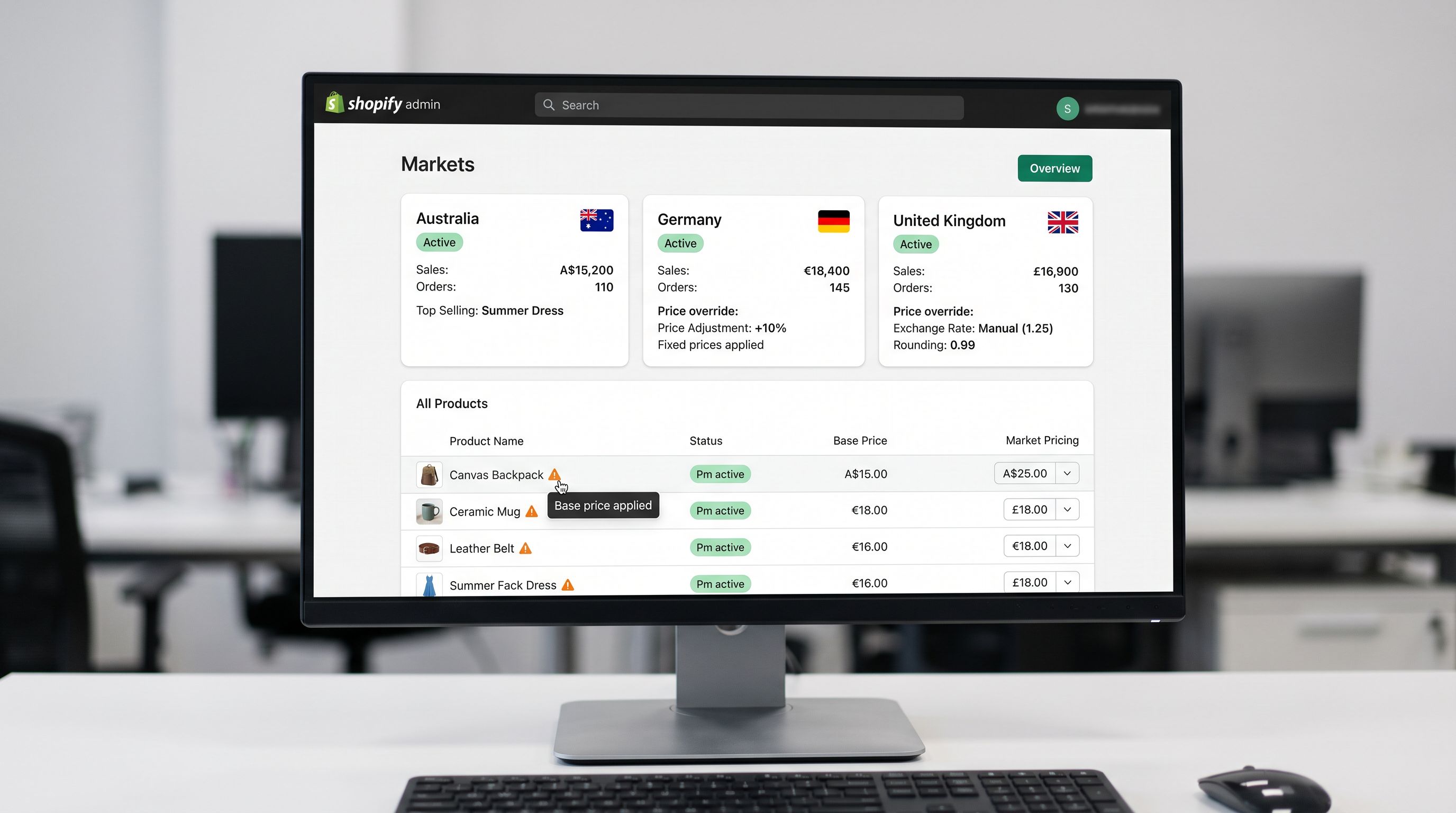
The furniture merchant re-ran the import for their DE and UK markets. Three price columns. Tax and Compliance configured with IOSS and UK VAT numbers. Benefits-First descriptions with the Homewares persona and AU idiom removed from the Brand Voice avoidance list. Data Enrichment for HS codes.
German market at 90 days after the corrected launch: 1.4% conversion rate. UK market: 1.8%. Not yet matching the AU rate (the store brand had no EU awareness at launch), but 3.5x and 4.5x the rates from the currency-conversion approach.
According to [Shopify's documentation on per-market pricing](https://help.shopify.com/en/manual/markets/pricing/per-market-prices), market price overrides are separate from the base price and can be set for each product independently. [Shopify's Translate & Adapt documentation](https://help.shopify.com/en/manual/markets/languages/translate-and-adapt) covers the fields translated, the glossary feature for brand terminology, and the review workflow for translation output.
The import was the same 240 products. The configuration was different. So were the results.
Try Importier free at importier.app.