# Shopify Brand Voice: Keywords and Example Phrases for AI
> Learn how Importier's Brand Voice Keywords and Example Phrases fields train AI to write product descriptions that sound like your brand, not a template.
- Published: 2026-08-28
- Author: Importier Team
- Category: Agentic Commerce / AI Product Descriptions
- Canonical: https://www.importier.app/blog/shopify-brand-voice-keywords-phrases
---
A gin distillery imports 22 expressions from a production spreadsheet and runs Importier's AI description generator. The output is accurate: correct botanical ingredients, accurate production method, right proof. But it reads like a product listing, not a brand story. "A premium small-batch gin with botanical notes and a smooth finish" describes roughly forty percent of gins on the market.
The brand's own copywriters write differently. They use "copper pot-distilled" rather than "distilled." They open with the harvest rather than the product. Their closing lines include "distilled with intention" on almost every expression. Nothing about the AI output is wrong. It simply does not sound like the distillery.
Importier's Brand Voice feature has four configuration fields. The [Avoid Words field](https://importier.app/blog/shopify-brand-voice-avoid-words) prevents specific vocabulary from appearing. The Keywords field and the Example Phrases field do the opposite: they train the AI to include specific terminology and emulate specific writing patterns. Together, these two fields are how Importier's AI learns to write in a specific brand's voice rather than a generic product voice.
The Keywords field tells the AI which terms are important to your brand and product category. The Example Phrases field shows the AI how your brand writes. Both fields are required to get descriptions that are specifically yours rather than specifically accurate.
## What the Shopify Brand Voice Keywords Field Does
The Keywords field in Importier's Brand Voice configuration accepts a list of terms the AI should incorporate into product descriptions. These are brand-specific, category-specific, or audience-specific words that carry meaning beyond their literal definition.
For the gin distillery, the Keywords field might contain: copper pot-distilled, botanical forage, small-batch, single estate, terroir, expressions, still-house.
"Terroir" is rarely used in spirits writing outside of premium artisan producers. Including it in the Keywords field signals to the AI that this brand positions itself within that specific vocabulary tier. The AI incorporates the term where contextually appropriate, not artificially in every sentence. "Copper pot-distilled" appears as the production descriptor rather than the generic "distilled."
The Keywords field functions differently from the Avoid Words field. Avoid Words operates as a strict exclusion list: if a word appears in that field, it never appears in an output. Keywords work as a weighted vocabulary signal. The AI uses the specified terms where they are contextually appropriate, not in every possible location. If a keyword genuinely does not fit the product description being generated (for example, "single estate" on a blended expression), the AI will not force it in.

This distinction matters. A merchant who wants "organic" in every description because their certification applies to every product should include it as a keyword. A merchant who wants "organic" only on products where the attribute is genuinely true should handle that through the enrichment context field on a product-by-product basis rather than in Brand Voice, which applies globally.
## What the Example Phrases Field Does
The Example Phrases field accepts sample sentences and phrases that the AI reads as stylistic reference. It does not copy these sentences verbatim. Instead, it reads the sentence structure, the vocabulary register, the rhythm, and the relationship between claim and supporting detail, then writes in that style for the specific product being described.
For the gin distillery:
"Each expression tells the story of the land where the botanicals were foraged, from the damp riverbank herbs to the high-altitude citrus that defines the spirit's backbone."
"Distilled with intention in our Victorian copper still, this gin carries the imprint of its maker in every pour."
These two example phrases give the AI three style signals:
- Long, clause-rich sentences (not bullets or fragments)
- Geographic specificity (riverbank, high-altitude) rather than generic adjectives (fresh, smooth)
- The maker's presence in the product narrative (Victorian copper still, its maker)
The AI applies these patterns to descriptions of specific products. A single malt whisky distillery's example phrases produce different output from a streetwear brand's example phrases, even with the same product category persona selected. The Example Phrases field is where the brand's actual writing voice is injected into the AI's output at the level of sentence construction.
## Step-by-Step: Configuring Brand Voice Keywords and Example Phrases
The Example Phrases field does not template your descriptions. It teaches the AI how your brand constructs sentences, then the AI applies that construction to every product individually.
## Brand Voice Across Different Merchant Types
The Keywords and Example Phrases fields work differently depending on the merchant's product category and brand positioning.
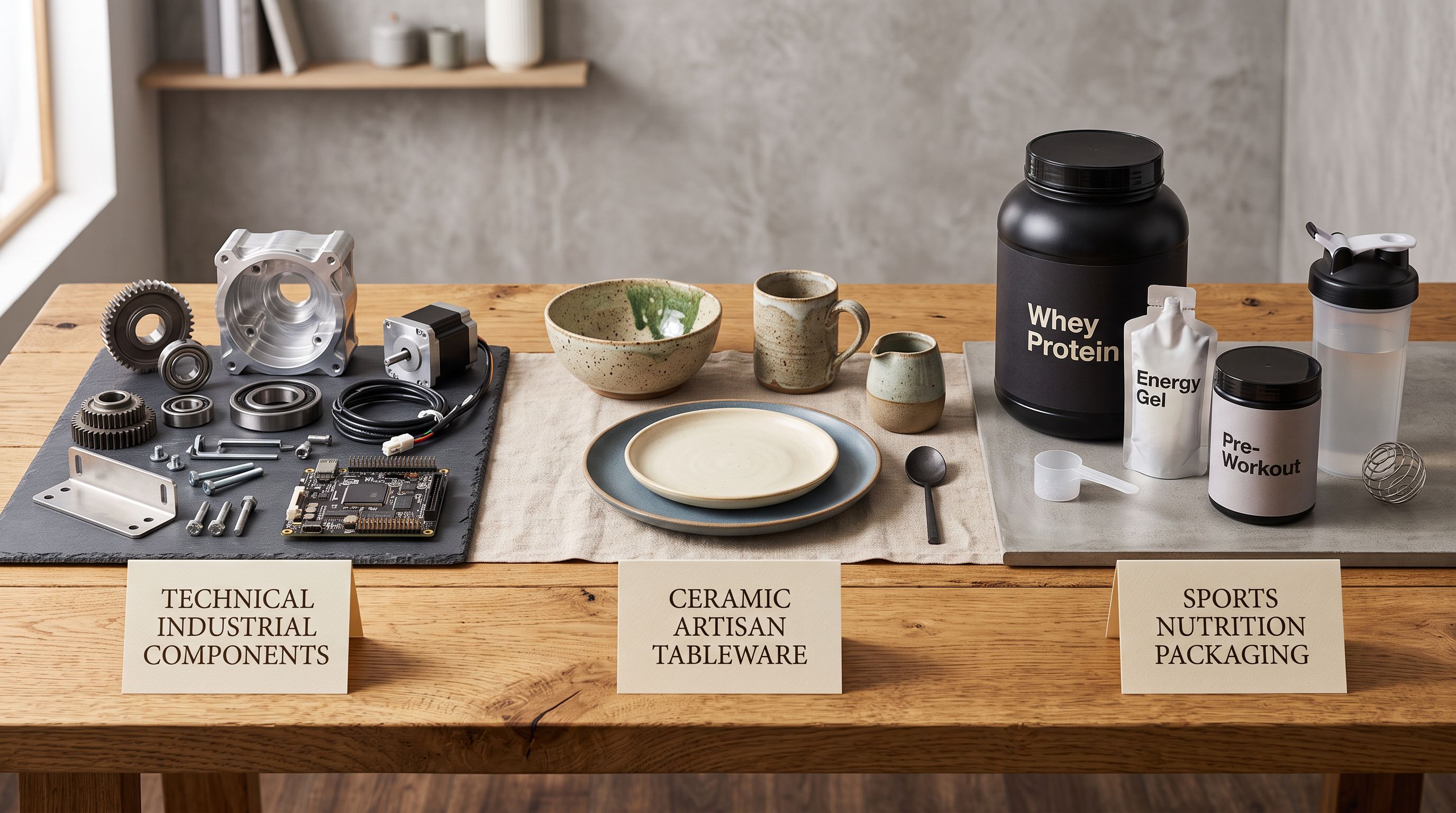
For a **technical B2B merchant** importing industrial components, the Keywords field might contain: IP67-rated, DIN-rail mountable, CE-compliant, ATEX-certified, galvanic isolation, ingress protection. The Example Phrases would use declarative technical sentences: "Rated for continuous operation in environments up to 85°C, this controller maintains precision regulation across the full temperature range." The AI output for each component reads as specification-accurate and technically dense.
For a **luxury homewares brand** importing ceramic tableware, the Keywords field might contain: kiln-fired, food-safe glaze, hand-thrown, organic form, artisan lead time, limited edition. The Example Phrases would use sensory and contextual language: "Each piece bears the mark of its maker in the slight irregularity of its form, a reminder that the table it graces was set with intention." The AI output uses the irregular-as-feature framing that distinguishes artisan positioning from mass market.
For a **sports nutrition brand** importing supplements, the Keywords field might contain: Informed Sport certified, third-party tested, no proprietary blends, clean label, performance-focused, athlete-formulated. The Example Phrases would use direct, claim-first language: "Backed by 25g of third-party tested whey isolate per serve, this formula was built for the training block, not the marketing brief." The AI picks up the skeptic-first, evidence-first writing mode.
In each case, the AI without Brand Voice configuration would produce technically accurate descriptions that sit in the correct product category but do not carry the brand's specific positioning. With Keywords and Example Phrases configured, the descriptions read as if they came from the brand's own content team.

## How Keywords and Example Phrases Interact With Other Brand Voice Fields
The four Brand Voice fields work as a system. Configuring Keywords and Example Phrases without also checking Avoid Words can produce output where the right vocabulary appears alongside vocabulary the brand would not use.
A luxury brand with "artisan" and "hand-thrown" in Keywords might still have the AI produce "This product is straightforward to clean and convenient to use" unless "easy" and "simple" are in the Avoid Words field. Keywords do not suppress conflicting vocabulary. They add vocabulary. Avoid Words must be used to remove specific vocabulary that contradicts the brand's positioning.
The [Brand Voice](https://importier.app/blog/shopify-brand-voice-avoid-words) Avoid Words field is the complement to Keywords and Example Phrases. Avoid Words removes vocabulary; Keywords and Example Phrases add it. A complete Brand Voice configuration uses all three fields together: vocabulary to exclude, vocabulary to include, and style to emulate.
The Brand Description field (the fourth field) provides the AI with a brief brand context statement. This is the field to describe what the brand is and who it serves: "a Victorian craft gin distillery focused on single-estate botanicals for the premium on-premise and gifting markets." The AI reads this before generating each description and uses it to orient the product within the brand's world.
According to [Google's guidance on creating helpful content](https://developers.google.com/search/docs/fundamentals/creating-helpful-content), the content that earns trust from readers and search systems alike demonstrates a depth of knowledge that reflects genuine expertise and a distinct perspective. The [Content Marketing Institute's analysis of brand voice in content marketing](https://contentmarketinginstitute.com/articles/brand-voice-content-marketing/) confirms that documented brand voice guidelines reduce decision time for content creators and increase consistency across all content touchpoints, whether written by humans or generated by AI tools. Configuring Brand Voice Keywords and Example Phrases is how that depth of perspective scales across hundreds of product descriptions without requiring a human copywriter to touch each one.
## When to Update Brand Voice Configuration
Brand Voice is a global setting that applies to every AI description run until it is changed. This makes it powerful for consistent catalogue-wide output, but it also means outdated configuration produces outdated descriptions at scale.
Common triggers for updating Brand Voice Keywords and Example Phrases:
- A brand refresh changes the vocabulary tier (moving from accessible to premium positioning)
- A new product line enters a category the current keywords do not serve
- Seasonal campaigns introduce terminology the brand wants applied to descriptions generated during that period
- A competitor has adopted the same vocabulary and the brand needs to differentiate further
When Brand Voice is updated, running a Store Scanner pass over the full catalogue in Replace mode regenerates all descriptions with the new configuration. This is how a brand refresh propagates across a 500-product store in a single session rather than over weeks of manual rewrites.
## Key Takeaways
Brand Voice Keywords and Example Phrases are the configuration fields that move Importier's AI output from accurate to distinctively yours. Accurate descriptions are the baseline; brand-specific descriptions are what build authority and trust with customers who encounter multiple competing products.
- **Keywords are vocabulary signals, not mandates**: the AI incorporates them where contextually appropriate. Use 5-15 terms drawn from your brand guidelines, highest-performing copy, and category vocabulary.
- **Example Phrases teach sentence construction**: the AI reads these for style, rhythm, and the relationship between claim and supporting detail. Two to four sentences from your strongest brand writing is sufficient.
- **All four fields work as a system**: Keywords and Example Phrases add vocabulary and style; Avoid Words removes conflicting vocabulary; Brand Description orients the AI to the brand's world. A complete configuration uses all four.
- **Brand Voice is global and persistent**: it applies to every AI run until updated. When your brand positioning evolves, update Brand Voice and run a Store Scanner Replace pass to regenerate the full catalogue with the new configuration.
- **Test before full catalogue runs**: run a 10-product test batch after configuring Keywords and Example Phrases, compare the output to your example phrases, and adjust once before running the full catalogue.
Configure Brand Voice Keywords and Example Phrases for your Shopify store at [importier.app](https://importier.app).